When researchers at the University of Liverpool tracked body composition changes in people taking semaglutide, they found something that should give every man on this medication pause: up to 40% of the weight lost during GLP-1 therapy can come from lean muscle mass, not fat. That’s not a minor footnote — that’s a significant metabolic problem disguised as success on the scale. The number goes down, the waist shrinks, but underneath, the body may be quietly dismantling the very tissue responsible for long-term metabolic health, strength, and vitality.
This is why exercise — specifically the right kind of exercise — isn’t optional when you’re on semaglutide. It’s arguably the most important variable you can control. Whether you’re using a GLP-1 medication, cutting calories the old-fashioned way, or simply trying to recompose your body over time, the principles here apply universally: protect your muscle, accelerate fat loss, and build a body that functions as well as it looks.
Resistance Training Is Non-Negotiable
If there’s one thing the research makes abundantly clear, it’s that lifting weights — or any form of progressive resistance training — is the single most effective tool for preserving lean mass during a caloric deficit. A landmark meta-analysis in the British Journal of Sports Medicine confirmed that resistance training alone significantly reduces fat mass while preserving or increasing lean muscle, even without changes in diet. Combine it with a calorie deficit created by semaglutide or dietary discipline, and you have a genuinely powerful one-two punch.
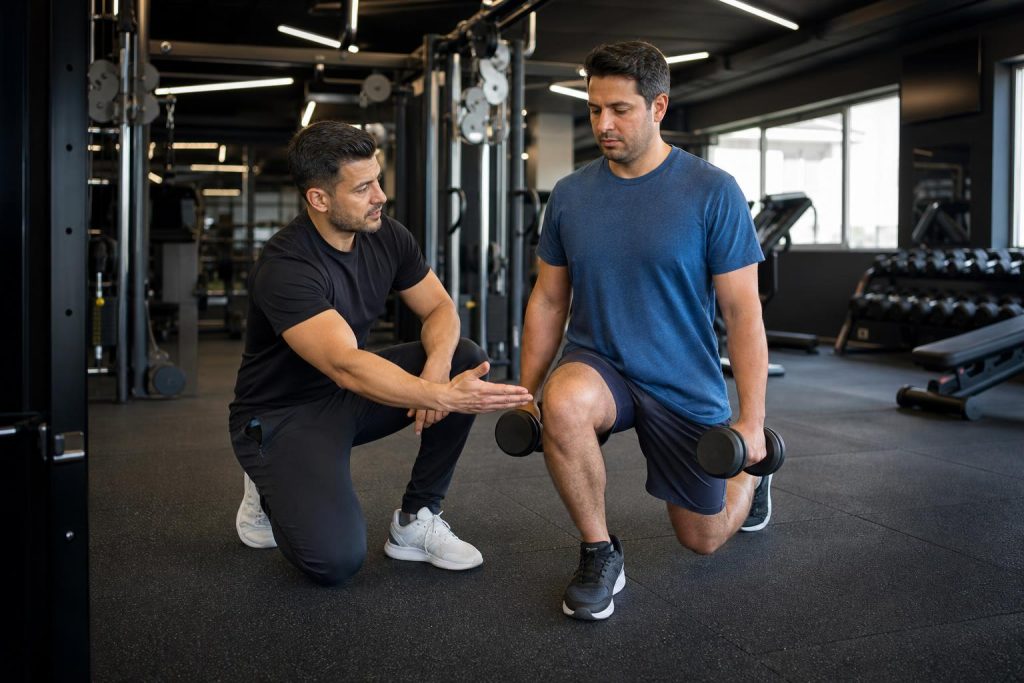
The practical prescription here is straightforward: train each major muscle group two to three times per week, using compound movements as your foundation. Squats, deadlifts, Romanian deadlifts, bench press, rows, overhead pressing, and pull-ups or lat pulldowns should make up the bulk of your sessions. These multi-joint exercises recruit the most muscle tissue, drive the greatest hormonal response, and burn the most calories — all while sending a strong anabolic signal that tells your body to hold onto its muscle even as you’re in an energy deficit.
Sets in the range of three to five per exercise, with reps between six and twelve, hit the sweet spot for hypertrophy and strength simultaneously. Progressive overload — gradually increasing weight, reps, or volume over time — is the engine that makes this work long-term. You don’t need to train like a powerlifter, but you do need to train with intention and consistency. Two to four sessions per week is realistic for most men and sufficient to drive meaningful results.
One critical consideration for men on semaglutide specifically: appetite suppression can make it tempting to under-eat protein. Research consistently supports a protein intake of 1.6 to 2.2 grams per kilogram of bodyweight per day for men engaging in resistance training — a target that becomes harder to hit when your hunger signals are blunted. Prioritizing protein at every meal isn’t just a fitness tip at this point; it’s a metabolic imperative.
Cardio Has a Role — But Choose It Wisely
Cardiovascular training earns its place in any serious health and fat loss program, but the type and volume matter more than most men realize. High-intensity interval training (HIIT) has been shown to produce superior improvements in cardiorespiratory fitness and metabolic markers compared to moderate-intensity steady-state cardio, often in a fraction of the time. For a man trying to preserve muscle while accelerating fat loss, this efficiency is critical — excessive steady-state cardio in an already significant caloric deficit can push the body into a catabolic state, breaking down muscle for fuel.
A practical approach is to anchor your week around three to four resistance training sessions and layer in two to three cardio sessions that emphasize either HIIT or lower-impact, moderate-intensity work like incline walking, cycling, or rowing. HIIT sessions of 20 to 25 minutes — think 30 to 40 seconds of hard effort followed by 90 seconds of recovery, repeated eight to ten times — deliver a potent metabolic stimulus without the recovery cost of long-duration cardio. Incline treadmill walking, on the other hand, is low-impact, easy to recover from, and remarkably effective at burning calories while sparing muscle tissue.
Avoid the trap of doing hours of cardio each week because the scale isn’t moving fast enough. On semaglutide or any calorie-restricted protocol, the deficit is already substantial. Piling on excessive cardiovascular volume without adequate protein and resistance training is a reliable path to losing weight in the worst possible way — lighter, but softer and metabolically weaker.
Walking deserves a specific mention here. Non-exercise activity thermogenesis (NEAT) — the calories burned through everyday movement — can account for a significant portion of total daily energy expenditure, often more than formal exercise sessions. Targeting 8,000 to 10,000 steps per day isn’t a casual wellness suggestion; it’s a legitimate metabolic strategy that complements your structured training without adding recovery burden.
The Takeaway
Semaglutide can be a powerful tool for initiating fat loss, but it’s a tool — not a complete strategy. The men who come out of a GLP-1 cycle leaner, stronger, and metabolically healthier are the ones who treated exercise as the primary driver of their body composition, not an afterthought. Build your week around resistance training, use cardio strategically, hit your protein targets even when your appetite is suppressed, and stay active throughout the day. The medication may change the appetite equation, but it’s the iron and the effort that determine what kind of body you actually end up in.