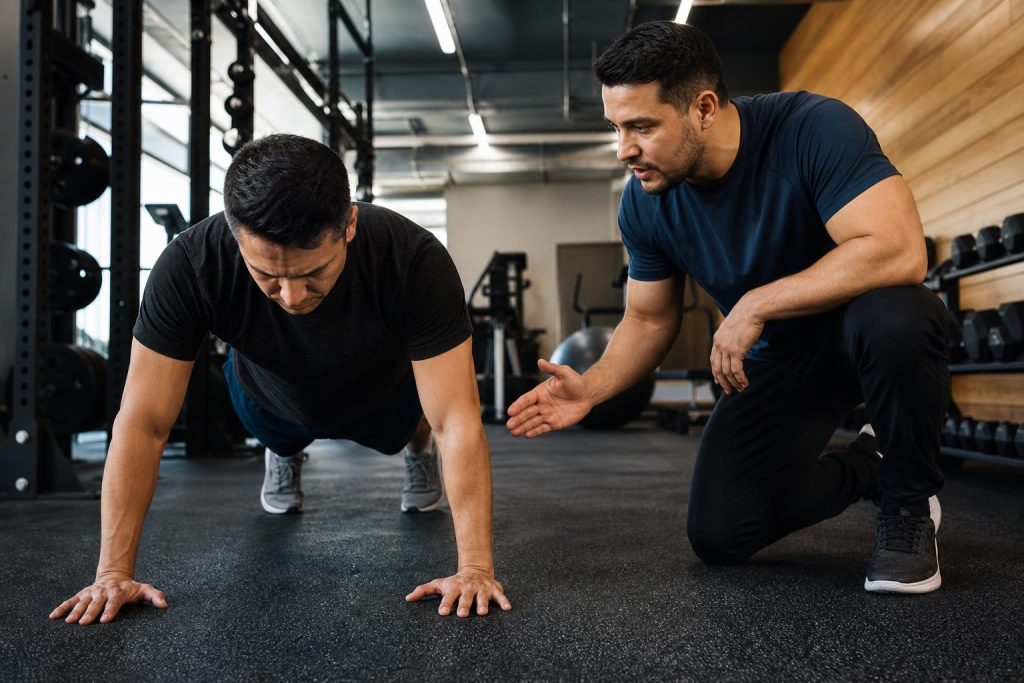
There’s a reason elite military units, Olympic gymnasts, and strength coaches who’ve seen everything still program push-ups. A 2022 study published in PLOS ONE found that push-up capacity is a significant independent predictor of cardiovascular disease risk in middle-aged men — more predictive, in fact, than submaximal treadmill testing. Men who could complete 40 or more push-ups had a 96% lower risk of cardiovascular events compared to those who could do fewer than 10. That’s not a trivial finding. It means your ability to push yourself off the floor is a genuine biomarker of metabolic and physical health, not just a party trick from gym class.
The problem is that most men either dismiss the push-up as too basic or attempt it so poorly that they never extract its real muscle-building potential. They crank out sloppy reps with a sagging core and flared elbows, get nowhere near their chest to the floor, and wonder why their chest and triceps aren’t responding. Or they hit a plateau at 20 reps and assume the movement has nothing left to offer. Both groups are leaving significant gains on the table.
This guide is about fixing that. Whether you’re training at home with no equipment, working back into the gym after a period of inactivity, using a GLP-1 medication and trying to preserve muscle during aggressive fat loss, or simply looking to build your pressing strength from the foundation up — progressive push-up training done correctly can add real muscle to your chest, shoulders, and triceps, and it scales from beginner to elite with the right roadmap.
Why Push-Ups Are a Legitimate Muscle-Building Tool (Not Just a Warm-Up)
The skepticism around push-ups as a hypertrophy tool usually comes from one assumption: that bodyweight training can’t provide enough resistance to stimulate muscle growth. That assumption is increasingly unsupported by the literature. Research published in the Journal of Exercise Science and Fitness demonstrated that an eight-week push-up training program produced comparable gains in muscle thickness and strength to bench press training when volume was equated. The key phrase there is “when volume was equated” — meaning push-ups only underperform when you’re not doing enough of them or progressing intelligently.
Mechanistically, muscle hypertrophy responds to three primary stimuli: mechanical tension, metabolic stress, and muscle damage. Push-up variations can generate all three. A standard push-up places the pectoralis major under significant stretch at the bottom of the movement, which is associated with mechanical tension-driven hypertrophy. Pike push-ups shift demand heavily onto the anterior deltoid. Close-grip push-ups overload the triceps brachii. Archer push-ups create unilateral loading that approaches what you’d get from a dumbbell press. And weighted vest push-ups or ring push-ups elevate resistance to levels that challenge even experienced lifters.
The key principle that unlocks push-up-based muscle development is progressive overload — the same principle that governs all resistance training. A meta-analysis in the Journal of Strength and Conditioning Research confirmed that progressive overload — systematically increasing volume, intensity, or difficulty over time — is the primary driver of muscle hypertrophy regardless of training modality. This means a structured push-up progression isn’t just a beginner strategy. It’s the exact same stimulus mechanism used in barbell training, applied through bodyweight leverage and variation.
One additional advantage worth naming: push-ups train closed-chain movement patterns, meaning your hands are fixed and your body moves through space. This is neurologically more complex than open-chain pressing (like a bench press) and requires greater co-contraction from stabilizing muscles throughout the shoulder girdle, serratus anterior, and core. EMG research has shown that the serratus anterior — a muscle critical for shoulder health and scapular control — is significantly more active during push-ups than during bench pressing. For men dealing with shoulder impingement history or trying to bulletproof their rotator cuff, this matters enormously.
The Progression Map: From Wall to One-Arm
Effective push-up progression moves through a logical sequence based on body angle, leverage, and load distribution. Think of it as a continuum: the more upright your body angle, the less of your bodyweight you’re pressing. As you move toward horizontal — and eventually past it — the demand increases dramatically. The goal is never to rush through levels. You stay at each stage until you can perform it with perfect mechanics, full range of motion, and genuine control through every inch of the movement.
The starting point for men who struggle with a standard push-up is the incline push-up — hands elevated on a surface like a bench, box, or countertop. This reduces effective load while preserving the correct movement pattern. The mechanics here are non-negotiable: hands slightly wider than shoulder-width, elbows tracking at roughly a 45-degree angle from the torso (not flared to 90 degrees), core braced as if expecting a punch, and hips, spine, and head forming a single rigid line. You lower your chest — not your face, not your pelvis — all the way to the surface, pause briefly, and press back up with full elbow extension. Aim for three to four sets of 15 to 20 clean reps before progressing.
The floor push-up is the true foundation, and most men should spend more time here than they think necessary. The same mechanics apply. If your hips are sagging, your elbows are winging out past 70 degrees, or you’re only going halfway down, you are not doing a push-up — you are doing a movement that mimics a push-up while bypassing its actual demands. Fix this before moving on. A useful cue: imagine you’re trying to pull the floor apart with your hands as you press up. This external rotation cue activates the lats and locks the shoulder into a more stable, powerful position, and it immediately makes a mediocre push-up feel like a completely different exercise.
Once you can perform 20 to 25 strict floor push-ups, the most productive next step for hypertrophy is not simply doing more reps — it’s manipulating load and movement complexity. Feet-elevated push-ups shift more weight onto the upper chest and anterior deltoids, mimicking an incline press. Place your feet on a box at knee height initially, then progress to hip height and eventually a full pike-decline position. Simultaneously, you can begin introducing tempo manipulation: a three-second lowering phase increases time under tension significantly and has been shown to augment hypertrophic response even without adding external load.
Diamond push-ups and close-grip variations isolate the triceps to a degree that rivals cable pushdowns. Wide-grip push-ups maximize pectoral stretch. The archer push-up — where you extend one arm out to the side while the opposite arm does the majority of the pressing — is the critical bridge between bilateral and unilateral training. It loads each side independently while still allowing both hands to be on the floor for balance, making it a far more accessible precursor to the one-arm push-up than most guides suggest.
The pseudo planche push-up deserves special mention for men pursuing upper chest development and anterior deltoid strength. By leaning your body forward so your hands are at hip level rather than chest level, you dramatically shift the torque demands onto the shoulder and change the angle of force production through the pectoral. Research on shoulder joint mechanics during pressing supports the idea that varying hand position and body angle during push-up training activates different regions of the pectoral musculature — meaning deliberate variation isn’t just about novelty, it’s about ensuring complete muscular development.
The weighted push-up is where bodyweight training fully meets resistance training. A 20-pound weight plate on your upper back transforms a standard push-up into a loaded pressing movement with a defined, incrementally increasable resistance. Progress it exactly as you would a barbell lift: add load gradually, track your sets and reps, and prioritize quality over quantity. A weighted push-up with a 45-pound plate on your back is not a beginner exercise. Men who’ve built up to that level are doing something physiologically very similar to a loaded barbell press — the primary difference is the closed-chain demand on their stabilizers.
Programming Push-Ups for Maximum Muscle Retention and Growth
The question of how to program push-up training depends heavily on your goals and current training context. If push-ups are your primary pressing movement — which is entirely valid, particularly for men training at home — you need to treat them with the same programming discipline you’d apply to bench pressing. That means tracking volume, managing fatigue, ensuring adequate protein intake, and allowing sufficient recovery between sessions.
For muscle building, the most effective approach is to train push-up variations three to four times per week, distributing volume across sessions rather than performing one massive daily effort. A sample weekly structure might look like this: Monday focuses on flat and decline variations for chest volume; Wednesday shifts to pike push-ups and close-grip work targeting the shoulders and triceps; Friday returns to horizontal pressing with weighted or archer variations to drive progressive overload. This allows cumulative volume to accumulate — which the research strongly supports as the primary driver of hypertrophy — without excessive local fatigue.
Protein intake is the non-negotiable nutritional complement to any muscle-building program. A systematic review in the British Journal of Sports Medicine established that protein intakes beyond 1.62 grams per kilogram of body weight per day do not confer additional muscle-building benefits — but intakes below that threshold meaningfully limit muscular adaptation to training. For a 200-pound man, that’s roughly 147 grams of protein per day as a working ceiling. Many men, particularly those in a caloric deficit, fall significantly short of this number. If you’re losing weight through dietary restriction — whether through GLP-1 therapy, intermittent fasting, or a straightforward calorie deficit — hitting this protein target becomes even more critical to preserving lean mass during fat loss.
This is particularly relevant for men using GLP-1 receptor agonists like semaglutide or tirzepatide, which can significantly reduce appetite and total caloric intake. Clinical data from GLP-1 trials has shown that a portion of weight lost on these medications comes from lean mass, not just fat — making resistance training and adequate protein intake essential countermeasures for anyone on this class of drugs. Push-up progressions provide an accessible, equipment-free way to maintain the mechanical stimulus that signals the body to preserve muscle even in a hypocaloric state. But this principle applies equally to any man in a caloric deficit, with or without medication. The training signal is what tells your body that lean tissue is worth keeping.
Rest periods matter more than most bodyweight trainees realize. Research in the Journal of Strength and Conditioning Research found that longer inter-set rest periods — three minutes versus one minute — produced significantly greater gains in muscle strength and size, likely due to more complete phosphocreatine resynthesis between sets. If you’re racing through push-up sets with 30-second breaks, you’re working your cardiovascular system more than your muscles. Take two to three minutes between sets when the goal is hypertrophy and strength. Save the short rest work for conditioning circuits with a different purpose.
Sleep and recovery are where adaptation actually happens, and this point is chronically underemphasized in most training content. Studies on sleep deprivation and muscle protein synthesis have shown that insufficient sleep blunts anabolic hormone production and impairs recovery from resistance training. Seven to nine hours of quality sleep isn’t a luxury — it’s the primary recovery tool that makes your training productive. No push-up program, no supplement, and no medication works optimally in a chronically sleep-deprived state.
The Takeaway
Push-ups are deceptively simple and brutally effective when taken seriously. The man who masters a strict floor push-up, builds to weighted and archer variations, and programs his training with the same intentionality he’d bring to a barbell program is going to build real muscle, develop functional pressing strength, and improve cardiovascular fitness markers simultaneously. The movement scales from complete beginner to advanced athlete — the progression never truly ends, it just gets harder and more interesting.
More broadly, this guide is a case study in a principle that applies to all of health and fitness: foundational movements done with precision and progressive intent outperform complex programs executed sloppily. You don’t need a fully equipped gym, an expensive training protocol, or any particular medication to build a stronger, leaner body. You need consistency, progressive challenge, adequate protein, quality sleep, and the discipline to execute basic movements with genuine effort over time. Push-ups are one of the best places to start — and for many men, they remain one of the best places to stay.