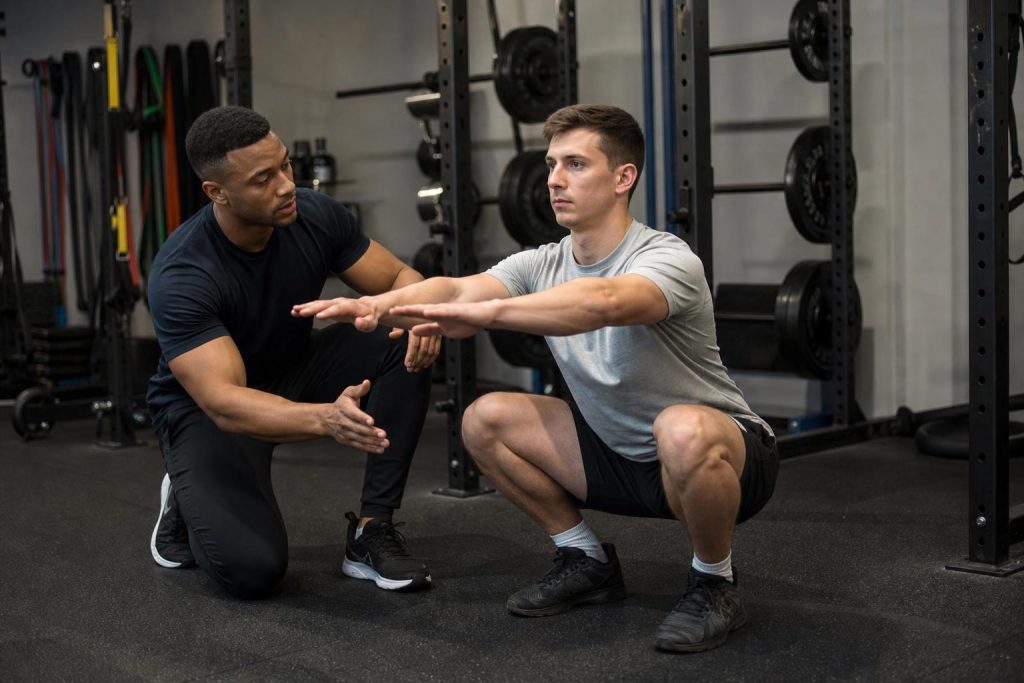
A 2022 study published in the Journal of Strength and Conditioning Research found that progressive bodyweight training produced comparable hypertrophy outcomes to moderate-load resistance training in untrained men — a finding that challenges the long-held assumption that you need a barbell to build or preserve muscle. For men navigating fat loss, caloric restriction, or simply working around gym access, that distinction matters enormously. Bodyweight squats, when applied with intelligent progression, are not a fallback plan. They are a legitimate training tool.
The critical variable is progression. A standard bodyweight squat performed at the same depth, tempo, and volume week after week offers diminishing returns. The neuromuscular system adapts quickly, and without a new stimulus, muscle retention during a caloric deficit becomes increasingly difficult. Research has consistently demonstrated that mechanical tension — the primary driver of muscle protein synthesis — must be progressively increased over time to maintain or grow lean tissue. The good news is that mechanical tension can be manipulated through load, range of motion, tempo, and leverage — not just external weight.
Why Muscle Retention During Fat Loss Demands a Smart Squat Strategy
When men enter a caloric deficit — whether through diet alone, structured nutrition protocols, or GLP-1 medications like semaglutide — the body faces a physiological dilemma. Energy availability drops, and without a sufficient training stimulus, the body becomes increasingly willing to catabolize muscle tissue for fuel. A landmark review in Obesity Reviews confirmed that resistance training during caloric restriction is one of the most effective interventions for attenuating lean mass loss — more effective than cardio alone or diet modification without exercise.
The lower body represents roughly 60 percent of your total muscle mass. Glutes, quadriceps, hamstrings, and calves — the muscles targeted by squat variations — are metabolically active tissue that contributes to resting energy expenditure, insulin sensitivity, and physical function. Studies have shown that men who preserve lower body muscle mass during weight loss phases maintain higher metabolic rates and experience better body composition outcomes long-term. Neglecting this muscle group during fat loss is a costly mistake regardless of how you are approaching your diet.
This is precisely where bodyweight squat progression enters as a strategic tool. By systematically advancing through movement variations that increase difficulty without adding external load, you can maintain the mechanical tension your muscles need to survive — and in some cases thrive — during a deficit. The key is understanding the progression ladder and applying it with the same discipline you would bring to a barbell program.
The Progression Framework: Building Difficulty Without a Barbell
Effective bodyweight squat progression follows a logical path rooted in biomechanics. The foundational squat — feet shoulder-width, full depth, bodyweight only — serves as the baseline. From there, difficulty can be escalated through several levers. Narrowing stance increases the demand on the quadriceps. Elevating the heels shifts center of mass and deepens the stimulus. Slowing the eccentric phase to three to five seconds dramatically increases time under tension, which research has linked to greater muscle damage and subsequent hypertrophic signaling.
Pause squats represent another underused tool. Holding the bottom position for two to three seconds eliminates the stretch-shortening reflex — the elastic energy stored in the tendon that helps you bounce out of the hole — forcing the quadriceps to generate force from a fully loaded, isometric position. This dramatically increases muscular demand without adding a single pound of load. Once pause squats become manageable at high volume, the progression moves toward single-leg variations.
The Bulgarian split squat performed with bodyweight is where many men are surprised by the challenge. With the rear foot elevated on a bench and the front leg bearing the majority of load, this movement demands quad strength, hip flexor flexibility, and significant core stability. Electromyography research has demonstrated that unilateral lower body exercises produce similar or greater quadriceps activation compared to bilateral barbell squats, particularly in the loaded limb. This makes the bodyweight split squat a genuinely difficult, productive exercise for most men — not a beginner modification.
The apex of bodyweight squat progression is the pistol squat — a single-leg squat to full depth with the non-working leg extended forward. This movement demands exceptional strength, mobility, and balance simultaneously. For men working toward this skill, assisted variations using a TRX strap, door frame, or counterweight provide effective intermediate steps. A practical programming approach for muscle retention during a cut involves three to four lower body sessions per week, cycling between bilateral pause squats, split squat variations, and single-leg work. Sets should be taken close to failure — within two to three reps — to maximize motor unit recruitment. Research published in Sports Medicine confirms that proximity to failure, not absolute load, is the primary determinant of hypertrophic stimulus when using lighter or bodyweight resistance.
Protein intake remains non-negotiable in this context. Even with optimal training, muscle retention during fat loss requires sufficient dietary protein to support muscle protein synthesis. Most evidence supports a target of 0.7 to 1.0 grams per pound of bodyweight daily during a deficit, distributed across three to five meals. Without this nutritional foundation, even the best training program will yield suboptimal results.
The Takeaway
Bodyweight squat progressions are not a consolation prize for men without gym access. Applied with structure and discipline, they deliver enough mechanical tension to preserve — and in some cases build — meaningful lower body muscle mass during fat loss phases. The progression from standard squats through pause variations, split squats, and eventually pistol squats represents a legitimate strength continuum. Match it with adequate protein, train close to failure, and advance systematically. Your legs — and your metabolism — will thank you.