Here’s a stat that should get your attention: research published in the New England Journal of Medicine found that participants using semaglutide lost an average of 15% of their body weight — but a significant portion of that loss came from lean mass, not just fat. That’s not a GLP-1 problem exclusively. It’s a caloric deficit problem, and it affects every man who’s ever aggressively cut calories without a structured resistance training plan. The muscle you ignore during a cut is the muscle you’ll spend months trying to rebuild afterward.
Whether you’re on a GLP-1 medication like semaglutide or tirzepatide, running a traditional calorie deficit, or simply trying to stay lean and functional without a gym membership, the challenge is identical: how do you preserve — or even build — muscle when your body is in an energy-restricted state? The answer isn’t complicated, but it does require intentionality. And the good news is, you don’t need a barbell, a rack, or a monthly gym fee to make it happen.
Why Muscle Retention Demands Active Effort During Any Cut
Your body is remarkably efficient at cannibalizing muscle when calories drop. Research from the American Journal of Clinical Nutrition confirms that without adequate resistance training and protein intake, caloric restriction alone leads to meaningful losses in skeletal muscle mass — losses that directly compromise your resting metabolic rate, insulin sensitivity, and long-term body composition. This is why the men who lose weight without lifting tend to end up “skinny fat” — lighter on the scale, but softer and metabolically worse off than when they started.
The physiological mechanism here is muscle protein synthesis. Your body needs a mechanical stimulus — the actual tension and stress placed on muscle tissue — to signal that muscle is worth keeping. Without that signal, dietary protein alone isn’t enough to preserve lean mass at a significant scale. A landmark study in the Journal of Physiology demonstrated that resistance exercise triggers muscle protein synthesis for up to 48 hours post-workout, making even two to three sessions per week a meaningful intervention against muscle loss. You don’t need volume. You need consistency and progressive challenge.
Bodyweight training, when programmed correctly, delivers that stimulus. The key is understanding that progression — not equipment — is what drives adaptation. Once push-ups become easy, you shift to archer push-ups or decline variations. Once bodyweight squats are a warmup, you move to single-leg pistol progressions or tempo squats. The mechanical load changes even when the external weight doesn’t.
A Practical Home Training Framework That Actually Works
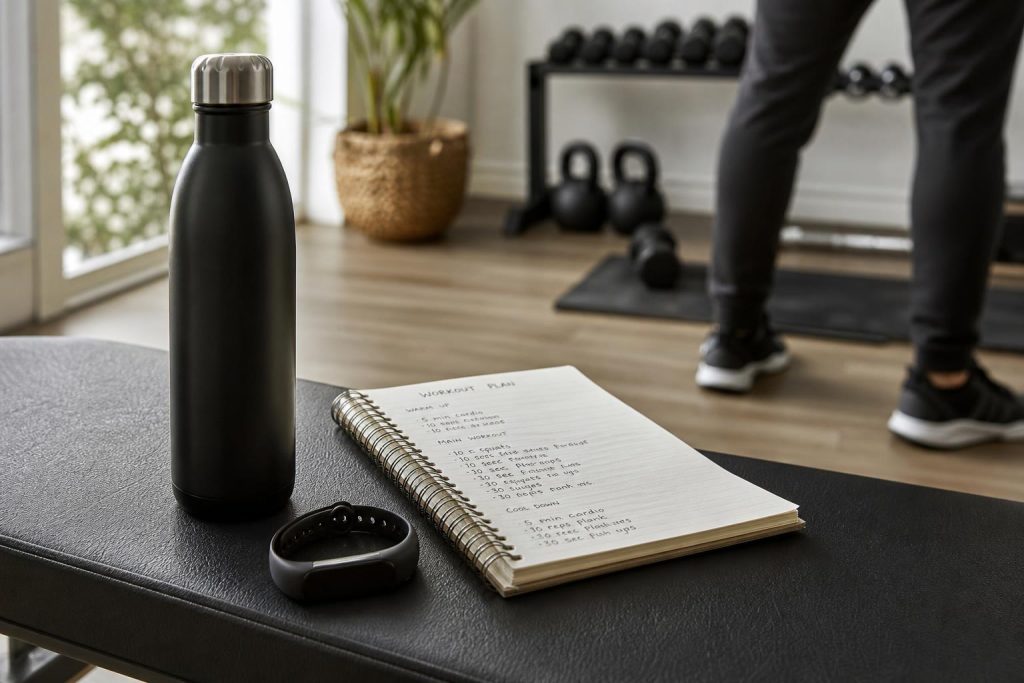
An effective no-equipment program for muscle retention centers on three movement patterns: pushing, pulling, and lower body loading. Train three to four days per week, with at least one full rest day between sessions. Each session should take 30 to 45 minutes and prioritize compound movements that recruit the most muscle mass per rep.
For pushing, work through push-up progressions — standard, close-grip, decline, and eventually one-arm negatives. For pulling, a door-frame pull-up bar (under $30 and worth every cent) opens up rows, chin-ups, and inverted rows — movements that are essentially impossible to replicate otherwise and are critical for upper back and bicep development. For lower body, Bulgarian split squats, glute bridges, single-leg Romanian deadlifts, and step-ups onto a chair or box are among the most effective tools available, with or without weight. Studies confirm that single-leg training not only builds strength comparable to bilateral loading but also corrects asymmetries that accumulate from sedentary lifestyles.
Protein intake is the other non-negotiable variable. Target at least 0.7 to 1.0 grams of protein per pound of bodyweight daily. Research published in the Journal of the International Society of Sports Nutrition consistently shows that higher protein intakes during caloric restriction preserve lean mass more effectively than lower intakes — regardless of training status. If your appetite is suppressed by medication or aggressive dieting, prioritizing protein at every meal before anything else is a practical strategy that works.
Sleep and recovery round out the framework. A study from the Annals of Internal Medicine found that sleep-restricted dieters lost significantly less fat and more lean mass compared to well-rested counterparts on identical calorie deficits. Seven to nine hours isn’t a luxury — it’s part of the training program.
The Takeaway
Muscle retention during a cut — whether that cut is driven by GLP-1 medication, a disciplined diet, or sheer willpower — comes down to three things: a consistent mechanical stimulus from resistance training, sufficient protein intake to support muscle protein synthesis, and enough recovery to let adaptation happen. No gym required. The framework above gives you everything you need to stay strong, functional, and metabolically healthy while the scale moves in the right direction. Start where you are, progress what you can, and protect the muscle you’ve earned.