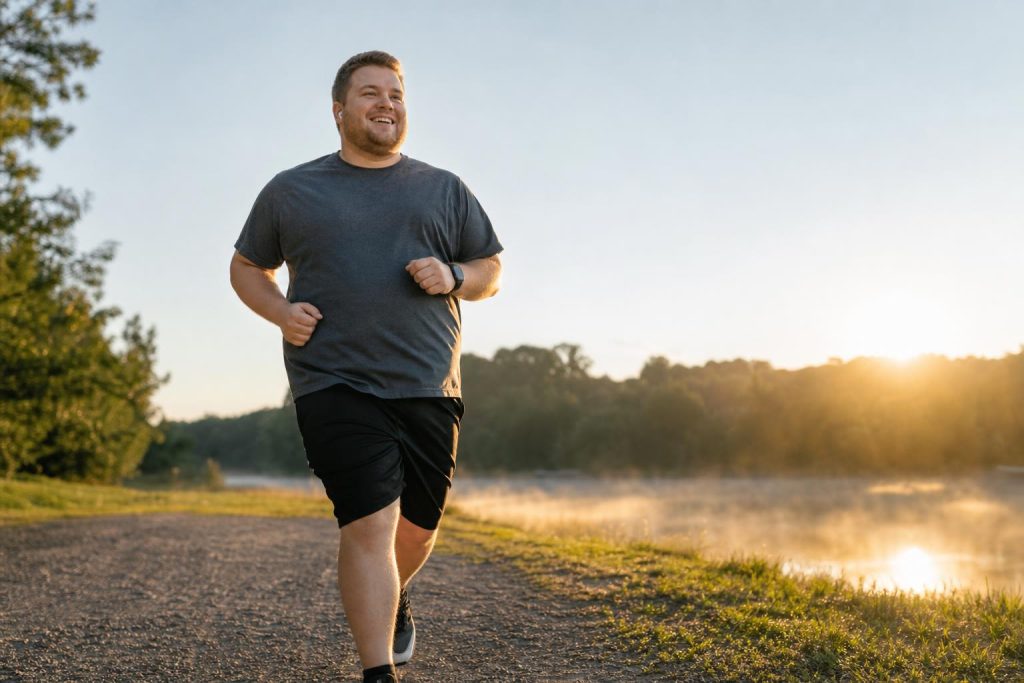
The before-and-after photos circulating online tell one story. The clinical data tells a more complicated one. Men using GLP-1 receptor agonists like semaglutide and liraglutide — or the dual agonist tirzepatide — are achieving weight loss figures that were previously only seen with bariatric surgery. We’re talking 15 to 24 percent reductions in body weight across randomized controlled trials. But when researchers look beyond the scale and into what’s actually changing inside the body, the picture becomes significantly more nuanced — and more actionable.
This isn’t an article about whether GLP-1 medications work. They demonstrably do. This is about understanding what your body composition actually looks like before and after a course of GLP-1 therapy, why the lean mass question matters more than most people realize, and what the science says you can do to ensure that what you lose is mostly fat — not the muscle you’ve spent years building.
The Scale Moves, But So Does Your Muscle
Here’s the number that changes everything: approximately 25 to 39 percent of weight lost on GLP-1 receptor agonists can come from lean mass — not fat. A 2024 narrative review published in Diabetes Care by Locatelli, Costa, Haynes and colleagues quantified this as roughly 6 kilograms of lean mass lost — equivalent, the authors noted, to more than a decade of normal age-related muscle loss. For a man in his 40s who’s worked hard to maintain or build his physique, that’s a staggering amount of collateral damage hidden behind an otherwise impressive weight loss transformation.
The mechanism driving weight loss on these medications is well-established. A landmark 2017 randomized controlled trial published in Diabetes, Obesity & Metabolism by Blundell, Finlayson, Axelsen and colleagues showed that 12 weeks of once-weekly semaglutide at 1.0 mg produced a 24 percent reduction in total daily energy intake across all ad libitum meals. Subjects experienced meaningful reductions in hunger, fewer food cravings, better control over eating behavior, and a measurably lower preference for high-fat, energy-dense foods. Critically, resting metabolic rate — adjusted for lean body mass — did not differ significantly between semaglutide and placebo, suggesting the weight loss was driven primarily by eating less, not by a direct metabolic boost.
That’s an important distinction. When you’re in a substantial caloric deficit — which is essentially what GLP-1 therapy engineers pharmacologically — your body doesn’t distinguish neatly between fat and muscle when it’s breaking down tissue for energy. Without adequate protein intake and a sufficient mechanical stimulus from resistance training, lean mass losses are virtually guaranteed. The medications do the hard work of appetite suppression brilliantly. They do not, however, preferentially protect your muscle.
So what does a realistic body composition transformation actually look like? A man starting GLP-1 therapy at 240 pounds with 30 percent body fat might lose 40 to 50 pounds over a year of treatment. On paper, that’s exceptional. But if 12 to 15 of those pounds are lean mass rather than fat, he may end up lighter but metabolically worse off — with a lower muscle mass, a depressed resting metabolic rate, and a body that’s more vulnerable to fat regain the moment treatment stops. The scale shows a success. The DEXA scan tells a more complex story.
Adaptive vs. Maladaptive: What the Research Actually Shows About Muscle Quality
Not every researcher views GLP-1-associated muscle loss as a crisis, and that nuance is worth understanding. A 2024 primer published in Circulation by Linge, Birkenfeld, Neeland and colleagues used magnetic resonance imaging data to argue that skeletal muscle changes associated with GLP-1 receptor agonist treatment appear largely adaptive rather than maladaptive. In other words, when you account for age, disease status, and the degree of weight loss achieved, the muscle volume changes observed in GLP-1 users are roughly proportional to what you’d expect from any significant weight reduction — not dramatically worse.
The Circulation paper makes another compelling point: GLP-1 therapy substantially improves insulin sensitivity and reduces intramuscular fat infiltration. Muscle fat infiltration — where lipids accumulate within the muscle fibers themselves — is a major driver of metabolic dysfunction and reduced muscle quality. A leaner, less lipid-infiltrated muscle may actually function better and generate force more efficiently than a heavier, fat-infiltrated muscle, even if the absolute muscle volume is slightly lower. From this perspective, some of what appears to be a loss of muscle mass may actually represent an improvement in muscle quality.
However, the authors are careful not to offer blanket reassurance. They specifically flag older men and those with pre-existing frailty as populations where the calculus changes significantly. For someone who is already operating close to the sarcopenic threshold — where muscle mass and function are already marginal — a 6-kilogram reduction in lean mass is not adaptive. It’s potentially dangerous. The risk of falls, functional decline, and metabolic fragility rises sharply when muscle loss occurs in already-depleted individuals. This means that body composition assessment before starting GLP-1 therapy isn’t just useful — for some men, it’s essential.
The takeaway from this body of evidence is that muscle changes on GLP-1 medications exist on a spectrum. For a younger, stronger, well-nourished man with substantial muscle reserves, the losses may be modest and manageable. For an older man with limited lean mass, or anyone who loses weight rapidly without preserving the anabolic signals that keep muscle intact, the outcome can be meaningfully worse. The variable that consistently separates these two groups in the research? Resistance training and protein intake.
Resistance Training Is Not Optional — Here’s the Evidence
The Diabetes Care review by Locatelli and colleagues is direct about this: supervised resistance exercise training programs lasting more than 10 weeks can produce approximately 3 kilograms of lean mass gain and strength improvements of around 25 percent in both men and women. Set that against the 6 kilograms of lean mass that GLP-1 therapy tends to strip away, and the arithmetic becomes obvious. Resistance training doesn’t just preserve muscle during pharmacological weight loss — it can functionally offset the most concerning body composition consequence of these medications.
The research on exercise and GLP-1 therapy gets even more compelling when you look at long-term outcomes. A 2024 post-treatment analysis published in EClinicalMedicine by Jensen, Blond, Sandsdal and colleagues followed participants for one full year after they stopped active treatment — a critical window that most weight loss studies completely ignore. The trial compared three groups: those who had completed one year of liraglutide alone, those who had completed one year of supervised exercise alone, and those who had done both combined.
The results were striking. One year after stopping all treatment, participants who had previously received the combination of exercise and liraglutide had maintained a mean reduction of 5.1 kilograms in body weight and a 2.3 percentage point reduction in body fat compared to the liraglutide-alone group. More importantly, those who had previously done exercise — with or without medication — were dramatically more likely to maintain a clinically meaningful 10 percent weight loss one full year after stopping everything. The odds ratio for maintaining that 10 percent loss was 7.2 for the combination group versus placebo, and 4.2 for combination versus liraglutide alone. Exercise alone carried an odds ratio of 3.7 versus placebo.
Weight regain after stopping liraglutide alone was 6.0 kilograms greater than in those who had stopped exercise — a number that represents a near-complete reversal of the pharmacological benefit. The supervised exercise group, by contrast, maintained their body weight and composition even a full year after stopping. This isn’t a minor effect. It suggests that exercise — particularly the type that preserves and builds lean mass — creates a durable physiological change that medication alone simply cannot replicate. Muscle is metabolically active tissue. The more of it you carry, the harder your resting metabolism works, and the more resistant you become to fat regain when the appetite suppression of a GLP-1 medication is removed.
Practically speaking, what does an effective resistance training protocol look like in this context? The evidence points to compound, multi-joint movements performed at moderate to high intensity — squats, deadlifts, rows, presses — performed two to four times per week with progressive overload as the central organizing principle. The sessions don’t need to be marathon efforts. Forty-five to sixty minutes of focused work, with sufficient volume targeting the major muscle groups, is enough to generate the anabolic stimulus that preserves lean mass during a caloric deficit. The key word in the research is supervised — structured, progressive programming consistently outperforms unstructured gym attendance in clinical trials, and this likely reflects the importance of progressive overload being applied systematically rather than haphazardly.
Protein, Appetite, and the Body Composition Equation
No discussion of body composition during weight loss — with or without GLP-1 medications — is complete without addressing protein intake. When semaglutide suppresses appetite by 24 percent across all meals, it suppresses protein intake along with everything else. That’s a problem, because protein is the single most important dietary variable for preserving lean mass during a caloric deficit.
A 2020 review published in the Journal of Obesity & Metabolic Syndrome by Moon and Koh synthesized the clinical evidence on high-protein diets and body composition, finding consistent support across trials: consuming protein above the standard recommended dietary allowance reduces body weight while simultaneously preserving or enhancing fat-free mass compared to standard-protein approaches. The mechanisms are multiple. High protein intake raises anorexigenic hormone levels — including GLP-1 itself, along with cholecystokinin and peptide YY — while suppressing ghrelin, the appetite-stimulating hormone. It elevates diet-induced thermogenesis, which means more calories burned during digestion. And it directly supplies the amino acids that serve as the raw material for muscle protein synthesis.
For men on GLP-1 therapy, who are eating substantially less food overall, the practical implication is that protein must become a deliberate priority within a reduced food volume. If a man was previously eating 3,000 calories per day and drops to 2,000 on semaglutide, hitting 160 to 200 grams of protein daily becomes meaningfully harder — but no less important. Lean meats, eggs, Greek yogurt, cottage cheese, and protein shakes become tools for hitting targets within a compressed caloric envelope. The goal is simple to state and requires genuine attention to execute: make every bite count for protein, and let fat and carbohydrate fill the remaining calories around it.
Men not on GLP-1 medications face the same fundamental challenge during any fat loss phase. A caloric deficit sufficient to drive fat loss — typically 300 to 500 calories below maintenance — creates the same risk of lean mass erosion if protein intake and resistance training are not held constant. The science isn’t medication-specific. The physiological response to caloric restriction is the same whether the deficit is driven by willpower, meal planning, or a weekly injection. Preserve muscle through mechanical loading and protein. Lose fat through the deficit. That’s the body composition equation regardless of the tool being used to create it.
Where GLP-1 medications do genuinely change the picture is in the magnitude and speed of weight loss achievable. Losing 20 percent of body weight in 12 to 18 months is not a realistic outcome for most men through diet and exercise alone. The medications expand what’s possible. But expanding what’s possible in terms of total weight loss also expands the risk of lean mass loss if the supporting behaviors aren’t in place. Higher total weight loss without adequate protein and resistance training produces more dramatic lean mass erosion — which is why the urgency of these recommendations scales proportionally with how aggressively the weight is coming off.
The Takeaway
GLP-1 weight loss before and after transformations can be genuinely impressive — and the cardiovascular, metabolic, and glycemic benefits are real and well-documented. But the most important thing a man can understand before starting this journey is that the number on the scale is not the same thing as his body composition, and that body composition is what ultimately determines long-term metabolic health, physical function, and the sustainability of his results.
The research is clear on what separates the men who finish GLP-1 therapy leaner, stronger, and more metabolically resilient from those who end up lighter but functionally worse off: resistance training performed consistently throughout the weight loss phase, and protein intake that doesn’t get lost in the appetite suppression. Add structured exercise to pharmacological treatment and you dramatically improve both the composition of weight lost during treatment and the durability of results after it ends. Ignore training and protein while the medication does its work, and you risk trading muscle for scale numbers — a trade that becomes increasingly costly with age.
The medications are a tool. An increasingly powerful one. But the physiology of muscle preservation is non-negotiable, and no drug changes that equation. Lift heavy things. Eat enough protein. Let the medication — or your diet, or your discipline — handle the caloric deficit. That’s not a complicated protocol. It’s just the one that actually works.
Scientific References
-
Locatelli, Costa, Haynes et al. (2024).
Incretin-Based Weight Loss Pharmacotherapy: Can Resistance Exercise Optimize Changes in Body Composition?.
Diabetes care.
View on PubMed → -
Linge, Birkenfeld, Neeland et al. (2024).
Muscle Mass and Glucagon-Like Peptide-1 Receptor Agonists: Adaptive or Maladaptive Response to Weight Loss?.
Circulation.
View on PubMed → -
Jensen, Blond, Sandsdal et al. (2024).
Healthy weight loss maintenance with exercise, GLP-1 receptor agonist, or both combined followed by one year without treatment: a post-treatment analysis of a randomised placebo-controlled trial..
EClinicalMedicine.
View on PubMed → -
Blundell, Finlayson, Axelsen et al. (2017).
Effects of once-weekly semaglutide on appetite, energy intake, control of eating, food preference and body weight in subjects with obesity..
Diabetes, obesity & metabolism.
View on PubMed → -
Moon, Koh et al. (2020).
Clinical Evidence and Mechanisms of High-Protein Diet-Induced Weight Loss..
Journal of obesity & metabolic syndrome.
View on PubMed →