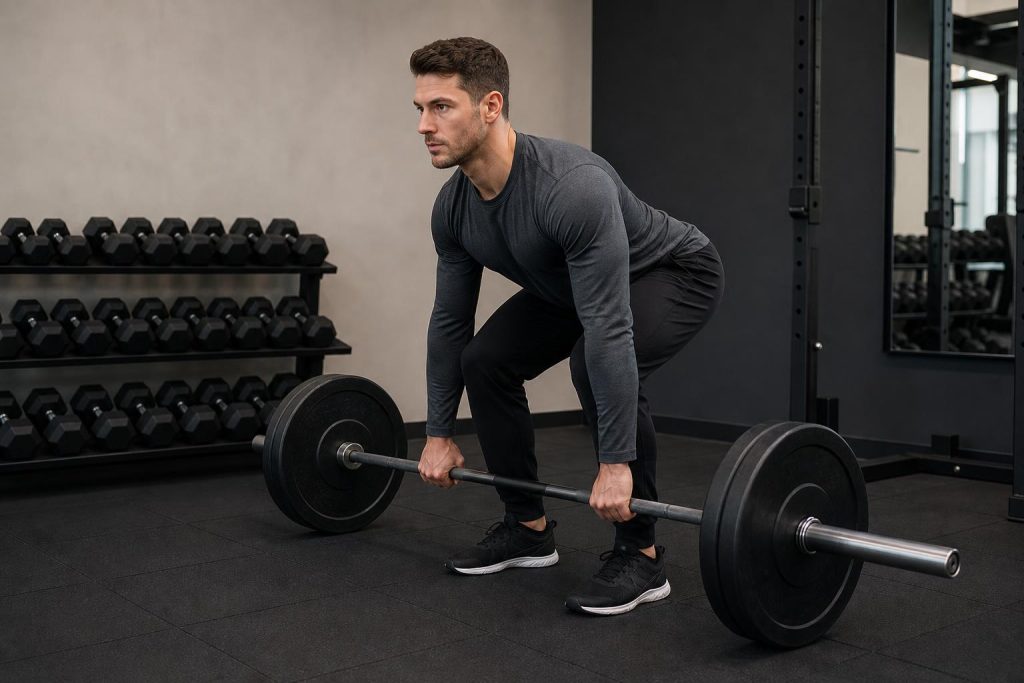
Ask most men what separates a productive training program from an ineffective one, and you’ll get answers about cardio protocols, calorie deficits, or the latest supplement stack. Rarely will anyone mention a fundamental movement pattern — and that oversight is costing them results. The hip hinge, the cornerstone motion behind deadlifts, Romanian deadlifts, kettlebell swings, and good mornings, is arguably the single most valuable movement pattern a man can master for simultaneous fat loss and muscle retention. Research published in the Journal of Strength and Conditioning Research confirms that compound posterior chain movements produce significantly greater hormonal responses — including testosterone and growth hormone — compared to isolation exercises, creating a systemic anabolic environment that small movements simply cannot replicate.
The hip hinge is not a single exercise. It is a movement pattern defined by a specific biomechanical signature: the hips move backward as the primary driver of motion, the spine maintains a neutral position throughout, and the hamstrings and glutes generate the force to return the body to standing. When executed correctly, this pattern loads the posterior chain — the glutes, hamstrings, spinal erectors, and to a significant degree the lats and upper back — in a way that no squat, press, or row can duplicate. It is a pattern humans are built to perform, and yet it is the one most men have completely lost through years of sitting, poor coaching, or avoidance.
Why the Posterior Chain Is the Engine of Your Metabolism
The glutes are the largest muscle group in the human body. The hamstrings are among the most metabolically active. When you train these muscles with heavy, progressive loading through hip hinge movements, you are not just building strength — you are fundamentally altering your body’s metabolic set point. A landmark study in Obesity demonstrated that resistance training preferentially preserves lean mass during a caloric deficit, and the effect is most pronounced when large-muscle compound movements are included in the program. The mechanism is partly hormonal and partly mechanical — heavy loading of major muscle groups sends a powerful signal that muscle tissue is needed, making the body reluctant to catabolize it even when calories are restricted.
This matters enormously for men pursuing fat loss. The body’s default response to a caloric deficit is not purely to burn fat — it is to reduce total energy expenditure through any means available, including breaking down metabolically expensive muscle tissue. This adaptive thermogenesis is well-documented, and research from the American Journal of Clinical Nutrition highlights how resistance exercise blunts this metabolic downregulation, helping men retain the muscle mass that keeps their resting metabolic rate elevated. A man who loses 20 pounds while preserving his posterior chain will burn more calories at rest a year later than a man who lost the same weight without resistance training. The hip hinge is the most direct path to that outcome.
Beyond the metabolic case, the posterior chain is where power lives. Athletes, laborers, and anyone who has ever moved a heavy object understands this intuitively. The ability to generate force from the hips — to extend powerfully and explosively — is the foundation of athletic performance, injury resilience, and functional independence. Studies tracking hip extensor strength have consistently linked it to reduced lower back pain, better sprinting mechanics, and greater overall training longevity. Men who hinge well get hurt less and train more consistently — and training consistency is the most underrated variable in any fat loss or body composition program.
How to Build the Hip Hinge Pattern From the Ground Up
Most men who think they know how to hip hinge are actually squatting with a forward lean. The diagnostic test is simple: stand about six inches from a wall, then push your hips back until they touch it. Your torso should hinge forward, your weight should shift into your heels, and your knees should bend only slightly. If your knees shoot forward and you squat down, or if you feel nothing in your hamstrings, you are defaulting to a quad-dominant pattern. This matters because the exercises are different, the muscles loaded are different, and the metabolic and structural adaptations are different.
The wall hip hinge drill, performed for five to ten reps before any lower body session, teaches the nervous system what a proper hinge feels like. From there, the Romanian deadlift is the best teacher — a barbell or pair of dumbbells held in front of the thighs while the hips drive back, the weights track close to the legs, and the hamstrings load under a controlled stretch before the glutes contract to drive the hips forward. This is the foundation. Three to four sets of eight to twelve reps with moderate weight, focused on feeling the hamstring load at the bottom, will do more for posterior chain development in a month than a year of leg curls and hyperextensions.
Once the pattern is ingrained, the conventional deadlift becomes the primary strength builder. Research on the acute hormonal response to heavy deadlifting shows significant elevations in testosterone and IGF-1 following maximal effort sets — hormonal signals that directly support muscle protein synthesis and fat oxidation. Programming deadlifts once or twice weekly, with loads that challenge you in the three to six rep range after a proper warm-up, delivers a systemic stimulus that no machine-based program can match.
The kettlebell swing deserves its own mention here, not as a replacement for deadlifts but as a power development and conditioning tool that operates through the same hinge pattern. A study published in the Journal of Human Kinetics found that kettlebell swings produced significant improvements in both maximal strength and aerobic capacity simultaneously — a rare dual adaptation that makes them uniquely valuable for men trying to build muscle while losing fat. The explosive hip extension required by the swing trains the posterior chain under velocity, a quality that heavy deadlifts alone do not fully develop. Ten to twenty minutes of swing work two or three times per week, programmed as a finisher or standalone conditioning session, creates a metabolic demand that compounds over time.
For men using GLP-1 medications, the importance of hip hinge training is even more acute. Appetite suppression can create unintentional protein deficits and significant caloric restriction — conditions under which muscle loss accelerates. Maintaining heavy compound hinge work while ensuring adequate protein intake is the primary mechanism for preserving lean mass during rapid weight loss on these medications. But this advice holds universally: whether you are cutting calories through counting macros, intermittent fasting, low-carbohydrate eating, or any other approach, the hip hinge pattern provides the training signal that tells your body to hold onto muscle while it sheds fat.
The Takeaway
Movement patterns outlast any diet trend, medication cycle, or program phase. The hip hinge is a fundamental human movement that loads your largest and most metabolically significant muscles, drives hormonal adaptations that support fat loss and muscle retention, and builds the kind of structural resilience that keeps men training for decades. If your program does not include Romanian deadlifts, conventional deadlifts, or kettlebell swings performed with good technique and progressive overload, it is leaving your most powerful body composition tool unused. Learn the pattern, load it consistently, and let the biology do the rest.