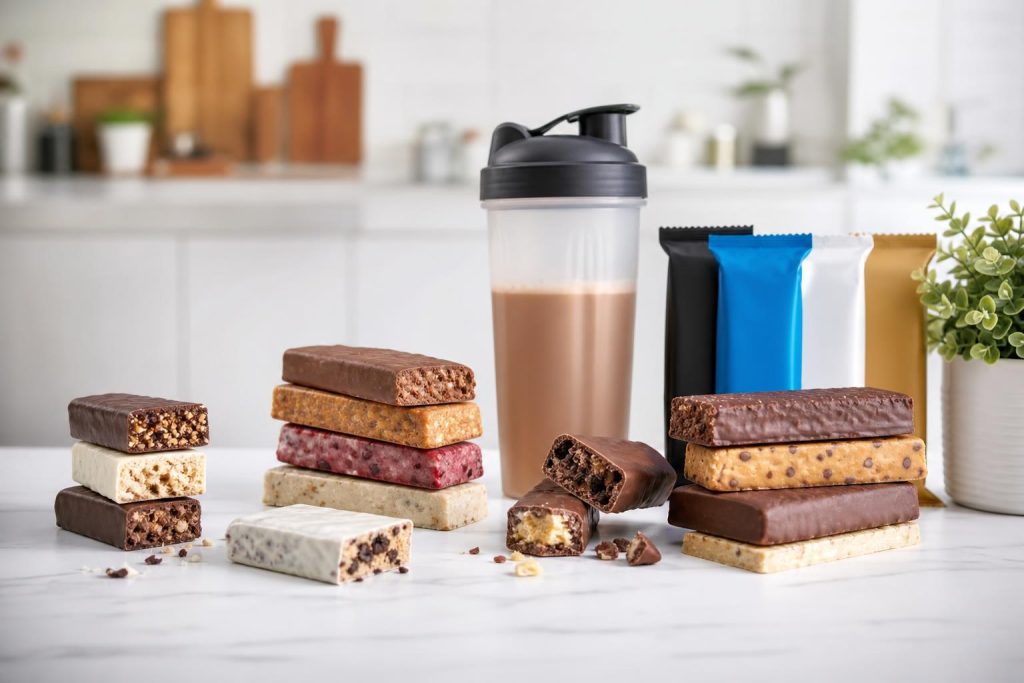
Most men eating in a caloric deficit face the same brutal math: you need more protein than ever, but your appetite — whether suppressed by semaglutide, a disciplined cut, or sheer willpower — gives you less room to work with. A 2023 analysis published in Obesity Reviews confirmed that protein intakes of 1.2 to 1.6 grams per kilogram of body weight are necessary to preserve lean mass during significant caloric restriction. That’s a high bar to hit when your stomach has effectively shrunk — and whole food meals alone often fall short.
Enter the protein bar. Maligned for years as glorified candy, the category has genuinely evolved. Today’s best options pack 20 to 30 grams of high-quality protein into a compact, shelf-stable format that doesn’t require cooking, digesting a full meal, or force-feeding yourself. For men using GLP-1 receptor agonists like semaglutide or tirzepatide — where reduced gastric emptying makes large meals physically uncomfortable — this matters enormously. But it matters just as much for any man in a fat-loss phase, anyone doing intermittent fasting, or anyone who simply needs to hit their protein numbers on a chaotic day.
The problem is that most protein bars are nutritional theater. They lead with a big protein number on the front, then bury 25 grams of sugar alcohols, 15 grams of added sugar, and a fiber count so high it practically guarantees GI distress. For anyone with already-sensitive digestion — GLP-1 users especially, but also anyone dealing with gut issues — that’s not a feature, it’s a flaw. The best bar for this context is one that delivers dense, bioavailable protein in a low-volume, low-sugar, gut-friendly format.
What the Research Says About Protein Quality and Timing
Not all protein is created equal, and the bar market is full of inferior sources dressed up with marketing language. Whey protein isolate and micellar casein remain the gold standards for leucine content and muscle protein synthesis stimulation. Research published in the Journal of the American College of Nutrition demonstrated that whey protein significantly outperforms soy in stimulating muscle protein synthesis post-exercise — a meaningful difference when muscle preservation is the goal. Bars built primarily on whey isolate, egg white protein, or a well-formulated casein blend will outperform those relying on collagen peptides or plant protein blends with incomplete amino acid profiles.
Leucine threshold matters here too. Norton and Layman’s foundational work on leucine as a trigger for mTOR activation suggests that each feeding should ideally contain at least 2.5 to 3 grams of leucine to fully stimulate muscle protein synthesis. A bar with 20 to 25 grams of quality whey protein will typically clear that threshold — one built on lower-quality blends often won’t, even at similar gram counts. When you’re only eating small amounts per sitting, the amino acid profile of what you do eat becomes disproportionately important.
Fiber is another lever worth understanding. Soluble fiber can blunt glucose spikes and improve satiety, which sounds ideal — until you’re already nauseous from gastroparesis-adjacent GLP-1 side effects or simply trying to avoid bloating during a training session. Bars in the 5 to 8 gram fiber range tend to be the sweet spot: enough to support glycemic control without creating the gut turmoil that some ultra-high-fiber bars (18 to 25 grams) can trigger.
The Bars Worth Your Money
Quest Bars remain one of the most scrutinized and validated options in the category. With 20 to 21 grams of protein — primarily from whey and milk protein isolate — and roughly 4 to 5 grams of net carbs, they hit a macro profile that holds up under real nutritional scrutiny. The fiber content sits around 14 grams, which is on the higher end, but for most men without pre-existing GI sensitivity, the formulation is well-tolerated. For GLP-1 users specifically, starting with half a bar is a practical strategy during the early adaptation phase.
RXBAR takes a different approach — minimal ingredients, egg whites as the primary protein source, dates as the binder. A standard RXBAR delivers 12 grams of protein and about 200 calories, which makes it a lower-protein option but one with exceptional ingredient transparency and digestibility. The smaller caloric footprint actually suits men who need a between-meal protein top-up without committing to a full 250 to 300-calorie bar.
Barebells — the Swedish import that’s taken the fitness market by storm — deserves serious consideration for men prioritizing protein density and palatability. At 20 grams of protein and only 200 calories per bar, with 5 grams of sugar and no maltitol (which is responsible for the notorious sugar alcohol GI issues in competing bars), Barebells offers genuinely impressive nutrition in a format that tastes closer to a candy bar than a protein supplement. For GLP-1 users battling food aversion, palatability is not a luxury — it’s a clinical consideration.
Kirkland Protein Bars (Costco’s house brand, manufactured by Quest) offer essentially the same macro profile as Quest at a meaningfully lower cost per bar — an underrated option for men who go through bars consistently as part of a structured nutrition plan. The One Bar and Built Bar both merit consideration as well, with Built Bar in particular standing out for its lower calorie count, mousse-like texture, and 17 to 20 grams of whey-based protein — an option that sits well for men with smaller appetites.
What you want to avoid are bars that lead with collagen protein (lacking tryptophan, making it an incomplete protein), bars where sugar alcohols like maltitol dominate the ingredient list, and anything marketed primarily as an energy bar that happens to contain some protein. The label hierarchy matters: protein source should appear in the first three ingredients. If it doesn’t, the bar is built around something else.
The Takeaway
Whether you’re on a GLP-1 medication, deep into a caloric deficit, or simply trying to hit 180 grams of protein on a day when life doesn’t cooperate, the right protein bar is a legitimate nutritional tool — not a shortcut or a cheat. The research is clear that protein quantity and quality during fat loss phases directly determines how much muscle you keep, and keeping muscle is the entire game if your goal is a better body composition rather than just a lower number on the scale. Prioritize bars built on whey isolate or egg white protein, keep fiber in a manageable range, avoid maltitol, and treat palatability as a real factor — especially if your appetite is already working against you. A bar you actually want to eat is infinitely more effective than a perfect-macro option sitting uneaten in your bag.