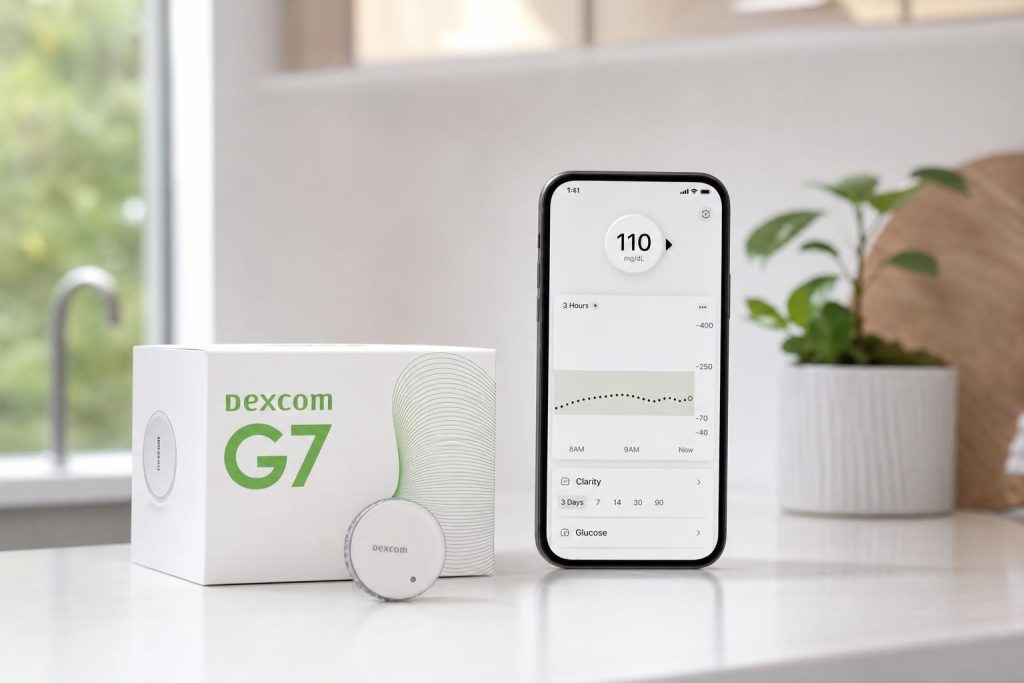
Most men have no idea what their blood sugar is doing between meals — and that blind spot may be costing them more than they think. A landmark study published in PLOS Biology found that even among healthy individuals without diabetes, postprandial glucose spikes varied dramatically from person to person eating identical foods. Two men could eat the same bowl of oatmeal and experience wildly different glycemic responses — one staying flat, the other spiking into prediabetic territory. That kind of data doesn’t show up on an annual fasting glucose test. It shows up on a continuous glucose monitor, and right now, the Dexcom G7 is one of the most capable devices for capturing it.
Whether you’re using a GLP-1 medication like semaglutide or tirzepatide, dialing in a low-carb diet, training hard and trying to optimize recovery, or simply trying to understand your metabolic health at a deeper level — real-time glucose data changes the way you make decisions. This review takes a close look at the Dexcom G7, how it performs in the real world, what the science says about continuous glucose monitoring (CGM) for non-diabetic users, and whether it belongs in your health stack.
What the Dexcom G7 Actually Does — and Why It Matters Beyond Diabetes
The Dexcom G7 is a wearable CGM sensor that measures interstitial glucose — the glucose in the fluid between your cells — every five minutes, continuously, for up to 10 days per sensor. A small filament the width of a human hair sits just under the skin on the back of your upper arm or abdomen, and data streams wirelessly to your smartphone or a dedicated receiver. No finger pricks required during the wear period. The G7 improved significantly on its predecessor, the G6, with a smaller all-in-one design, a 30-minute warmup period (down from two hours), and tighter accuracy metrics. Its mean absolute relative difference (MARD) — the gold-standard accuracy measure — sits at approximately 8.2%, which is competitive with the best devices on the market and more than adequate for lifestyle optimization purposes.
For men with type 1 or type 2 diabetes, CGM is a life-management tool. But the clinical picture for metabolic health optimization in non-diabetic populations is growing rapidly. Research published in Diabetes Care demonstrated that CGM use in individuals without diabetes can identify patterns of glucose dysregulation — prolonged elevations, reactive hypoglycemia, poor overnight glucose control — that conventional testing misses entirely. This is especially relevant for men in their 30s, 40s, and 50s who may appear metabolically normal on paper but are quietly trending toward insulin resistance. The Dexcom G7 makes these invisible patterns visible.
Setup is genuinely straightforward. The sensor applicator clicks into place with a single press, and integration with the Dexcom G7 app delivers a clean, readable glucose graph with trend arrows showing whether your levels are rising, falling, or stable. You can set high and low glucose alerts, log meals and exercise, and share data with a healthcare provider. For men who appreciate data-driven decision-making — the kind who track their macros, monitor HRV, or log their lifts — the G7 slots into that ecosystem naturally.
The GLP-1 Connection: Why Glucose Visibility Amplifies Medication Effectiveness
For men using GLP-1 receptor agonists like semaglutide (Ozempic, Wegovy) or tirzepatide (Mounjaro, Zepbound), continuous glucose monitoring adds a layer of feedback that makes the therapy significantly more intelligent. GLP-1 medications work in part by stimulating glucose-dependent insulin secretion, slowing gastric emptying, and reducing post-meal glucose excursions. The problem is that without a CGM, you’re flying blind on whether those mechanisms are performing optimally for your specific eating patterns and physiology.
A clinical review in Frontiers in Endocrinology highlighted that CGM use alongside GLP-1 therapy improves time-in-range metrics and helps identify periods of unintended hypoglycemia — a real concern for men who are aggressively cutting calories while on these medications and also exercising regularly. The Dexcom G7’s low glucose alerts become a practical safety feature in this context, not just a data curiosity. Beyond safety, the G7 lets you see which meals still spike you despite medication, how your glucose responds to different exercise modalities, and whether your fasting periods are keeping you in a stable range.
One of the more actionable insights GLP-1 users report with CGM is learning how meal timing interacts with their injection schedule. Because semaglutide peaks pharmacokinetically around 24–48 hours post-injection for once-weekly formulations, glucose control is not perfectly uniform across the week. Pharmacokinetic data published in Clinical Pharmacokinetics confirms this variability. Wearing the G7 in the days immediately following an injection versus the days before the next one can reveal meaningful differences in postprandial response — information that lets you and your prescriber make smarter decisions about diet and timing.
It’s worth being direct about something: GLP-1 medications do not eliminate the need for good nutrition and training. The men who get the best outcomes on these therapies are the ones pairing them with high-protein diets, resistance training to preserve muscle mass, and genuine attention to their metabolic inputs. CGM, and specifically the Dexcom G7, supports that integrated approach by making feedback loops faster and more concrete.
CGM for Men Who Aren’t on Medications — What the Data Says
If you’re not on a GLP-1 or any diabetes medication, here’s the case for still considering a CGM cycle: glucose variability is an independent marker of metabolic health, and most men have never measured it. Research in Diabetologia found that higher glucose variability — even within the normal range — is associated with increased oxidative stress and inflammation, both of which accelerate aging, impair recovery, and compromise body composition over time. You don’t need to be diabetic to have suboptimal glucose dynamics.
For men following a ketogenic or low-carbohydrate diet, the G7 provides objective confirmation that dietary ketosis is actually suppressing glucose where it should be. For men in a caloric surplus trying to build muscle, it helps identify whether carbohydrate timing around training is actually improving post-workout glucose uptake or just spiking insulin at the wrong times. For endurance athletes, it maps the glucose valleys that precede bonking and the hyperglycemic overshoots that follow aggressive fueling. In each case, the data replaces guesswork with evidence — and for men who are already putting real effort into their health, that return on information is high.
The practical protocol most metabolic health practitioners recommend for non-diabetic users is wearing a sensor for two to four weeks during a period of intentional behavior change — introducing a new diet, a new training block, or a new sleep schedule — and using that data to calibrate long-term habits. At roughly $89–$109 per sensor (without insurance, Dexcom’s retail pricing), two sensors represent a one-time investment in self-knowledge that many men find more informative than expensive blood panels. Dexcom does offer a cash-pay program, and for those with type 2 diabetes or prediabetes, insurance coverage is often available.
There are real limitations worth acknowledging. The G7 measures interstitial glucose, not blood glucose directly, which introduces a physiological lag of roughly 5–10 minutes during rapid glucose changes. This is generally not clinically significant for lifestyle monitoring, but it means the device is less precise during intense exercise, where rapid glucose fluctuations can temporarily outpace the sensor’s reading. Exercise-related CGM accuracy has been studied, and the consensus is that trend direction remains reliable even when absolute values drift slightly during high-intensity effort. For lifestyle optimization — which is the primary use case for most men reading this — the G7’s accuracy is more than sufficient. Compression artifacts from sleeping on the sensor can also cause false low readings overnight, a minor annoyance that typically resolves within minutes of changing position.
Compared to the Abbott FreeStyle Libre 3 — its closest competitor in the consumer CGM space — the Dexcom G7 has the edge on real-time alerts (Libre 3 requires a phone scan for alarms on some configurations), share functionality, and integration depth with third-party apps like Apple Health and various glucose logging platforms. The Libre 3 is often slightly cheaper out of pocket and may be preferred by men who just want trend data without frequent alerts. For men on GLP-1 therapy or anyone wanting the most comprehensive alert and sharing system, the G7’s ecosystem is the stronger choice.
The Takeaway
The Dexcom G7 is not a gadget for people obsessed with numbers for its own sake. It’s a feedback tool — and the quality of your feedback determines the quality of your decisions. Whether you’re managing your glucose on a GLP-1 medication, fine-tuning carbohydrate intake on a performance diet, or simply trying to understand why you feel sluggish after certain meals and sharp after others, two weeks of continuous glucose data will tell you more about your metabolic health than most annual physicals. The science supporting CGM use in non-diabetic men for lifestyle optimization is still maturing, but the early signal is clear: glucose variability matters, most men don’t know theirs, and the Dexcom G7 is currently one of the best instruments available to change that. For men serious about their health — not just the men who are sick — that kind of visibility is worth the investment.