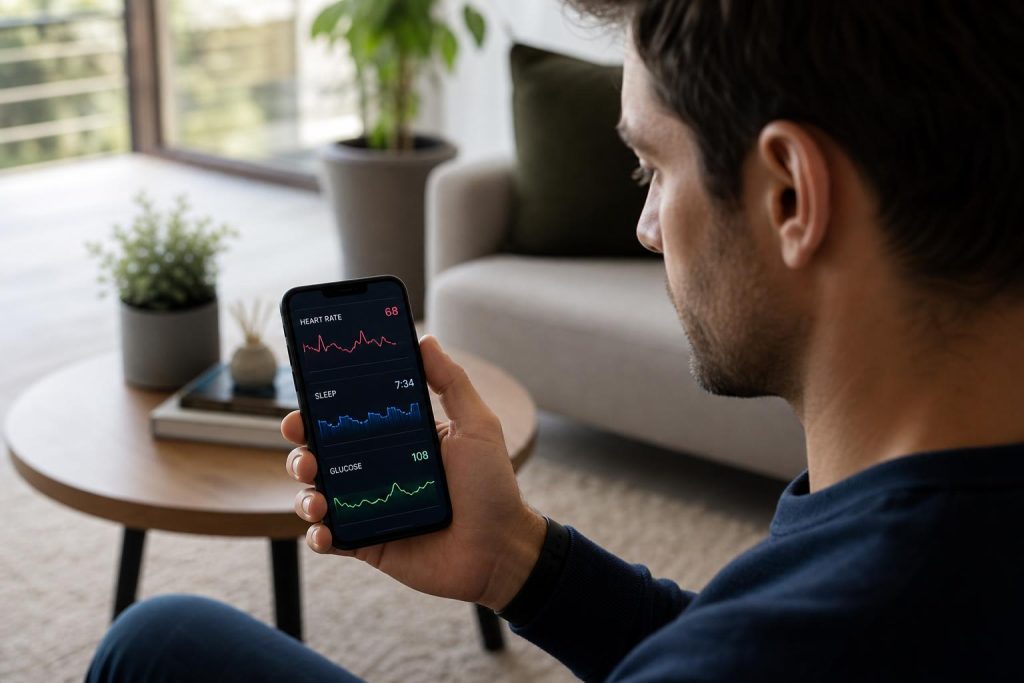
You’ve probably seen athletes and fitness influencers wearing small sensors on their arms—continuous glucose monitors (CGMs). But CGMs aren’t just for diabetics anymore. A growing body of research shows that real-time glucose tracking can be a powerful tool for optimizing metabolic health, improving workout performance, and supporting fat loss—regardless of whether you’re using GLP-1 medications, following a strict diet, or just trying to make smarter nutritional choices.
The science is compelling: recent research demonstrates that CGM use improves time in range (TIR), optimizes metabolic intervention strategies, and helps prevent adverse glucose events during physical activity. For men focused on fat loss, muscle building, or simply understanding how their body responds to food and training, CGM data provides unprecedented insight into your personal metabolic profile.
This guide breaks down how to use CGM technology strategically—whether you’re an endurance athlete, a strength trainee, or someone working to reverse metabolic dysfunction.
How Continuous Glucose Monitors Work and Why They Matter for Metabolic Health
A continuous glucose monitor measures glucose concentration in interstitial fluid (tissue fluid beneath the skin) every 5-15 minutes, providing real-time glucose data without fingerstick testing. Unlike traditional blood glucose testing, which gives you one snapshot at a single moment, CGM reveals patterns—how different foods, meal timing, stress, sleep, and exercise affect your glucose trajectory throughout the day.
For metabolic health optimization, this matters because:
- Glucose variability is a risk factor. Rapid spikes and crashes aren’t just uncomfortable; they drive inflammation, impair insulin sensitivity, and increase oxidative stress.
- Individual responses vary dramatically. Two men eating identical meals may have completely different glucose responses—genetic variation, gut microbiome composition, and insulin sensitivity all play a role. CGM reveals your specific patterns, not population averages.
- Performance and body composition are affected. Research on endurance athletes shows that blood glucose regulation differs significantly between athletes and healthy controls, and glucose monitoring can help optimize both training outcomes and metabolic health.
The goal isn’t to achieve “perfect” glucose numbers—it’s to understand your metabolic response and make data-driven adjustments to nutrition, training, and lifestyle.
CGM Data Interpretation: What the Numbers Actually Mean
If you’re new to CGM, the data can be overwhelming. Here’s what to focus on:
Time in Range (TIR)
This measures the percentage of time your glucose stays between your target range. For metabolically healthy men without diabetes, a reasonable target is 70-100 mg/dL. Studies show that increased time in range is one of the primary benefits of CGM use, associated with better insulin sensitivity and reduced inflammation.
Action step: Aim for 80%+ time in range. If you’re consistently spiking above 140 mg/dL or dropping below 70 mg/dL, your current eating or training pattern needs adjustment.
Glucose Variability (Standard Deviation)
This shows how much your glucose fluctuates. High variability—even if your average glucose is “normal”—is associated with worse metabolic outcomes. Smooth, gradual changes are better than sharp spikes and crashes.
Action step: If your glucose swings 50+ mg/dL in short periods, focus on: pairing carbs with protein/fat, reducing refined carbs, timing carbs around training, and eating slower.
Area Under the Curve (AUC)
This reflects the total glucose load your body processes. Lower AUC = less metabolic stress.
Action step: Use CGM to test how different foods and meal compositions affect your cumulative glucose load. This is how you build personal dietary rules that actually work.
CGM for Training Optimization and Performance
One of CGM’s most underutilized applications is training optimization. Your glucose availability directly impacts work capacity, recovery, and adaptation.
Pre-Workout Fueling
CGM data shows you exactly when your glucose dips too low for optimal performance. For strength training, you want stable glucose around 100-120 mg/dL at workout start. For endurance work, this becomes even more critical.
Protocol: Track your glucose for 2-3 weeks during your normal training. Note when you feel strongest and when you underperform. Correlate these with glucose readings. Most men find they perform best when glucose is between 90-130 mg/dL with minimal variability.
Preventing Hypoglycemia During Exercise
CGM can help prevent adverse glucose events such as hypoglycemia and nocturnal hypoglycemia following exercise—a particular concern if you’re training fasted, doing high-intensity intervals, or in a caloric deficit (especially relevant for men using GLP-1 medications, who may have altered appetite cues and risk under-eating).
Action step: If you’re doing intense training in a deficit, use CGM to ensure glucose doesn’t drop excessively post-exercise. Consuming 20-30g carbs + protein within 60 minutes post-workout prevents excessive glucose dips while supporting recovery.
Endurance Athletes: Individualized Fueling Strategies
If you’re training for endurance events, CGM shows you exactly how much carbohydrate fuel you need during long sessions—no guessing. This data dramatically improves race-day nutrition decisions.
Diet Optimization: Using CGM to Find Your Metabolic Macros
This is where CGM becomes genuinely transformative. Instead of following generic nutrition advice, you can see how you specifically respond to different foods and macronutrient combinations.
The Personal N=1 Experiment
Use your first 2 weeks of CGM to run mini-experiments:
- Week 1: Eat your normal diet. Baseline data.
- Week 2: Add protein to meals (aim for 30-40g per meal). Track glucose response.
- Week 3: Swap refined carbs for whole grains/legumes. Compare glucose variability.
- Week 4: Test intermittent fasting windows. Does skipping breakfast spike glucose later?
This personal data is worth more than any generic diet book. You’ll discover that maybe you tolerate white rice fine but oatmeal spikes you. Or maybe you need food every 4 hours or your cortisol-driven glucose rises. These insights are individual and priceless.
Carb Timing and Composition
Instead of asking “should I eat carbs?” CGM lets you ask “what carbs, when, and with what?”
Practical template:
- Post-training: Higher carb, moderate protein (glucose utilization is high from muscle damage)
- Breakfast: Include protein + fat to blunt early-day spikes
- Lunch/Dinner: Balanced macros; observe which foods keep you most stable
- Evening: Lower refined carbs; track sleep quality correlation
Practical Considerations: Cost, Accuracy, and Real-World Implementation
Cost and Access
CGM devices (FreeStyle Libre, Dexcom, Eversense) cost $30-100 per sensor, lasting 10-14 days. That’s $90-300/month—significant, but worthwhile if you’re serious about metabolic optimization. Some insurance plans cover CGM for prediabetes; check your policy.
Alternatively, use CGM for 1-2 months to gather data, then maintain that understanding through periodic fasting glucose and A1C testing.
Limitations and Accuracy
CGM measures interstitial glucose, which lags blood glucose by 5-15 minutes. During rapidly changing conditions (e.g., immediately after intense exercise), there’s a small discrepancy. This doesn’t invalidate the data—it just means you’re seeing the fuller pattern, not single-point measurements.
Behavioral Considerations
Some men find continuous glucose tracking psychologically burdensome or obsessive. If you’re prone to orthorexia or disordered eating patterns, use CGM strategically (e.g., 4-week testing cycles) rather than continuously. The goal is freedom through understanding, not anxiety through perfectionism.
Bottom Line: How CGM Fits Into Your Metabolic Health Strategy
Continuous glucose monitoring is a data collection and learning tool, not a treatment. It pairs with—not replaces—solid fundamentals:
- Consistent strength training to improve insulin sensitivity and glucose utilization
- Whole-food nutrition with adequate protein and controlled calories
- Sleep and stress management (stress and poor sleep dramatically impair glucose control)
- Consistency over perfection (one perfect day of CGM data is useless; you need patterns)
Whether you’re using GLP-1 medications, counting macros, following keto, or just trying to eat smarter, CGM gives you a personalized instruction manual for your metabolism. Most men see dramatic improvements within 4-6 weeks of using CGM to optimize nutrition and training—faster fat loss, better energy, improved workout performance, and genuine metabolic health gains.
The question isn’t whether CGM is worth the cost—it’s whether understanding your own metabolism is worth a few months’ investment. For most men serious about health optimization, the answer is yes.
Ready to optimize your metabolic health?
Explore our complete guides on fasting glucose management, nutrition for fat loss and muscle building, and training protocols for metabolic adaptation. Or start with our beginner’s guide to metabolic health testing to understand your baseline before considering CGM.
Scientific References
-
Schubert-Olesen, Kröger, Siegmund et al. (2022).
Continuous Glucose Monitoring and Physical Activity..
International journal of environmental research and public health.
View on PubMed → -
Flockhart, Larsen et al. (2024).
Continuous Glucose Monitoring in Endurance Athletes: Interpretation and Relevance of Measurements for Improving Performance and Health..
Sports medicine (Auckland, N.Z.).
View on PubMed → -
Nwokolo, Hovorka et al. (2023).
The Artificial Pancreas and Type 1 Diabetes..
The Journal of clinical endocrinology and metabolism.
View on PubMed → -
Albairmani, Basheer, Macky et al. (2025).
Management of Diabetes in Pregnancy: A Review of Clinical Guidelines and Practices..
Cureus.
View on PubMed → -
Luo, Wang, Sun et al. (2022).
Isocaloric-restricted Mediterranean Diet and Chinese Diets High or Low in Plants in Adults With Prediabetes..
The Journal of clinical endocrinology and metabolism.
View on PubMed →