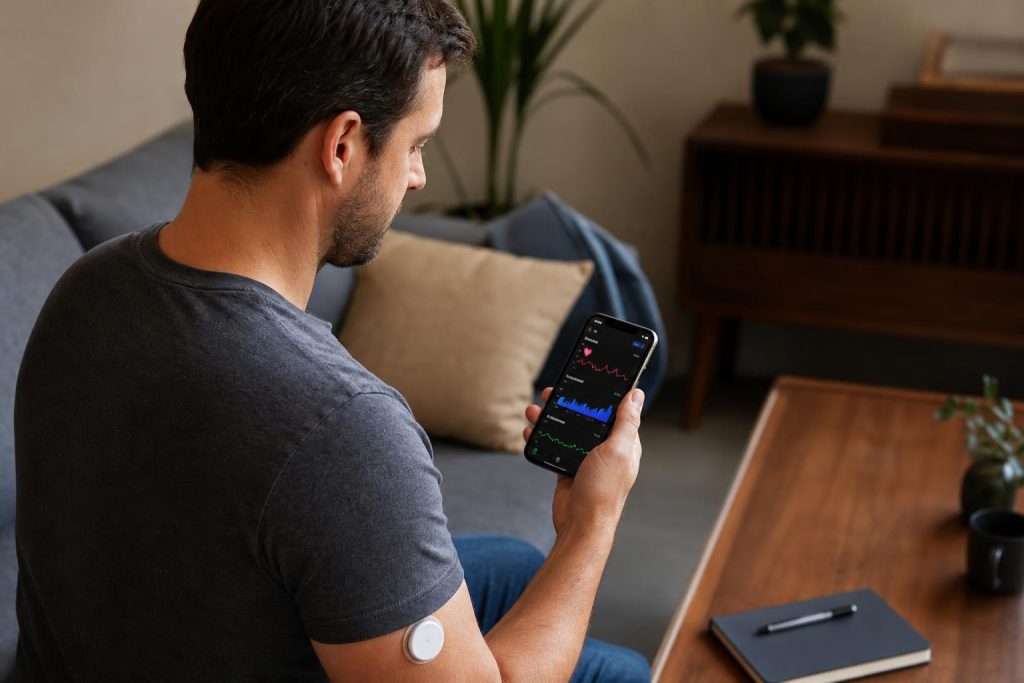
You’ve probably seen it: endurance athletes and fitness influencers sporting small sensors on their arms, tracking blood glucose in real time. But continuous glucose monitoring (CGM) isn’t just for diabetics or elite athletes anymore. Emerging research shows that CGM technology has gained popularity in the sports community for monitoring glucose concentrations in real-time, though there is currently no consensus on how to interpret these measurements or well-defined approaches for using glucose monitoring to improve performance and health..
The key insight? Your blood glucose patterns reveal far more about your metabolism than a scale or body composition test ever could. And when you can see those patterns in real time, you gain the power to optimize nutrition timing, training intensity, and recovery in ways that were previously invisible.
This guide walks you through the science of CGM, how it works, and practical protocols to leverage it for your specific goals—whether you’re managing weight, improving athletic performance, or simply building sustainable metabolic health.
What Continuous Glucose Monitoring Actually Measures (And Why It Matters)
A continuous glucose monitor is a small sensor worn on the back of your arm or abdomen that measures interstitial glucose—the glucose in the fluid between your cells—every 15 minutes. This gives you roughly 96 data points per day, compared to the single snapshot a traditional blood test provides.
Research published in the Journal of Clinical Endocrinology & Metabolism confirms that CGM systems improve time in optimal glycemic range and reduce erratic glucose fluctuations, which is critical because glucose stability—not just average levels—drives energy availability, hormonal balance, and metabolic efficiency.
Here’s what matters for your metabolic health:
- Time in Range (TIR): The percentage of time your glucose stays between 70–180 mg/dL (3.9–10 mmol/L). Target: 70% or higher for non-diabetic men.
- Glucose Variability: How much your glucose swings up and down. High variability stresses your metabolic system and impairs energy utilization.
- Postprandial Response: How quickly and how high your glucose spikes after eating. This tells you which foods and meal combinations work best for your physiology.
- Nocturnal Patterns: Whether your glucose dips too low during sleep or stays elevated—both disrupt recovery and hormonal function.
Unlike HbA1c (which shows your 3-month average), CGM gives you immediate behavioral feedback. You eat something, you see the result within 15 minutes. This real-time signal is what makes CGM a powerful optimization tool.
CGM and Physical Activity: Optimizing Training Fueling and Recovery
This is particularly valuable for men pursuing muscle building or endurance work, because glucose is the primary fuel source during resistance training and high-intensity work. Here’s how CGM optimizes your training:
Identifying Your Pre-Workout Fuel Window
CGM shows you exactly how much glucose you need before training to maintain performance without crashing. For most men doing strength work, this is 30–60g fast-digesting carbs 30–45 minutes before training. You can see if you’re underfueled (glucose drops during sets) or overfueled (unnecessary spikes that trigger fat storage).
Preventing Nocturnal Hypoglycemia After Training
Research shows CGM can prevent dangerous post-exercise glucose crashes that disrupt sleep and impair recovery. After intense or prolonged training, your muscles pull glucose from the bloodstream for hours—sometimes causing low glucose at night. CGM alerts you so you can add carbs to evening meals on heavy training days.
Timing Carbs Around Performance Goals
Want to maximize muscle glycogen for a leg day? CGM shows you if you’re adequately loaded. Pursuing fat loss and doing fasted training? CGM confirms your glucose stays stable enough to preserve muscle and mental performance.
Practical Protocol:
- Wear CGM for 2–4 weeks around your normal training schedule
- Log meals and workouts in the CGM app (most devices have companion apps)
- Look for patterns: What pre-workout meal keeps glucose stable? What post-workout carb amount prevents nocturnal crashes?
- Once you identify your personal pattern, adjust fueling strategy accordingly
CGM and Diet Optimization: Real-Time Feedback on Nutrition Choices
This is where CGM becomes a personalized nutritionist. Everyone’s glucose response to food is different. Some men spike to 140 mg/dL from a bowl of oatmeal; others stay at 100 mg/dL. Traditional nutrition advice ignores this—CGM doesn’t.
A recent study in the Journal of Clinical Endocrinology & Metabolism used CGM to compare Mediterranean, plant-forward, and control diets in men with prediabetes, and found that Mediterranean and plant-rich diets maintained more stable glucose patterns while reducing hypoglycemic episodes—even during calorie restriction. The diet that “worked best” was the one that kept glucose steady for that individual.
Here’s what CGM reveals about your diet:
Which Foods Spike Your Glucose Fastest
Refined carbs (white bread, pasta, sugar) spike glucose sharply. Protein and fat slow the rise. Fiber dramatically blunts the response. CGM shows you the actual magnitude of your response to each food—not theoretical values.
Meal Composition Matters More Than Macro Ratios
Eating carbs with protein and fat slows glucose absorption, improves satiety, and reduces energy crashes. A 50g carb meal of white rice alone will spike higher and faster than 50g from sweet potato with chicken and olive oil. CGM proves this on your metabolism.
Timing of Meals Affects Glucose Stability
Eating larger meals earlier in the day generally produces smaller glucose swings than identical meals eaten late at night. CGM confirms whether this pattern applies to you.
Practical CGM-Based Nutrition Protocol:
- Establish Baseline (Days 1–5): Eat normally, log all meals. Identify your average glucose range and biggest spikes.
- Test Single Variables (Days 6–14): Hold everything constant except one meal. For example, eat your usual lunch one day, then test a different meal composition the next day. Compare glucose patterns.
- Optimize Meal Composition (Days 15–21): Once you know which foods spike you most, reduce portion sizes or add protein/fat/fiber to blunt the response.
- Fine-Tune Timing (Days 22–28): Shift meal timing and measure impact on evening glucose stability and sleep quality.
The goal isn’t perfection—it’s identifying which changes move the needle for you. This is far more actionable than generic macros.
CGM for Fat Loss Without Metabolic Damage
One of the biggest pitfalls during aggressive calorie restriction is that your glucose stability deteriorates, making hunger worse and energy crashes more severe. This often leads to diet abandonment or the craving-driven overeating that negates your deficit.
Research using CGM in a calorie-restricted setting showed that men eating plant-forward or Mediterranean diets maintained better glucose stability and lower hypoglycemic risk than control diets, even during 25% calorie restriction. This matters because stable glucose = fewer cravings = sustainable fat loss.
CGM-Guided Fat Loss Strategy:
- Monitor Glucose During Deficit: As you drop calories, CGM should show stable glucose in the 80–120 mg/dL range. If you’re seeing frequent dips below 70 or sustained highs above 140, your current food choices or meal timing aren’t working.
- Protect Your TIR: Aim for 70%+ time in range even during deficit. This correlates with better adherence, less muscle loss, and faster metabolic recovery post-diet.
- Use CGM to Identify Hunger Triggers: Glucose crashes drive hunger. If you’re ravenous at 3 PM, CGM will show a postprandial dip from lunch. Fix it by adding protein or fat to that meal.
- Adjust Carb Timing Around Training: During a deficit, front-load carbs around your workouts (where they fuel performance and muscle preservation) rather than spreading them throughout the day.
Choosing and Using a Continuous Glucose Monitor: Practical Considerations
Several CGM devices are available. Most accurate options for non-diabetic men:
- FreeStyle Libre 3: 14-day wear, no fingerstick calibration, ~$50/sensor, available without prescription
- Dexcom G7: 10-day wear, real-time smartphone alerts, ~$50/sensor, higher accuracy in lower glucose ranges
- Abbott Guardian: Hospital/clinical use primarily
Cost Reality: Without diabetes diagnosis, insurance rarely covers CGM. Expect $600–$1,200/year for continuous monitoring. Many men find a 4–8 week initial assessment worth the cost, then periodic 1–2 week checks (2–3 times/year) to track progress.
Key Accuracy Notes: Interstitial glucose (what CGM measures) lags blood glucose by ~10–15 minutes and can differ by ±10–15 mg/dL, especially during rapid changes. It’s directionally accurate for optimization—don’t obsess over exact numbers.
Best Practices for Getting Useful Data:
- Wear for minimum 2–4 weeks for meaningful patterns (one week = noise)
- Log all meals, training, sleep, stress in your CGM app
- Focus on patterns, not individual data points
- Make one change at a time so you can isolate what moved the needle
- After initial assessment, retest quarterly to track progress and adjust as needed
Bottom Line: Is CGM Right for Your Goals?
Continuous glucose monitoring is most valuable if you’re:
- Pursuing significant fat loss and want to optimize for satiety and energy
- Training intensely and want to maximize performance and recovery fueling
- Managing prediabetes or metabolic syndrome risk factors
- Experimenting with different diets (keto, plant-based, carnivore) and want objective data on what works for your metabolism
- Plateauing on results despite consistent diet and training, and need a new variable to tweak
If you’re already lean, training consistently, and feeling good, CGM is probably a nice-to-have rather than essential. Nutrition, training consistency, and sleep remain the primary pillars.
The real power of CGM isn’t the technology—it’s the behavioral feedback. When you see in real time how a food choice affects your body for the next 3 hours, you make better decisions. That’s the optimization that compounds.
Next Steps:
Ready to test your personal glucose response? Start with a 2–4 week CGM trial. Most men discover 2–3 high-impact adjustments in the first week alone. From there, you can make informed decisions about nutrition and training that are rooted in your actual physiology, not generic advice.
Explore more: Check out our guides on optimizing your fat loss nutrition, training fueling protocols, and metabolic health markers that actually matter.
Scientific References
-
Schubert-Olesen, Kröger, Siegmund et al. (2022).
Continuous Glucose Monitoring and Physical Activity..
International journal of environmental research and public health.
View on PubMed → -
Flockhart, Larsen et al. (2024).
Continuous Glucose Monitoring in Endurance Athletes: Interpretation and Relevance of Measurements for Improving Performance and Health..
Sports medicine (Auckland, N.Z.).
View on PubMed → -
Nwokolo, Hovorka et al. (2023).
The Artificial Pancreas and Type 1 Diabetes..
The Journal of clinical endocrinology and metabolism.
View on PubMed → -
Albairmani, Basheer, Macky et al. (2025).
Management of Diabetes in Pregnancy: A Review of Clinical Guidelines and Practices..
Cureus.
View on PubMed → -
Luo, Wang, Sun et al. (2022).
Isocaloric-restricted Mediterranean Diet and Chinese Diets High or Low in Plants in Adults With Prediabetes..
The Journal of clinical endocrinology and metabolism.
View on PubMed →