When you’re cutting calories to lose fat, your body faces a choice: burn fat, burn muscle, or some combination of both. Research shows that higher dietary protein intake during an energy deficit combined with intense exercise promotes greater lean mass gain and fat mass loss compared to lower protein approaches. This isn’t theoretical—it’s a practical advantage that separates men who lose fat AND keep their muscle from those who shrink down uniformly.
If you’re pursuing fat loss through diet and exercise, GLP-1 medications, or any other approach, understanding how to use protein strategically can mean the difference between looking athletic and looking depleted.
Why Protein Matters More During Fat Loss
During a caloric deficit, your body increases protein breakdown to fuel itself. Without adequate protein intake, you lose disproportionate amounts of lean body mass along with fat. The Longland study in The American Journal of Clinical Nutrition found that protein intake higher than standard recommendations preserved lean body mass significantly better, particularly when combined with resistance training.
Here’s the practical takeaway: protein acts as a metabolic shield. It’s harder for your body to break down muscle tissue when amino acids are readily available. Additionally, protein has a higher thermic effect than carbs or fat—meaning your body burns more calories simply digesting it.
The target: Aim for 0.7–1.0 grams of protein per pound of body weight during fat loss. For a 200-lb man, that’s 140–200 grams daily. This is higher than the RDA (0.8g per kg, or roughly 0.36g per lb) but evidence-supported for your goal.
Protein + Resistance Training = Muscle Preservation
Protein alone isn’t enough. The research specifically emphasizes that high protein intake works best when paired with intense exercise. Resistance training sends a signal to your body that muscle is valuable and worth keeping. Without that signal, even high protein won’t fully prevent muscle loss.
Practical protocol:
- Training frequency: 3–5 days per week of resistance training (compound lifts prioritized)
- Intensity: Working sets should be challenging—aim for 6–12 reps per set, stopping 1–2 reps short of failure
- Consistency: More important than perfection. A sustainable program beats an extreme one
The synergy is real: high protein + heavy lifting + caloric deficit = fat loss with muscle retention. Skip any one piece, and results suffer.
Carbohydrate Approach: Balanced vs. Restricted
A common question: should you lower carbs to accelerate fat loss? A 2022 Cochrane systematic review on low-carbohydrate versus balanced-carbohydrate diets found that both approaches produce similar weight loss when calories are controlled. The difference isn’t as dramatic as marketing suggests.
A 2018 Lancet study examining carbohydrate restriction noted that extremely low carbohydrate intake may carry long-term metabolic considerations worth monitoring, particularly around cardiovascular health markers.
The practical answer: Choose a carbohydrate level you can sustain. For most men:
- Moderate carb (40–50% of calories): Supports training performance, easier to maintain
- Lower carb (20–30% of calories): Slightly faster initial water loss, may suppress appetite
- Very low carb (<20%): Only necessary if adherence improves significantly; not superior for long-term fat loss when protein and calories are matched
The key variable is total calorie deficit and protein intake—not carb restriction itself.
Caloric Deficit: How Aggressive Should You Go?
The CALERIE trial showed that sustained caloric restriction improves multiple cardiometabolic risk factors over 2 years, but the study also highlighted that moderate, consistent deficits work better than aggressive ones for long-term adherence and health.
Recommended deficit range: 300–500 calories below maintenance per day, producing 0.5–1 lb of fat loss per week. This pace:
- Preserves strength and training performance
- Minimizes hunger and energy crashes
- Reduces muscle loss risk
- Is sustainable for months, not weeks
More aggressive deficits (>750 calories/day) accelerate fat loss initially but increase muscle loss, metabolic adaptation, and abandonment rates. You’re looking for a marathon approach, not a sprint.
Protein Sources and Timing
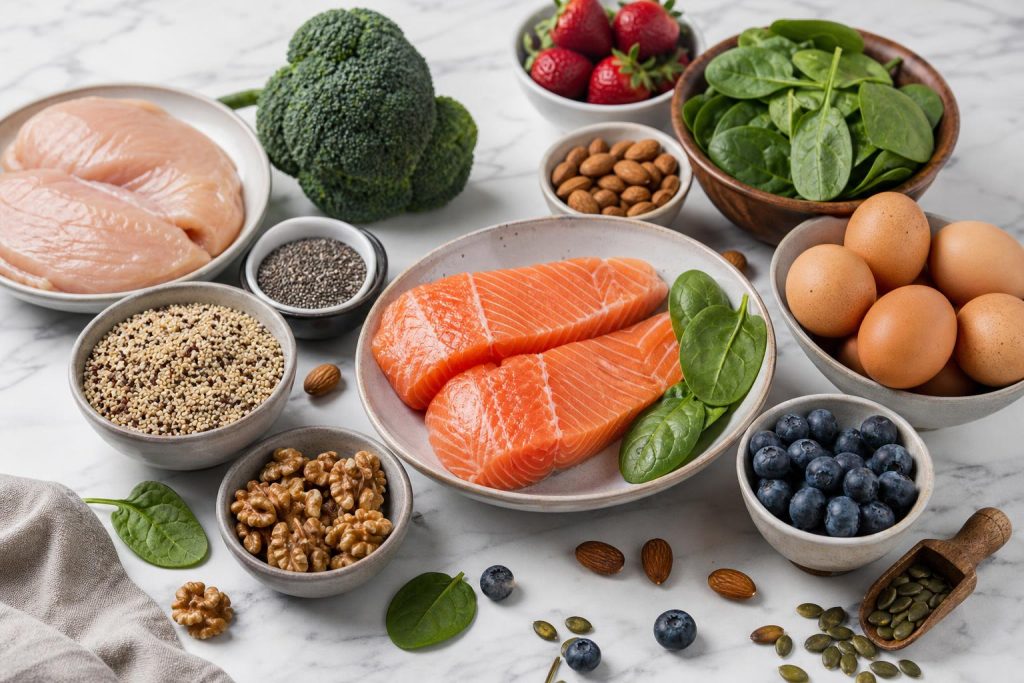
Quality matters, but consistency matters more. Spread protein throughout the day—roughly 30–40g per meal works well for most men. Good sources include:
- Lean meats (chicken, turkey, lean beef)
- Fish (salmon, tilapia, cod)
- Eggs and Greek yogurt
- Legumes and tofu
- Whey or casein protein powder
Timing around workouts helps, but total daily intake matters far more than pre/post-workout windows. Focus on hitting your daily target first; fine-tune timing second.
Bottom Line
Fat loss in men doesn’t require complexity—it requires adherence to fundamentals: adequate protein (0.7–1.0g per lb bodyweight), consistent resistance training, a moderate caloric deficit (300–500 cal/day), and patience. Science clearly shows that higher protein intake during a deficit preserves lean mass better than lower protein approaches, particularly when combined with strength training. Whether you’re using diet and exercise alone or supplementing with other tools like GLP-1 medications, these principles remain the foundation of sustainable fat loss with muscle preservation.
Next step: Calculate your maintenance calories, set a 300–500 calorie deficit, hit 0.7–1.0g protein per pound of bodyweight, and train hard 3–5 days per week. Results follow consistency.
Scientific References
-
Longland, Oikawa, Mitchell et al. (2016).
Higher compared with lower dietary protein during an energy deficit combined with intense exercise promotes greater lean mass gain and fat mass loss: a randomized trial..
The American journal of clinical nutrition.
View on PubMed → -
Seidelmann, Claggett, Cheng et al. (2018).
Dietary carbohydrate intake and mortality: a prospective cohort study and meta-analysis..
The Lancet. Public health.
View on PubMed → -
Naude, Brand, Schoonees et al. (2022).
Low-carbohydrate versus balanced-carbohydrate diets for reducing weight and cardiovascular risk..
The Cochrane database of systematic reviews.
View on PubMed → -
Kraus, Bhapkar, Huffman et al. (2019).
2 years of calorie restriction and cardiometabolic risk (CALERIE): exploratory outcomes of a multicentre, phase 2, randomised controlled trial..
The lancet. Diabetes & endocrinology.
View on PubMed → -
Bazzano, Hu, Reynolds et al. (2014).
Effects of low-carbohydrate and low-fat diets: a randomized trial..
Annals of internal medicine.
View on PubMed →