Here’s a number that should reframe how you think about your kitchen gear: in a controlled study published in the American Journal of Clinical Nutrition, participants who used pre-portioned meals consumed an average of 250 fewer calories per day without feeling more hungry — a deficit that, sustained over a year, translates to roughly 26 pounds of fat loss. The container you pack your lunch in isn’t a trivial detail. It’s an intervention.
Whether you’re running a caloric deficit to strip body fat, eating in a modest surplus to build muscle, managing blood sugar through a low-glycemic diet, or using a GLP-1 medication that has already compressed your appetite, the physical structure of your meals — how much fits in a container, how it’s divided, what gets prioritized — silently governs your results more than most men realize. Meal prep isn’t just a productivity hack for Sunday afternoons. It’s a nutritional architecture decision, and the container is the blueprint.
Why the Container Itself Is Part of the Strategy
Behavioral scientists call it the “unit bias” — the deeply wired human tendency to treat whatever portion is placed in front of us as the appropriate amount to consume. Research from Brian Wansink’s lab at Cornell demonstrated that people consistently eat more when served from larger containers, regardless of hunger signals, and dramatically underestimate how much they’ve consumed when vessel size isn’t standardized. The implication is simple but underappreciated: if your containers aren’t calibrated to your goals, your eyeballing is working against you.
For men focused on fat loss, this matters in a direct caloric sense. For men trying to build or preserve muscle — especially those in a moderate caloric deficit — it matters because protein distribution across meals is as important as total daily intake. A landmark study in the Journal of Nutrition found that muscle protein synthesis was maximized when protein was distributed evenly across three to four meals rather than skewed toward dinner, as most men eat. If your prep containers are random sizes grabbed from the back of a cabinet, you’re likely front-loading carbohydrates and back-loading protein — exactly backwards from what the research supports.
Men using GLP-1 receptor agonists like semaglutide or tirzepatide face a compounded version of this challenge. Appetite suppression is dramatic on these medications, which means caloric intake can drop so sharply that protein targets become nearly impossible to hit through intuitive eating alone. Structured containers with dedicated protein compartments essentially force the nutritional hierarchy: protein first, then vegetables, then energy substrates. That hierarchy isn’t arbitrary — it’s what the physiology demands when total volume is constrained.
What to Look for When Choosing Containers
The market for meal prep containers has expanded significantly, but most products are designed for aesthetics and stackability rather than nutritional structure. The features that actually matter come down to compartment configuration, material integrity, volume accuracy, and thermal performance.
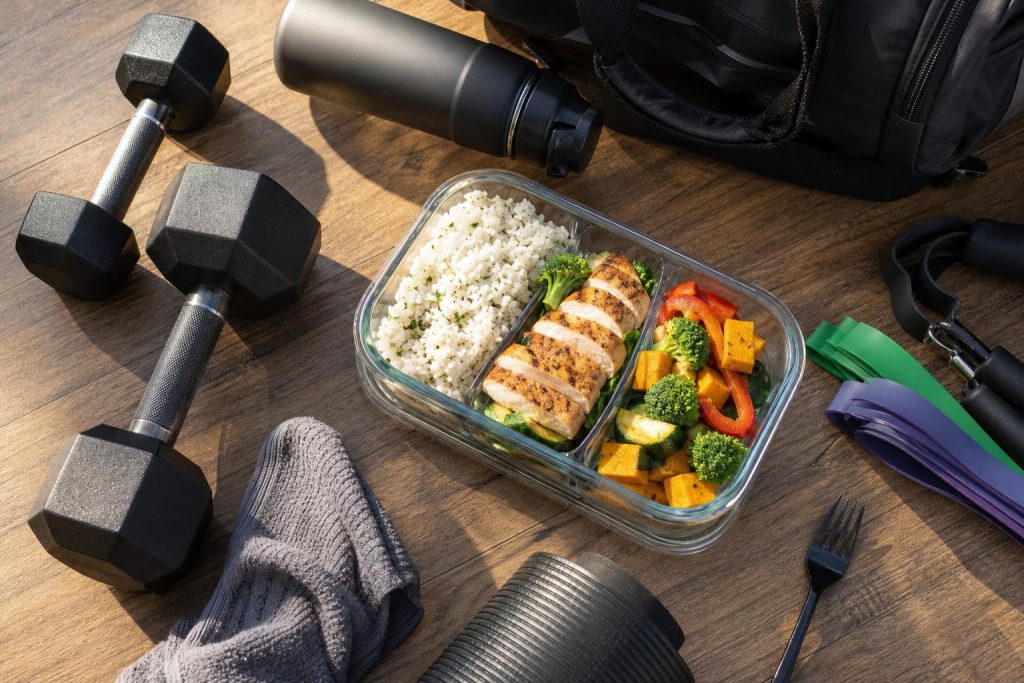
Compartmentalized containers — specifically those with two to three sections — outperform single-cavity options for most men’s goals. A practical configuration for fat loss or body recomposition looks like this: one large compartment holding four to six ounces of a lean protein source (chicken breast, salmon, lean ground beef, Greek yogurt, cottage cheese), one medium compartment for non-starchy vegetables or a mixed salad, and one smaller compartment for a starchy carbohydrate or healthy fat source. This isn’t a rigid formula — it’s a flexible framework that keeps macros visible and intentional rather than accidental.
Volume matters more than most buyers consider. A 32-to-36 ounce total capacity hits the sweet spot for a moderate meal: enough volume to fill a plate visually, which research confirms reduces hunger through volumetric eating principles, without enabling caloric overreach. Men in a muscle-building phase may want one larger single-cavity container in the 40-to-48 ounce range for post-training meals where caloric density needs to climb.
On material: glass containers consistently outperform plastic for food safety, temperature retention, and longevity. BPA and phthalate leaching from plastic containers — particularly when heated — has been linked in epidemiological research to disruptions in androgen signaling, which is the last thing any man focused on body composition and metabolic health wants to introduce into a daily meal routine. Borosilicate glass containers with locking silicone lids are the gold standard. They’re heavier, but they heat evenly, don’t absorb odors, and don’t degrade over hundreds of dishwasher cycles the way polypropylene does.
Leak-proof construction is non-negotiable for anything containing proteins cooked in sauces or marinades. Silicone gasket seals with four-sided locking clips perform significantly better in real-world transit than the snap-lid designs that dominate the budget category. For men who carry their meals in a gym bag or backpack, this distinction matters immediately.
Thermal containers — insulated stainless steel bento-style boxes — are worth having in rotation if you’re eating outside a microwave environment. They maintain food temperatures safely for four to six hours and eliminate the need for refrigeration access, which is a genuine barrier to consistency for men with unpredictable work schedules or outdoor jobs.
Building a Portioning System That Actually Works
The most effective meal prep systems aren’t built around a single container type. They’re built around a small collection of purpose-matched vessels used consistently for specific meal types. For most men, a practical starting inventory includes four to six glass two-compartment containers in the 32-ounce range for lunch and dinner meals, two to four smaller single-compartment containers in the 16-ounce range for protein-heavy snacks or breakfast components like egg bites or overnight oats, and one or two insulated stainless boxes for days when reheating isn’t possible.
The portioning logic should be anchored to protein targets first. Current evidence supports a daily protein intake of 1.6 to 2.2 grams per kilogram of body weight for men engaged in resistance training or pursuing fat loss while preserving lean mass. For a 185-pound man, that’s roughly 135 to 185 grams of protein per day. Distributed across four meals — including a prep container-based lunch and afternoon snack — each meal needs to deliver approximately 35 to 45 grams of protein. That translates to roughly five to six ounces of cooked chicken, beef, or fish, or a combination of animal and plant-based sources. Build the container around that anchor first, then fill the remaining compartments.
For men on GLP-1 medications specifically, smaller container sizes often become necessary as appetite adapts downward. The strategic response is not to simply eat less of everything — it’s to compress volume while protecting protein density. A 20-to-24 ounce container filled primarily with high-protein, nutrient-dense food outperforms a half-eaten 36-ounce container nutritionally and psychologically. Right-sizing the vessel to the realistic intake level eliminates the visual cue of unfinished food, which research consistently links to reduced meal satisfaction and increased likelihood of dietary deviation.
The Takeaway
Meal prep containers are infrastructure. Like a well-organized gym or a consistent sleep environment, they make the behavior you want easier and the behavior you don’t want harder. The science on portion size, protein distribution, and unit bias is unambiguous: structure drives outcomes. Whether your goal is dropping twenty pounds, adding lean mass, stabilizing blood sugar, or simply eating better on a demanding schedule, the physical design of your meals — down to the container they travel in — is a variable worth optimizing. Get the containers right, build a portioning framework around your protein targets, and let the system do the heavy lifting your willpower doesn’t have to.