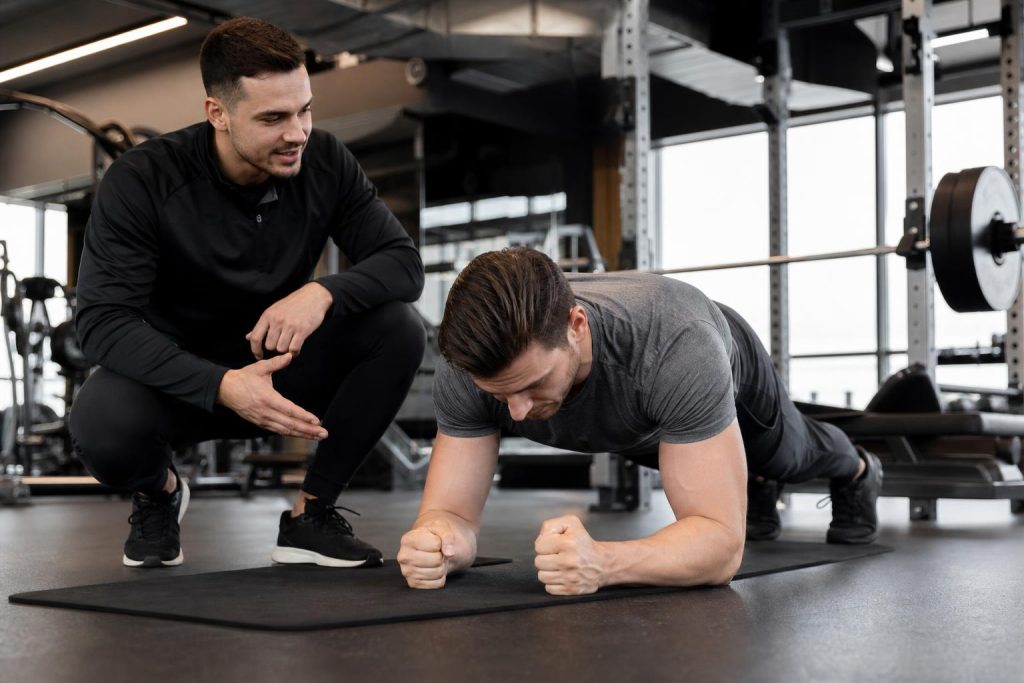
Most men think they know how to plank. They drop to their forearms, hold for thirty seconds while their hips sag toward the floor, and consider the job done. But research published in the Journal of Strength and Conditioning Research found that core stability training — when properly progressed — produces significantly greater improvements in functional strength and injury resilience than isolated abdominal exercises like crunches. The plank isn’t just a beginner move you outgrow. It’s a foundational tool with a ceiling far higher than most men ever reach.
Whether you’re deep into a fat loss phase, rebuilding fitness after a period of inactivity, using a GLP-1 medication like semaglutide while trying to preserve muscle, or simply trying to perform better in the gym and in life — your core is the throughline. Every squat, every deadlift, every carry, every time you bend down to pick something up, your core is either working efficiently or compensating in ways that eventually lead to pain and injury. Building that foundation systematically, through a structured plank progression, is one of the highest-return investments you can make in your physical health.
The science behind why core training matters goes well beyond aesthetics. A landmark study by McGill and colleagues established that spinal stability depends heavily on co-activation of the deep core musculature — including the transverse abdominis, multifidus, and internal obliques — rather than surface-level muscle strength alone. The plank, when performed correctly and progressively overloaded over time, trains exactly this system. It teaches your body to brace, resist movement, and transfer force — all of which translate directly to better performance, lower injury risk, and a stronger physique.
Understanding the Plank as a Progressive Training Tool
The biggest mistake men make with planks is treating them as a static endurance test rather than a strength exercise to be progressively loaded. Holding a plank for three minutes doesn’t make you functionally stronger — it just means you’ve trained your slow-twitch fibers to tolerate prolonged low-intensity contraction. Research from the American Council on Exercise has suggested that once you can hold a plank for about 60 seconds with perfect form, the more productive path is to increase difficulty through leverage, instability, or movement — not simply adding time.
True plank progression follows the same principles as any strength training protocol: introduce a stimulus, adapt, then increase the demand. The progression moves through five broad stages. First is the foundational forearm plank, where the goal is perfect alignment — ears, shoulders, hips, and heels in one straight line, glutes squeezed, core braced as if you’re about to take a punch. If you can’t hold this for 30 seconds without compensating, this is your starting point, and there’s no shame in it. Many men coming back from sedentary periods, or those who’ve lost significant weight and muscle mass, find this genuinely challenging. The goal here is three sets of 20 to 30 seconds, building to three sets of 45 to 60 seconds before advancing.
The second stage introduces the high plank, or push-up position plank, which demands more from the shoulder girdle and increases the lever arm slightly. From here, the progression moves to shoulder taps — lifting one hand at a time to tap the opposite shoulder while the hips stay perfectly square. This anti-rotation demand is where the real core training begins. A 2018 study in the International Journal of Sports Physical Therapy confirmed that anti-rotation exercises produce significantly higher activation in the obliques and transverse abdominis compared to standard isometric holds, making shoulder taps and similar variations far more effective for building functional core strength.
Stage three is where most intermediate trainees live: plank variations with leg or arm reaches. Extending one arm forward while extending the opposite leg — the bird dog plank — forces the body to resist extension and rotation simultaneously. This is also where instability tools like a stability ball can be introduced. Placing your forearms on a stability ball instead of the floor dramatically increases core activation, as research published in the Journal of Orthopaedic and Sports Physical Therapy demonstrated activation levels nearly double those seen in a standard forearm plank. If you don’t have a stability ball, a suspension trainer like TRX placed under your feet achieves a similar effect.
Advanced Plank Variations, Load, and Real-World Application
Stage four introduces weighted planks and loaded carries, which bridge the gap between isolated core work and full-body strength training. A weight plate placed across your upper back during a forearm plank, or a vest added to a high plank, turns a bodyweight drill into a genuine strength stimulus. From there, the plank-to-push-up — moving from forearms to hands and back again — adds both a strength and a coordination demand that most men find more challenging than they expected. Aim for three to five controlled reps per set rather than racing through the movement.
Stage five, the most advanced tier, includes exercises like the ab wheel rollout and plank with weight transfer. The ab wheel rollout is essentially an extended plank with a massive anti-extension demand. Electromyography data published in the Journal of Human Kinetics showed the ab wheel rollout produced higher rectus abdominis and external oblique activation than nearly every other core exercise tested, including decline crunches and cable crunches. If you’ve been looking for a single exercise to graduate toward, this is it — but only after you’ve built the foundational strength to control the movement, or you’ll simply jam your lumbar spine into extension and reinforce bad patterns.
For men using GLP-1 medications like semaglutide or tirzepatide, this type of structured core training carries particular importance. Rapid weight loss — whether from medication, aggressive caloric restriction, or any combination — comes with a real risk of muscle loss alongside fat. A 2023 analysis in Diabetes, Obesity and Metabolism highlighted that lean mass loss can account for a substantial portion of total weight lost on GLP-1 therapy when resistance training is absent. Core work alone won’t prevent that — you need compound lifting and adequate protein — but maintaining a strong, functional core keeps you training effectively and reduces the injury risk that can interrupt consistency. The same principle applies to anyone in a caloric deficit: the body is in a catabolic state, and structured resistance work signals your nervous system and muscle tissue that strength is still a priority worth preserving.
Programming this intelligently means treating plank progressions as part of your warm-up or finisher, not as your entire workout. Three to four sets of a plank variation at the appropriate stage, performed three to four times per week, is sufficient stimulus for most men to make consistent progress. The key variable is honest self-assessment. Ego is the enemy of core training. If your hips are dropping or your lower back is arching, you’re working the wrong muscles for the wrong reasons. Drop to an easier variation, own it with perfect form, and earn the next level.
Nutrition matters here too, in a way that’s often overlooked in core training discussions. Research published in the American Journal of Clinical Nutrition consistently supports protein intake of 1.6 to 2.2 grams per kilogram of bodyweight per day for men engaged in resistance training who want to maintain or build muscle mass. Core training is resistance training. If you’re not eating enough protein — especially if you’re in a caloric deficit — your body doesn’t have the raw materials to rebuild the muscle tissue you’re breaking down in training. This is true whether you’re a 250-pound man who just started exercising or a lean athlete fine-tuning his physique.
Recovery also plays a role that most men underestimate. Deep core muscles like the multifidus have a high density of slow-twitch fibers and recover relatively quickly, which is why daily low-intensity core work is generally tolerable. But as you advance to loaded variations and high-tension exercises like the ab wheel, the demand increases significantly and 48 hours between sessions becomes prudent. Sleep, hydration, and stress management all influence core neuromuscular function in ways that matter — evidence shows that sleep deprivation impairs motor control and proprioception, which means your ability to maintain proper plank alignment and bracing technique degrades when you’re running on five hours a night. Consistency over time beats intensity in any single session.
The Takeaway
The plank is not a punishment exercise or a simple warm-up afterthought. When you approach it as a true progressive strength movement — moving from the basic forearm hold through anti-rotation variations, instability challenges, loaded versions, and finally to advanced rollouts — it becomes one of the most versatile and effective tools in any man’s training arsenal. The men who build genuinely strong, functional cores are not the ones who hold the longest static planks. They’re the ones who progress intelligently, stay honest about their technique, fuel their training with adequate protein, and show up consistently over months and years. That applies whether you’re forty pounds overweight and just starting out, well into a fat loss phase with pharmaceutical support, or already in solid shape and looking to perform at a higher level. Your core is always the foundation. Build it like it matters — because it does.