Here’s a number that should change how you train: research published in Obesity found that men on GLP-1 receptor agonists lost approximately 39% of their weight from lean mass — not fat. That’s muscle walking out the door alongside the pounds. But this isn’t just a GLP-1 problem. Any aggressive calorie deficit, whether from medication, strict dieting, or extended cardio-only programs, puts your muscle tissue at risk. The solution is the same regardless of how you’re losing weight: resistance training, done consistently, even at home with a set of bands.
Resistance bands have earned a reputation as beginner tools, which undersells them badly. A 2019 meta-analysis in the Journal of Human Kinetics confirmed that elastic resistance training produces comparable strength and hypertrophy gains to free weights, provided you manage tension and progressive overload properly. For men training at home — whether on a GLP-1 protocol, running a calorie deficit, or simply building a leaner physique — bands offer full-range muscle stimulus, joint-friendly loading, and enough variety to build a complete program around.
What a Real Resistance Band Program Looks Like
The mistake most home trainers make is treating bands like a warm-up tool rather than a primary stimulus. Effective band training requires the same principles as barbell training: progressive overload, compound movement priority, adequate volume per muscle group, and structured recovery. The equipment is different; the physiology is identical.
A well-designed home program built around bands should hit three to four sessions per week, alternating between upper and lower body emphasis or running a push-pull-legs split. Each session should anchor around three to four compound movements — think band-resisted squats, Romanian deadlifts, rows, and overhead presses — followed by one or two isolation exercises for lagging areas. Sets should run three to four per exercise, with reps in the eight to fifteen range where you’re reaching genuine muscular fatigue in the final two reps. If you’re breezing through twenty reps with no effort, the band tension is too light.
For lower body, the movements that translate best to bands are the hip hinge (loop the band under your feet and deadlift), the goblet squat pattern (band under feet, held at chest), lateral band walks for glute activation, and standing hip abductions. Upper body responds well to banded rows anchored in a door, chest press variations lying on the floor, face pulls for rear delts, and bicep curls with the band underfoot. The key is maintaining constant tension — bands lose effectiveness when you let the slack go, so control both phases of every rep.
Men using GLP-1 medications should pay particular attention to protein intake alongside this training. A 2023 review in Nutrients highlighted that higher protein intake during caloric restriction is critical for preserving lean body mass, with most research supporting a target of 1.6 to 2.2 grams per kilogram of body weight daily. GLP-1 medications suppress appetite significantly, which can make hitting protein targets harder — but that makes intentional tracking more important, not less. The same principle applies to anyone in a deficit: protein and resistance training work as a team.
Choosing the Right Bands and Progressing Over Time
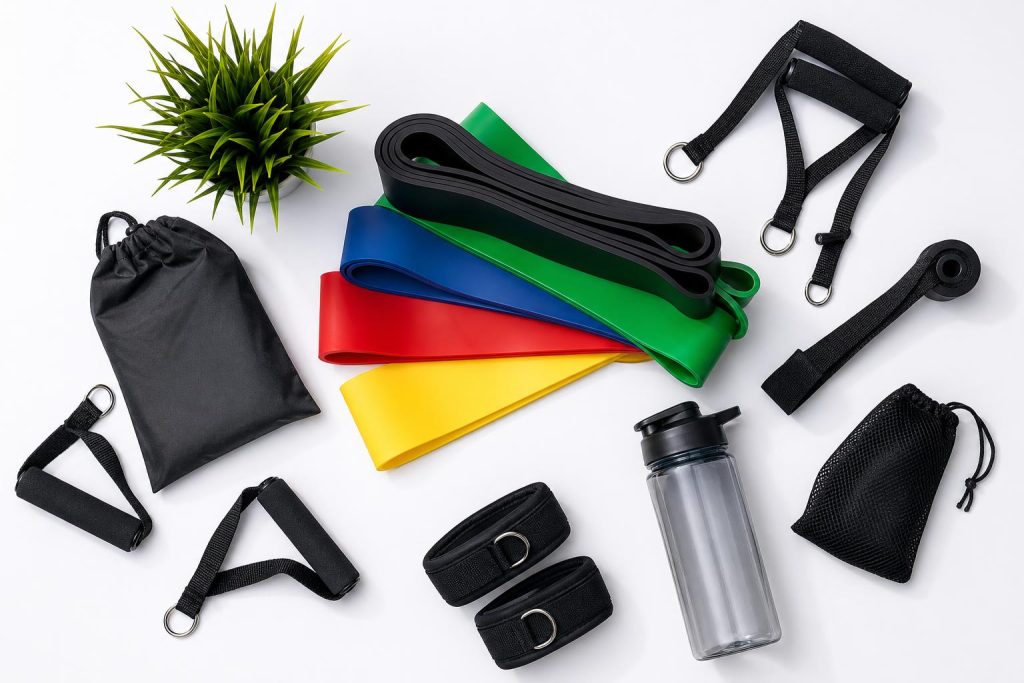
Not all resistance bands are created equal, and this matters more than most guides acknowledge. Tube bands with handles are versatile for upper body pressing and pulling. Flat loop bands excel for lower body work, hip hinges, and glute activation. Heavy-duty power bands — the thick, wide loops — can replicate significant loading for squats, deadlifts, and rows when doubled or anchored strategically. A complete home setup should include light (10–25 lb resistance), medium (25–50 lb), and heavy (50–80 lb) options across both tube and loop styles.
Progressive overload with bands works through three levers: increasing band tension by moving to a heavier band, shortening the band’s resting length to increase resistance at the starting position, or increasing reps and sets before graduating to a heavier band. Tracking these variables session to session is the difference between a program that builds muscle and one that just maintains fitness. Research in the Journal of Strength and Conditioning Research confirms that progressive overload is the primary driver of hypertrophy, regardless of equipment type.
The Takeaway
Whether you’re on a GLP-1, running a traditional deficit, or simply trying to build a leaner, stronger body without a gym membership, resistance bands can carry a serious program. The muscle you preserve — or build — during a fat loss phase is what determines how you look and perform on the other side of it. Bands remove the barrier of access. Progressive overload, adequate protein, and consistent effort remove the rest.