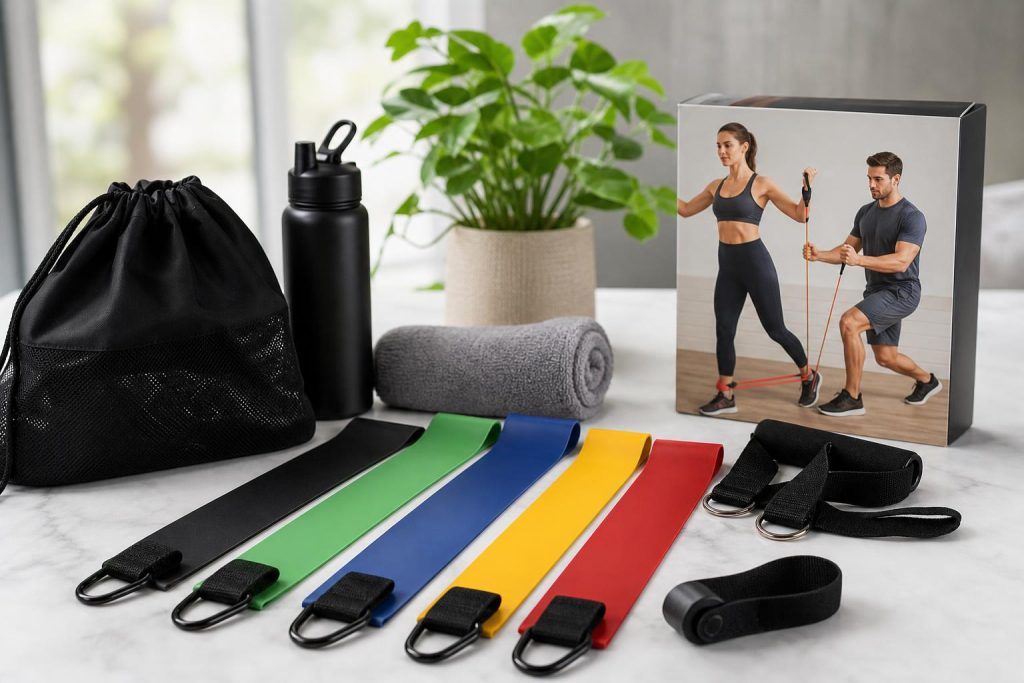
Here’s a number that should shift your perspective on home training: a 2019 meta-analysis published in the Journal of Human Kinetics found that resistance band training produces comparable strength and muscle gains to conventional free-weight training across multiple muscle groups. Not similar. Comparable. That means the $30 set of bands sitting in your closet — or the one you’ve been eyeing online — carries the same physiological potential as a rack of dumbbells. The variable isn’t the equipment. It’s whether you use it with intention.
For men who are actively working on body composition — whether through diet, structured training, GLP-1 medications, or some combination of all three — resistance bands represent one of the most underutilized tools available. They’re portable, joint-friendly, scalable in intensity, and capable of loading every major muscle group through a full range of motion. More importantly, when you’re in a caloric deficit or managing appetite suppression, maintaining muscle mass becomes your number one training priority. Bands give you a practical way to do that without needing a gym membership or an hour of commute time.
Why Muscle Preservation Should Be Your North Star
Fat loss without muscle preservation isn’t really a win. When men lose weight — regardless of how they get there — a significant portion of that weight loss can come from lean tissue if resistance training isn’t part of the equation. Research from the American Journal of Clinical Nutrition has shown that adequate protein intake combined with resistance training is the most effective strategy for preserving lean mass during a caloric deficit. The training stimulus tells your body that muscle is worth keeping. Without it, your metabolism adapts downward — and that’s a hole that’s very difficult to climb out of.
This is especially relevant for men using GLP-1 receptor agonists like semaglutide or tirzepatide, where appetite suppression can lead to significant reductions in overall food intake. A 2023 study in Diabetes, Obesity and Metabolism noted that muscle loss can account for a meaningful share of total weight lost in GLP-1 users who don’t train consistently. Resistance work — even moderate-intensity band training three to four times per week — is one of the clearest countermeasures available. But again, this isn’t just a GLP-1 conversation. Any man cutting calories needs to be lifting something.
The Workout: A Full-Body Protocol Built Around Tension and Volume
The following protocol is designed to be completed three to four times per week, requiring only a set of loop bands or tube bands with handles, and a door anchor for pulling movements. Sessions run 35 to 45 minutes. The goal is to accumulate enough mechanical tension across major muscle groups to drive a hypertrophic and metabolic stimulus — both of which support fat loss while protecting lean tissue.
Start each session with banded pull-aparts and face pulls to activate the posterior shoulder and upper back — two areas chronically underworked in men who sit for a living. Three sets of 15 to 20 reps here isn’t just warm-up filler; research on scapular stability consistently links this kind of pre-activation work to improved force output in subsequent pressing movements.
From there, move into your primary compound movements. Banded squats — either standing on the band with handles at shoulder height, or looping a heavy band across the upper back — load the quads, glutes, and hamstrings with accommodating resistance, meaning the band gets harder as you reach full extension. This mirrors how your muscles are strongest at the top of the movement. Follow with banded Romanian deadlifts, keeping a hip-hinge pattern strict, feeling the stretch in the hamstrings at the bottom. Three to four sets of 10 to 12 reps on each, with 60 to 90 seconds of rest.
For upper body, a door-anchored row is your highest-return investment. Anchor at chest height, grip the handles, and row your elbows back hard — squeezing the scapulae together at the end of each rep. This directly targets the lats, rhomboids, and rear delts. Superset this with banded push-ups — loop a band across your upper back and grip the ends under your palms — adding resistance through the full push-up range. Three rounds of 12 rows paired with 12 to 15 push-ups will build real pressing and pulling strength over time.
Finish with isolation work: banded bicep curls, tricep overhead extensions, and lateral raises for the shoulders. Keep these sets moderate — two to three sets of 15 reps — with minimal rest. This is where you accumulate volume for smaller muscle groups without loading the joints heavily, which matters when you’re training in a deficit or on lower caloric intake.
The single most important variable across all of this is progressive overload. A foundational principle in exercise science, progressive overload means incrementally increasing the challenge on your muscles over time — thicker bands, more reps, slower tempos, or reduced rest periods. Without it, your body adapts and stops responding. Track your workouts. Move up a band resistance every two to three weeks when the current one becomes manageable.
What This Means For You
A home resistance band workout isn’t a fallback plan. For men who are serious about changing their body composition — losing fat, building or preserving muscle, improving how they feel and perform — it’s a genuinely effective training modality backed by solid research. Pair consistent band training with adequate protein intake (aim for 0.7 to 1 gram per pound of bodyweight), prioritize sleep, and manage stress, and you’ve assembled the core pillars of real metabolic health. The bands are just the start. Show up three times a week, push with intention, and the results follow.