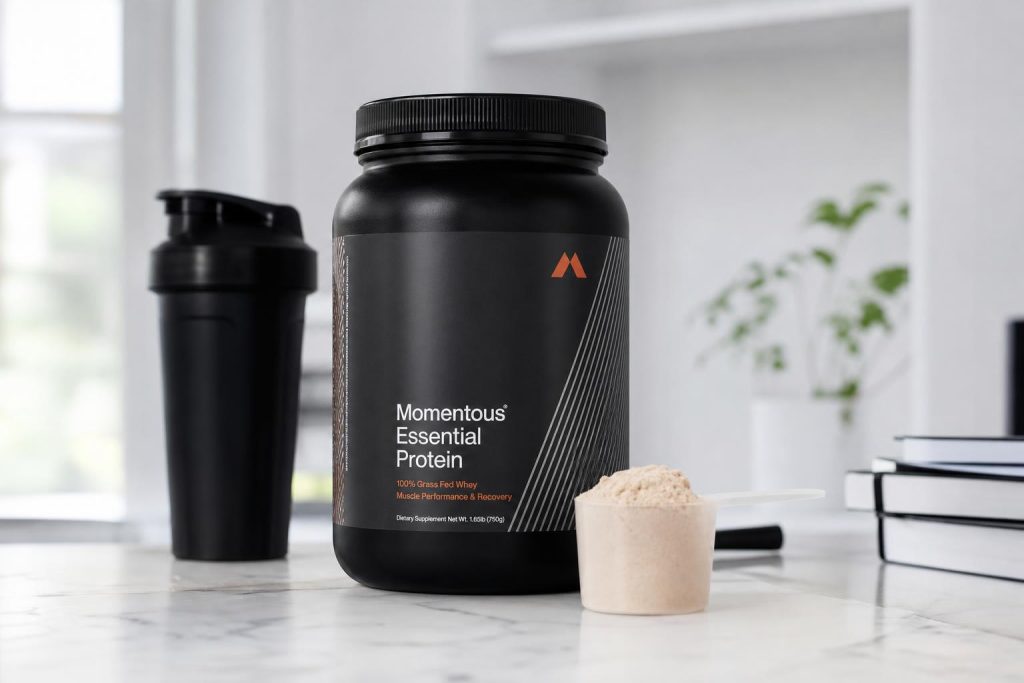
Most protein powders are not what they claim to be. Independent testing by organizations like Labdoor and NSF International has repeatedly found that a significant percentage of protein supplements on the market are under-dosed, contaminated with heavy metals, or spiked with cheap amino acids to inflate their apparent protein content. Against that backdrop, Momentous has built a reputation as one of the few sports nutrition companies genuinely willing to submit its products to third-party scrutiny — and the science behind their protein formulation is worth examining closely if you care about results, not just marketing.
The core question for any man investing in a high-quality protein supplement is simple: does it actually support muscle protein synthesis, and does the ingredient quality justify the price? With Momentous Whey Protein Isolate, the answer requires a look at both the research on whey isolate specifically and the brand’s manufacturing and testing standards.
The Science Behind Whey Isolate and Why It Matters
Not all whey is created equal. Whey concentrate retains more fat and lactose alongside the protein, while whey isolate undergoes additional filtration to remove most of those components, yielding a product that is typically 90% or more protein by weight. For men focused on body composition — whether they’re cutting fat, building lean mass, or simply hitting daily protein targets without excess calories — isolate has a meaningful edge. Research published in the American Journal of Clinical Nutrition has demonstrated that whey protein’s high leucine content and rapid absorption kinetics make it particularly effective at stimulating muscle protein synthesis compared to slower-digesting protein sources like casein. Leucine, the branched-chain amino acid that acts as a primary trigger for the mTOR pathway, is present in high concentrations in whey — and Momentous’s product delivers a meaningful dose per serving.
The current evidence base supports a leucine threshold of approximately 2–3 grams per serving to maximally stimulate muscle protein synthesis in most men. Work by Norton and Layman established this leucine threshold concept as foundational to understanding post-exercise nutrition. Momentous Whey Isolate provides around 2.5 grams of leucine per serving, putting it squarely in that target range. That’s not an accident — it reflects a formulation philosophy that aligns with the evidence rather than just chasing headline protein numbers.
Beyond leucine, the complete amino acid profile of whey isolate is what sets it apart. A 2014 meta-analysis in the British Journal of Sports Medicine confirmed that protein supplementation significantly increased gains in muscle mass and strength during resistance training, with whey isolate consistently performing among the best-studied sources. For men who lift consistently, the decision to use a high-quality isolate rather than a cheaper, poorly tested product is simply a matter of protecting the investment you’re already making in the gym.
Third-Party Testing, Transparency, and Why That’s Rare
Momentous holds NSF Certified for Sport certification — a distinction that matters considerably more than most consumers realize. NSF Certified for Sport requires that each batch be tested for over 270 banned substances, verified for label accuracy, and manufactured in a facility that meets NSF’s GMP standards. This isn’t a one-time certification; it’s ongoing, batch-level verification. For competitive athletes, this eliminates contamination risk. For everyday men, it means the product in the tub actually contains what the label says it does.
The supplement industry’s dirty secret is that label accuracy is not legally required to be exact — the FDA allows a degree of tolerance, and enforcement is reactive rather than proactive. Independent testing has found that some popular protein powders deliver 20 to 30 percent less protein than claimed per serving. Over weeks and months of consistent use, that gap compounds significantly, meaning men who rely on cheaper, unverified products may be systematically under-fueling recovery and muscle protein synthesis without realizing it. The premium Momentous commands — roughly $2.50 to $3.00 per serving compared to $1.50 or less for mass-market options — starts to look more reasonable when you factor in the certainty that you’re getting what you paid for.
For men using GLP-1 medications like semaglutide or tirzepatide, protein quality becomes especially critical. These medications suppress appetite substantially, and the risk of inadequate protein intake is well-documented in the clinical literature. A 2023 analysis in Obesity found that without deliberate attention to protein intake and resistance training, a significant portion of weight lost on GLP-1 therapy comes from lean mass rather than fat. That is not an outcome any man pursuing metabolic health should accept passively. A highly bioavailable, verified protein source becomes a practical tool for protecting muscle when total caloric intake drops — but this concern extends well beyond GLP-1 users. Any man in a caloric deficit, whether from structured dieting, intermittent fasting, or simply busy life circumstances, faces the same trade-off between fat loss and muscle preservation.
Real-World Performance: Taste, Mixability, and Practical Use
A protein powder that checks every scientific box but tastes like chalk will end up unused. Momentous Whey Isolate holds up well in practical use — it mixes cleanly in a shaker bottle without significant clumping, and the chocolate and vanilla flavors are restrained rather than aggressively sweet. For men who use protein as a functional food rather than a dessert, that restraint is a feature. It blends well into smoothies, oatmeal, or Greek yogurt without dominating the flavor profile, making it easier to hit daily protein targets across varied eating patterns.
Daily protein requirements for men pursuing muscle preservation or growth sit higher than general population recommendations. A landmark 2017 meta-analysis in the British Journal of Sports Medicine put the optimal intake for muscle hypertrophy at approximately 1.62 grams per kilogram of body weight per day, with benefits plateauing around 2.2 grams per kilogram for most men. For a 185-pound man, that translates to roughly 135 to 185 grams of protein daily — a target that whole food sources alone often struggle to meet consistently. One or two servings of Momentous as a supplement to a protein-rich diet is a practical and evidence-aligned strategy.
The Takeaway
Momentous Whey Protein Isolate earns its place in the premium tier not through marketing claims but through verifiable standards: NSF Certified for Sport batch testing, a leucine-optimized amino acid profile, and formulation decisions grounded in the exercise science literature. The price point is real, and men on a tight budget may find adequate alternatives in other NSF-certified products. But if you train seriously, eat deliberately, and want certainty that your supplement is doing what you think it is — Momentous delivers that. Whether you’re lifting five days a week, navigating a significant cut, or simply trying to hit your protein numbers with a cleaner product, the science supports making quality a non-negotiable part of your protein strategy.