Here is a humbling fact from the research: during periods of significant caloric restriction, men can lose as much as 25–30% of their total weight loss from lean muscle mass rather than fat — unless they actively train to prevent it. A 2017 review published in Obesity Reviews confirmed that resistance training during a caloric deficit is one of the most effective tools available for preserving lean body mass. That finding holds whether you’re cutting calories the old-fashioned way, following a structured nutrition protocol, or using a GLP-1 medication like semaglutide or tirzepatide to drive a deeper deficit. The mechanism that threatens your muscle does not care how you created the deficit — only resistance training can adequately counter it.
The challenge, of course, is that not everyone has a gym membership, and not everyone feels ready to walk into a weight room when they’re just getting started. This is where resistance bands — long dismissed as a rehabilitation tool or a beginner’s placeholder — deserve serious reconsideration. The science on them has matured considerably, and the results are more impressive than most men expect.
What the Research Actually Says About Resistance Bands
A 2019 meta-analysis in the Journal of Human Kinetics found that elastic resistance training produced comparable gains in muscular strength and functional fitness to conventional free-weight training across multiple populations. The key variable was not the equipment itself but progressive overload — the principle of gradually increasing the mechanical demand on the muscle over time. Bands can deliver that stimulus just as effectively as a barbell when used correctly, because the elastic tension increases as the band stretches, creating a unique loading curve that actually challenges muscles at the peak of contraction in ways that dumbbells cannot replicate.
For men in a fat loss phase — whether that’s driven by a 500-calorie daily deficit from diet alone or a sharper deficit facilitated by appetite suppression — the primary goal of any training session shifts subtly. You are no longer optimizing purely for hypertrophy. You are sending your body a clear hormonal signal: preserve this tissue, we still need it. Research from the American Journal of Clinical Nutrition demonstrated that men who combined resistance training with a caloric deficit retained significantly more lean mass and lost more fat mass compared to those who relied on diet alone. Bands give you a legitimate path to that outcome from your living room.
Building a Band Workout That Actually Works
The best approach for home-based resistance training during a fat loss phase is a full-body protocol performed three to four days per week with at least one rest day between sessions. This frequency is sufficient to stimulate muscle protein synthesis across all major muscle groups without overtaxing recovery — a particular concern when caloric intake is reduced and energy is already at a premium. Each session should target the upper body push pattern, the upper body pull pattern, the hinge, and the squat, because these movements recruit the largest volume of muscle tissue and produce the greatest metabolic response.
For the squat pattern, banded squats and goblet-style band squats with the band anchored under your feet deliver genuine quad and glute stimulus. For the hinge pattern, a Romanian deadlift variation using a heavy loop band stepped on at the midpoint creates meaningful hamstring and posterior chain loading. Rows — both seated rows with the band anchored to a door frame and bent-over rows — address the back musculature that most men neglect but that is critical for posture and metabolic calorie burning given its sheer size. For the push pattern, banded push-ups (band draped across the back) and standing chest presses anchor the pressing work. Curls and triceps pushdowns round out arm development without requiring any additional equipment.
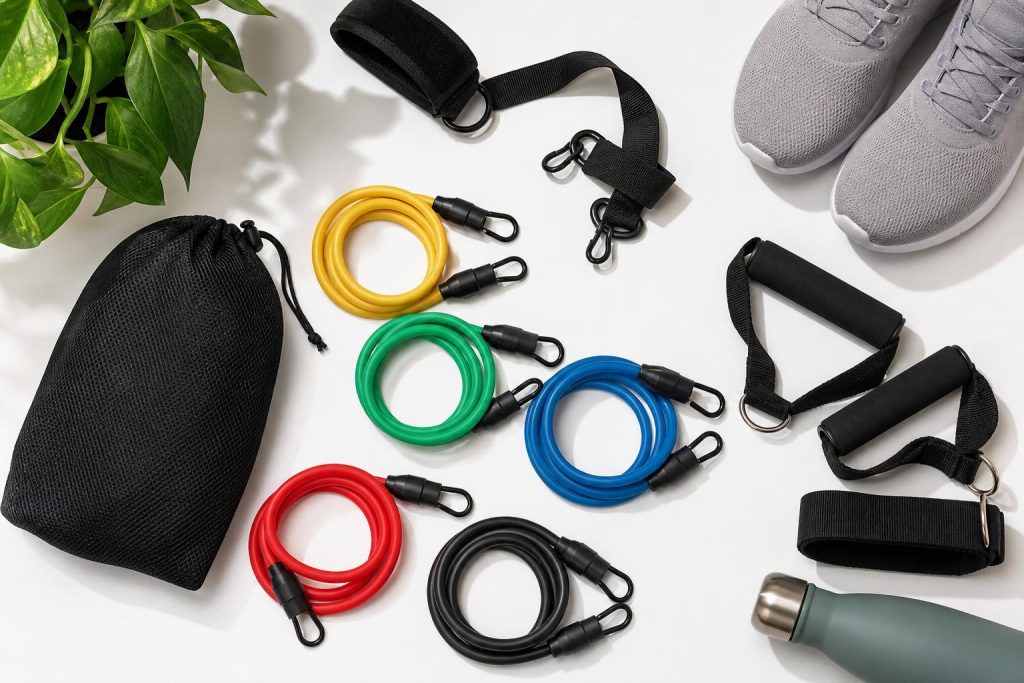
The critical variable is band selection. Most men new to elastic resistance underestimate how much tension they need and buy bands that are too light to create a meaningful training stimulus. A practical recommendation: invest in a set that includes at least three resistance levels — light (10–25 lbs equivalent), medium (30–50 lbs), and heavy (50–80 lbs). Several well-reviewed sets on the market, including fabric hip bands and stackable tube sets with handles, allow you to combine bands to increase tension as your strength improves. This is how you build progressive overload into a home system.
For men on GLP-1 medications specifically, one practical consideration worth noting is timing. These medications can significantly reduce appetite and occasionally cause mild nausea, particularly in the early weeks of use. Training in a fully fasted state during this period may not be optimal. A small protein-containing meal or shake — 20 to 30 grams of protein — consumed 60 to 90 minutes before training can support muscle protein synthesis without conflicting with the medication’s effects. Research consistently shows that pre-exercise protein intake enhances the anabolic response to resistance training, regardless of the broader dietary approach.
Protein targets during any fat loss phase should not be allowed to slip. A minimum of 1.6 grams per kilogram of body weight daily — and ideally closer to 2.0 to 2.2 grams per kilogram — is supported by current evidence in the British Journal of Sports Medicine as the threshold needed to preserve lean mass during a deficit. If appetite is suppressed, prioritizing protein at every meal before other macronutrients is the simplest practical strategy to hit that number.
The Takeaway
Resistance bands are not a compromise. Used with intent, progressive overload, and adequate protein, they represent a legitimate and accessible tool for men who want to lose fat without sacrificing the muscle they’ve built — or the muscle they’re trying to build for the first time. The gym is one path. Your living room, a set of quality bands, and a consistent three-day-per-week commitment is another. Both paths lead to the same outcome when the training principle is sound: your body gets a reason to hold on to muscle while it burns through fat. That is exactly the adaptation you are after.