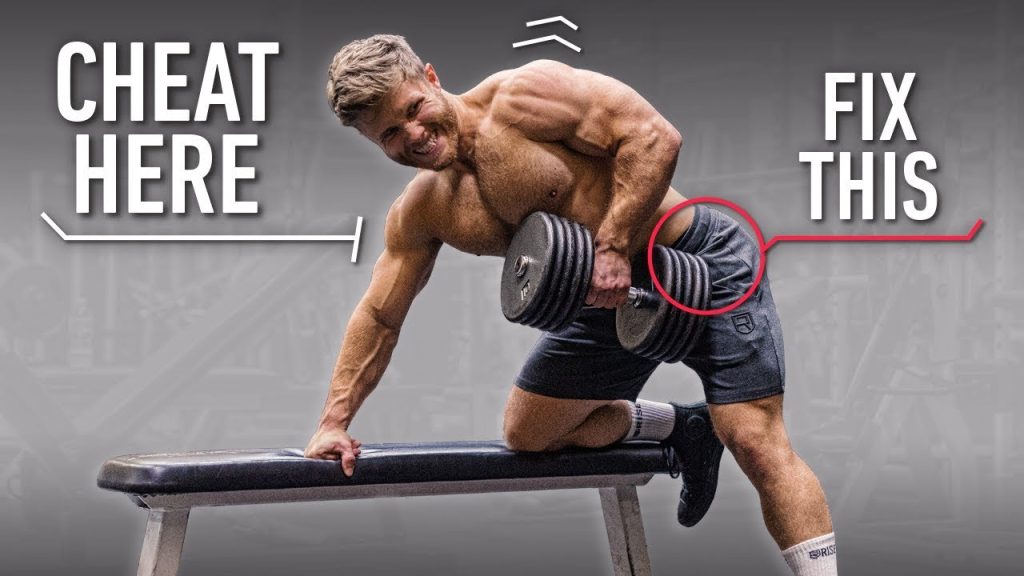
Video by Jeff Nippard on YouTube
Most men in the gym are leaving serious muscle on the table every time they row. Not because they’re skipping the exercise — but because the way they’re executing it is quietly undermining their results. A 2021 study published in the Journal of Strength and Conditioning Research confirmed that exercise technique directly influences which muscle fibers are recruited and the degree of mechanical tension applied to target tissue — and for compound pulling movements like the dumbbell row, small deviations in setup and execution can shift the load away from the lats entirely and onto the biceps, traps, or even the lower spine. That’s a problem if your goal is a thicker, stronger back.
The dumbbell row is one of the most effective unilateral exercises ever developed for building the latissimus dorsi, rhomboids, rear deltoids, and the deep stabilizers of the thoracic spine. It requires no barbell, no cable machine, and minimal space — making it genuinely accessible regardless of whether you’re training in a commercial gym, a garage setup, or a hotel room. And yet, despite its simplicity, it’s routinely performed with momentum, poor scapular mechanics, and loading that the target muscles never actually control. The result: accumulated training volume that doesn’t translate into muscle or strength.
Whether you’re trying to add mass, maintain the muscle you’ve built during a fat loss phase, or simply train smarter as you age, understanding the biomechanics of the dumbbell row gives you a real edge. Let’s get into exactly how this exercise should be performed, what the research says about why it works, and how to make it a cornerstone of your training for the long term.
The Biomechanics Behind a Proper Dumbbell Row
To row effectively, you need to understand what you’re actually asking your muscles to do. The primary mover in a dumbbell row is the latissimus dorsi — the large, fan-shaped muscle that originates along the thoracic and lumbar vertebrae and inserts into the humerus. Its job is to extend, adduct, and internally rotate the shoulder. During a row, the lat is responsible for pulling the upper arm back and down toward the hip — not simply bending the elbow. This distinction is crucial, and it’s what separates a lat-dominant row from a bicep-dominant one.
Supporting the lat are the rhomboids and middle trapezius, which retract the scapula at the top of the movement, and the teres major, which assists in shoulder extension. The rear deltoid contributes significantly when the elbow travels wide, and the erector spinae work isometrically to maintain spinal position throughout. EMG research on back exercises has shown that the dumbbell row produces high levels of lat activation — often superior to pulldowns when performed through a full range of motion with controlled mechanics.
Setup is where most technique problems begin. For the classic single-arm dumbbell row, place your supporting knee and hand on a flat bench, allowing your torso to become roughly parallel to the floor — or even slightly angled below horizontal if your mobility allows. Your spine should be neutral, not rounded at the thoracic or lumbar segments. Let the working arm hang fully extended at the bottom before initiating the pull. This full stretch is not optional: it’s where the lat reaches its most lengthened position, and recent research on muscle hypertrophy has made a compelling case that training muscles through their stretched range drives significantly greater growth stimulus compared to shortened-range training. Many lifters rush through the bottom of the row and never actually load the lat in the position where it can grow the most.
From that fully extended starting position, initiate the pull by depressing and retracting the scapula first — think of it as pulling your shoulder blade down and back before your elbow ever bends. This cue alone dramatically changes which muscles take ownership of the movement. Once the scapula has set, drive your elbow back and toward your hip, not straight up toward the ceiling. The elbow path matters: rowing toward the hip keeps the lat dominant; rowing straight up externally rotates the shoulder and recruits more rear delt and trap. Both have merit, but if lat thickness is your goal, the hip-directed pull is your move. At the top of the rep, pause briefly with the shoulder blade fully retracted — this moment of peak contraction is where the rhomboids and mid-traps do their most meaningful work, and skipping it by immediately lowering the weight is another common error that costs real muscle stimulus.
Lower the dumbbell under control, resisting gravity through the eccentric phase. Research on eccentric muscle contractions consistently shows that the lowering phase generates significant mechanical tension and muscle damage — both of which are key drivers of hypertrophy. A controlled three-second descent is a practical target. Once you reach full extension again, allow a moment of passive stretch before initiating the next rep. This loading in the lengthened position, repeated set after set, is what builds the kind of back thickness that actually shows up in the mirror and contributes to real-world pulling strength.
Why Back Muscle Matters More Than Most Men Realize
The back is the largest muscle group in the upper body, and it plays a structural role that goes far beyond aesthetics. The muscles of the posterior chain — lats, rhomboids, traps, erectors — are critical for postural health, shoulder stability, injury prevention, and metabolic function. More skeletal muscle mass generally correlates with better insulin sensitivity, improved resting metabolic rate, and greater functional capacity as men age. Research published in the American Journal of Clinical Nutrition has linked higher muscle mass to reduced all-cause mortality risk in men, independent of body fat levels — meaning the muscle you build and preserve is doing metabolic and longevity work that goes well beyond how you look in a shirt.
For men in a caloric deficit — whether through traditional dieting, a structured nutrition protocol, or GLP-1 medication-assisted fat loss — back training takes on added importance. Losing weight without preserving lean mass is a metabolic liability. Studies on resistance exercise during caloric restriction have consistently shown that progressive strength training — particularly compound movements that load large muscle groups — significantly attenuates muscle loss during weight loss phases. The dumbbell row, performed with proper load and technique, checks every box: it’s compound, it loads the largest muscles in the upper body, it’s scalable, and it can be progressed over time.
There’s also a structural case to be made. Modern life tilts most men into anterior-dominant postures — hours at a desk, behind a steering wheel, or hunched over a phone. The result is chronically shortened pectorals, internally rotated shoulders, and underactivated posterior chain muscles. This isn’t just a cosmetic issue. Research has associated thoracic kyphosis and poor scapular mechanics with elevated rates of shoulder impingement and rotator cuff pathology in men. Rows — done correctly — directly counteract this pattern by strengthening the retractors and external rotators of the shoulder, reinforcing the postural positions the body needs to stay pain-free and functional across decades of training.
The unilateral nature of the dumbbell row provides an additional benefit that bilateral rowing variations can’t fully replicate. Because each arm works independently, the movement helps identify and correct strength asymmetries between sides. Most men have a dominant side that unconsciously takes over during bilateral exercises, leading to one-sided strength imbalances that can contribute to joint stress and movement dysfunction over time. Training each side independently with a dumbbell forces the weaker side to do its own work without compensation, gradually correcting imbalances and building more symmetrical strength. This is particularly relevant for men returning from shoulder, elbow, or wrist injuries where one limb has been immobilized or underused.
Programming, Loading, and Making Progress Over Time
Knowing the technique is only useful if it’s embedded in a training approach that actually produces results. The dumbbell row is versatile enough to fit into almost any programming framework — whether you’re running a push-pull-legs split, an upper-lower program, or full-body sessions multiple times per week. In most well-structured programs for muscle building or muscle preservation during fat loss, you’d want to hit horizontal pulling movements two to three times per week, with adequate volume per session.
Volume and intensity targets should be guided by your training goal. For hypertrophy, evidence-based recommendations generally support ten to twenty sets per muscle group per week, with sets performed in the six to fifteen rep range taken close to muscular failure — meaning one to three reps shy of the point where technique would break down. For the dumbbell row, this translates practically to three to four working sets of eight to twelve reps per arm, using a load that genuinely challenges you in the final two reps. If you can cruise through twelve reps without effort, the weight is too light to drive a meaningful adaptation.
For muscle preservation during a caloric deficit, the prescription doesn’t change dramatically — the key is maintaining intensity even as total volume might decrease slightly due to recovery constraints. What changes the outcome most is keeping the load challenging and the technique precise. Dropping to lighter weights with sloppy form during a fat loss phase is how men lose muscle: the stimulus disappears, protein synthesis signals drop, and the body has no biological reason to preserve expensive tissue. Keeping weights heavy and rows technically sound sends the signal that the muscle is still necessary.
Progressive overload is the engine of long-term improvement. This doesn’t mean adding weight every single session — that’s not a sustainable model. It means finding systematic ways to increase the demand on the muscle over time. You can progress by adding load, adding reps within a rep range, adding a set, decreasing rest time, or improving the quality of each rep — slowing the eccentric, pausing at full stretch, achieving deeper scapular retraction at the top. All of these represent meaningful progress even when the dumbbell weight stays the same. Tracking your sets, reps, and loads is non-negotiable if you want objective evidence of whether you’re actually moving forward or just going through the motions.
Grip can also be a limiting factor. When the dumbbell weight exceeds what your grip can comfortably control for the target rep range, the forearms and biceps fatigue before the back does — and the entire movement becomes a grip exercise rather than a lat exercise. Lifting straps are a practical solution here, and using them is not a sign of weakness. Research on grip augmentation tools supports their use for exercises where grip is genuinely the limiting factor rather than the target muscle. Straps allow you to use appropriate loading for the back without your grip being the ceiling. Train your grip separately if it’s a weak point — farmer carries, dead hangs, and plate pinches — but don’t let it cap your back development in the meantime.
Rest periods matter more than most men give them credit for. For compound strength work in the four to six rep range, three to four minutes between sets allows adequate phosphocreatine resynthesis and neuromuscular recovery. For hypertrophy-focused rows in the eight to twelve rep range, two to three minutes is a practical target. Cutting rest too short — which is common in gym environments where equipment is shared or time feels limited — blunts force output in subsequent sets and reduces the total mechanical tension accumulated over the session. It’s a subtle form of undertraining that compounds over weeks and months.
The Takeaway
The dumbbell row is not a complicated exercise, but it is a deeply technical one — and the gap between doing it and doing it correctly is where most men’s back development stalls. Full range of motion, a neutral spine, scapular engagement before elbow movement, an elbow path directed toward the hip, a paused contraction at the top, and a controlled eccentric back to full stretch: these are not arbitrary coaching cues. They’re biomechanically grounded instructions for maximally loading the muscles you’re trying to build and preserve.
Whether you’re actively cutting body fat, building mass in a surplus, maintaining muscle through a busy stretch of life, or simply trying to move better and stay injury-free for decades — the dumbbell row, executed with intention and progressed consistently, delivers. It’s one of the most return-rich exercises you can put in your program. The research supports it. The physiology supports it. Now the only variable is whether you’re actually doing it right.