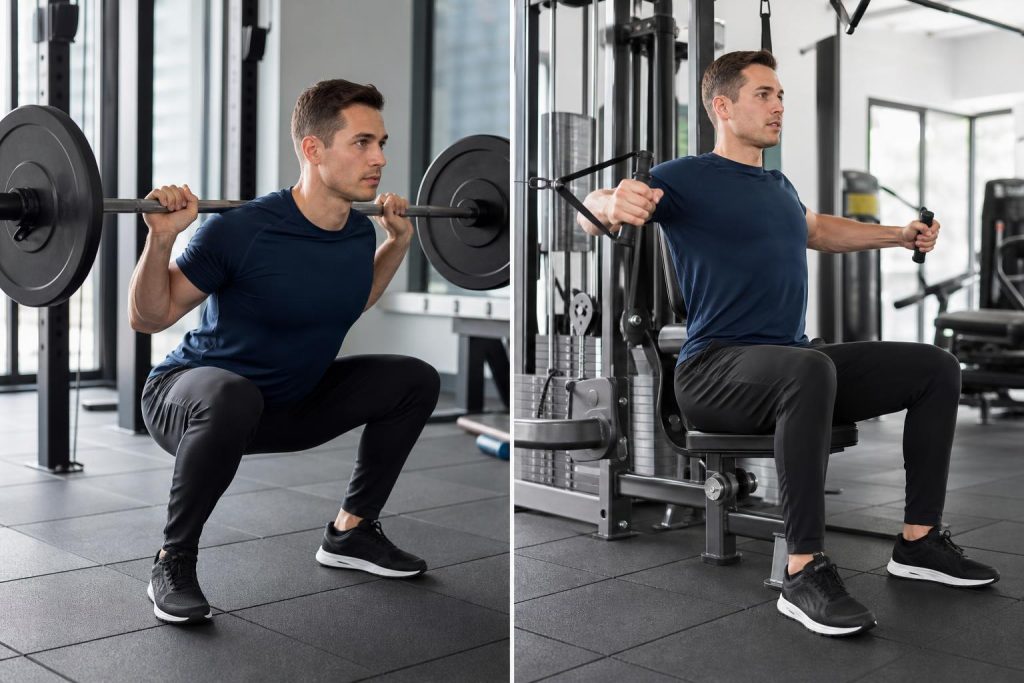
Here’s a number worth knowing: a single set of barbell squats activates over 200 muscles simultaneously, triggering a hormonal response that a leg extension machine simply cannot replicate. Research published in the Journal of Strength and Conditioning Research confirmed that multi-joint compound movements produce significantly greater acute testosterone and growth hormone responses compared to single-joint isolation exercises — and that hormonal spike matters enormously for fat loss, muscle growth, and long-term metabolic health. Yet walk into any commercial gym and you’ll watch the majority of men migrate straight to the cable machines and dumbbell curls, bypassing the squat rack entirely. Understanding why that’s a strategic mistake — and knowing exactly when isolation work actually earns its place — is one of the most valuable things you can do for your training.
This isn’t a debate about which exercise type is “better.” Both compound and isolation movements have a role in a well-designed program. The real question is how to weight that balance based on your goals, your recovery capacity, and where you are in your fitness journey. Whether you’re chasing fat loss, trying to build or preserve muscle, improving your metabolic health, or working through a body recomposition phase, understanding the physiology behind each approach will make every hour you spend in the gym more effective.
Why Compound Movements Are the Foundation of Any Serious Program
Compound exercises — squats, deadlifts, bench press, overhead press, pull-ups, barbell rows — are defined by their recruitment of multiple muscle groups and joints working together. That coordinated demand is exactly what makes them so metabolically expensive and hormonally powerful. When you pull a loaded barbell from the floor, your posterior chain, core, grip, and upper back are all contributing. You’re not just building strength in one area; you’re building systemic capacity.
From a fat loss standpoint, this matters more than most men realize. A study in the Journal of Applied Physiology demonstrated that resistance training increases resting metabolic rate for up to 72 hours post-exercise through a mechanism called excess post-exercise oxygen consumption, or EPOC. Compound lifts, by virtue of the sheer volume of muscle tissue they engage, generate a substantially greater EPOC effect than isolation movements performed at equivalent perceived effort. In practical terms, a workout built around deadlifts and squats keeps your metabolism elevated long after you’ve left the gym — a leg press and hamstring curl session does not produce the same effect.
There’s also the question of anabolic hormone release. Research from William Kraemer’s lab at the University of Connecticut showed that large multi-joint exercises elicit significantly higher acute elevations in testosterone, growth hormone, and IGF-1 compared to smaller isolation movements. These hormones don’t just build muscle — they support fat oxidation, bone density, cardiovascular health, and even cognitive function. This is why men who prioritize compound lifting tend to experience systemic improvements in body composition rather than just localized muscle development.
For men on GLP-1 medications like semaglutide or tirzepatide, this hormonal and metabolic dimension becomes especially relevant. GLP-1 receptor agonists suppress appetite aggressively, which creates a caloric deficit that can accelerate fat loss but also accelerates muscle loss if training is inadequate. A 2023 analysis in Diabetes Care noted that a meaningful proportion of weight lost on GLP-1 medications can come from lean mass rather than fat alone — which is precisely why compound, heavy resistance training should be a non-negotiable part of any GLP-1 protocol. The progressive mechanical tension from compound lifts is the most potent stimulus for muscle protein synthesis, and protein synthesis is your primary defense against muscle loss during aggressive caloric restriction.
For men not on any medication, the logic is identical. If you’re eating at a deficit to lose fat, or even maintaining calories while trying to recomp, compound movements provide the training stimulus that signals to your body that lean mass must be preserved. Without that signal, caloric restriction alone often results in a loss of both fat and muscle — leaving you lighter but not necessarily leaner or healthier in any meaningful functional sense.
Where Isolation Exercises Earn Their Place
Dismissing isolation exercises entirely is a mistake that leaves real gains on the table. The critical distinction is this: isolation movements are a complement to compound training, not a replacement for it. Once the foundation of your session is built around multi-joint lifts, targeted isolation work can correct weaknesses, improve joint health, accelerate hypertrophy in lagging muscle groups, and serve as effective accessory volume without taxing your central nervous system.
A meta-analysis in the Journal of Strength and Conditioning Research examining muscle activation patterns found that isolation exercises produce superior activation in specific target muscles compared to compound alternatives — which is useful for deliberate hypertrophy work. If a man has underdeveloped rear deltoids contributing to shoulder instability and poor posture, no amount of bench pressing will fully address that. Targeted rear delt flies will. If someone’s biceps aren’t keeping pace with their pulling strength, dedicated curl work — added after compound rows and pull-ups — fills that gap intelligently.
Isolation exercises also serve an important role in injury rehabilitation and prevention. A lifter recovering from a knee injury may not tolerate heavy squats, but can safely perform leg extensions and terminal knee extensions to rebuild quad strength and improve joint stability — creating a path back to compound loading. Similarly, men dealing with lower back sensitivity can maintain upper body development through isolation movements while addressing the underlying issue, rather than abandoning training entirely.
The mistake most men make isn’t doing isolation exercises — it’s leading with them. Starting a workout with three sets of preacher curls before getting to rows and pull-ups is putting the cart before the horse. Your central nervous system, your anabolic hormonal window, and your energy stores are all finite resources. Spend them first on the movements that generate the greatest systemic return, then use isolation work to target specific areas once the primary stimulus has been delivered.
There’s also a practical recovery argument. Research on training volume and muscle protein synthesis suggests that approaching 10–20 weekly sets per muscle group is associated with meaningful hypertrophy in trained individuals. Compound movements accumulate volume across multiple muscle groups simultaneously, making it easier to reach those thresholds without excessive workout duration. A man doing three sets of squats, three sets of Romanian deadlifts, and two sets of leg press has already accumulated significant quad, hamstring, and glute volume — a few sets of leg curls and leg extensions can then bring up any lagging areas without adding an hour to his training session.
Building the Optimal Program: How to Structure Both for Maximum Results
The most effective training programs for men — regardless of whether they’re cutting fat, building muscle, or both — follow a principle that exercise scientists sometimes call the compound-to-isolation progression. Every session should be anchored by one or two primary compound lifts performed when you are freshest, followed by secondary compound movements, and then isolation work added strategically based on individual weak points or hypertrophy priorities.
For a man focused primarily on fat loss and metabolic health, three to four sessions per week built around full-body or upper-lower compound splits will deliver the greatest metabolic benefit. Think squat or deadlift pattern, a horizontal push, a horizontal pull, and a vertical push or pull — that framework hits every major muscle group with meaningful loading and generates the hormonal environment that compounds fat loss between sessions. Isolation work here can be kept brief: one or two exercises per session targeting areas you want to bring up, or movements that support joint health and injury prevention.
For a man prioritizing hypertrophy — adding meaningful muscle mass — the programming shifts slightly. Brad Schoenfeld’s seminal research on hypertrophy mechanisms identifies mechanical tension, metabolic stress, and muscle damage as the three primary drivers of muscle growth. Compound movements dominate the mechanical tension category. Isolation movements, particularly those performed with controlled eccentrics and at longer muscle lengths, contribute disproportionately to metabolic stress and muscle damage — meaning a hypertrophy-focused lifter genuinely benefits from more isolation volume than someone purely chasing fat loss or strength.
A practical example: a chest day for a hypertrophy-focused man might open with four sets of barbell bench press (the primary compound stimulus), move to incline dumbbell press (secondary compound), and close with cable flyes and chest-supported pec dec work (isolation for metabolic stress and stretch-mediated hypertrophy). Each category is earning its place with a specific physiological purpose — nothing is filler, and nothing is prioritized over the compound foundation.
For men using GLP-1 medications specifically, protein intake becomes a critical complement to this training structure. Research consistently supports that protein intakes of 1.6 to 2.2 grams per kilogram of body weight are necessary to maximize muscle protein synthesis during resistance training — and this target becomes harder to hit when appetite is pharmacologically suppressed. Prioritizing protein-dense foods and potentially using a high-quality protein supplement helps bridge that gap. The training structure described above ensures the mechanical stimulus for muscle retention is present; adequate protein ensures the raw material for repair and growth is available.
What This Means For You
The compound versus isolation debate resolves itself cleanly once you understand what each tool actually does. Compound movements are the engine of any serious program — they build the hormonal environment, the metabolic capacity, and the functional strength that transforms body composition at a systemic level. Isolation movements are precision instruments — valuable for addressing specific weaknesses, adding targeted volume, and optimizing aesthetics once the foundation is in place.
If you walk into your next session and flip the order — if you choose the squat rack over the leg press, the barbell row over the cable pulldown, the overhead press over the lateral raise — you will get more from every hour you invest. Build your training around movements that demand something significant from your entire body. Use isolation exercises intelligently to address what compound movements leave behind. Do that consistently, eat enough protein, and you’ll build a physique and a metabolism that reflects the quality of the work — regardless of what else you’re doing to support your health.