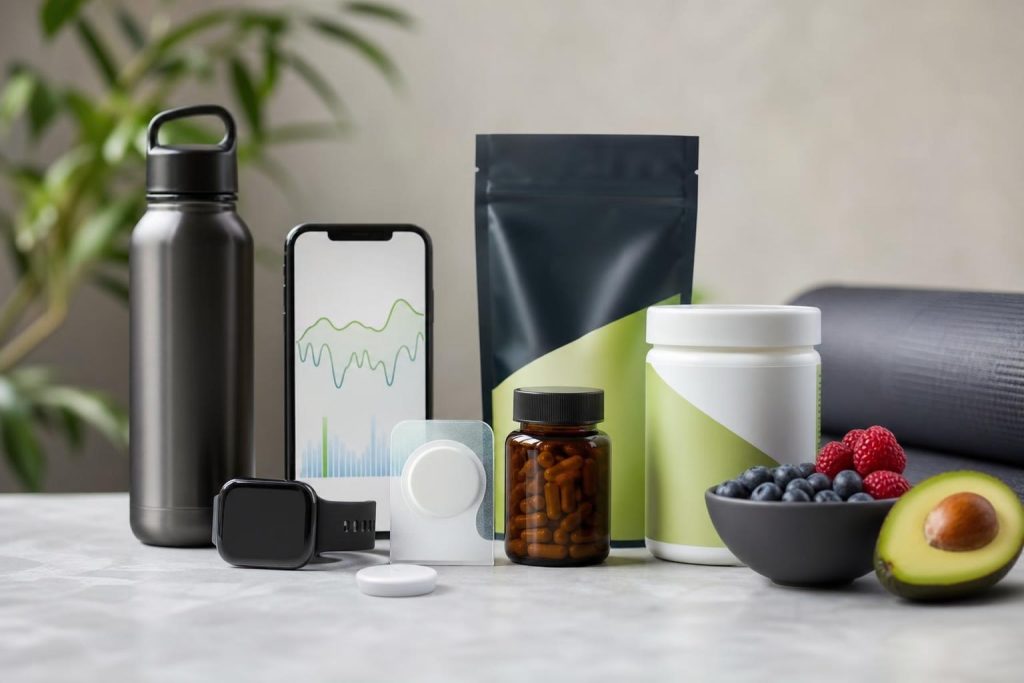
Here is a number that should get your attention: in a 2023 study published in Diabetes Care, researchers found that individuals who used continuous glucose monitors alongside lifestyle interventions reduced their time in hyperglycemia by more than 50% compared to those relying on standard self-monitoring. That is not a marginal gain — that is a fundamental shift in how the body is managed, informed, and optimized. And the technology behind it is now smaller than a quarter, lasts up to two weeks, and requires no fingersticks.
Continuous glucose monitors — CGMs — were once the exclusive domain of type 1 diabetics managing insulin doses in real time. That world has changed dramatically. Today, men on GLP-1 receptor agonists like semaglutide or tirzepatide are using CGMs to understand how their medication interacts with food. Men doing aggressive fat loss protocols are wearing them to eliminate glucose-spiking foods that stall progress. Athletes are using them to time carbohydrates around training windows. And men who simply want to know what is actually happening inside their bodies after every meal are strapping them on for the first time and being genuinely surprised by what they find.
This guide covers what CGMs are, why glucose data matters far beyond diabetes management, which devices are worth your money, and how to use the data intelligently — whether you are on a GLP-1 medication, eating keto, training hard, or just trying to understand your metabolic health for the first time.
Why Glucose Monitoring Matters for Metabolic Health — With or Without a Prescription
Blood glucose is not just a diabetic concern. It is one of the most informative real-time signals your body produces, and most men are flying completely blind on it. A fasting glucose measurement at your annual physical tells you almost nothing about how your body actually handles food across a full day. It is like checking a single frame of a film and believing you understand the plot.
What CGM data reveals is the full metabolic story — the peaks, the valleys, the duration of elevations, and the recovery patterns after meals. Research published in Nature Medicine demonstrated that even among people with normal fasting glucose levels, postprandial glucose responses varied enormously between individuals eating identical foods. Two men eating the same bowl of rice could have completely different glucose curves — one barely registering a spike, the other hitting pre-diabetic ranges for ninety minutes. CGM makes that visible. Without it, you are guessing.
This matters for fat loss because elevated and chronically fluctuating blood glucose drives insulin secretion, and sustained hyperinsulinemia inhibits lipolysis — the breakdown of fat for fuel. Studies have shown that glycemic variability, independent of average glucose levels, is associated with increased oxidative stress and inflammation — both of which directly impair body composition and recovery. If you are trying to lose fat and your glucose is swinging wildly after every meal, your hormonal environment is working against you.
For men on GLP-1 receptor agonists specifically, CGM provides an invaluable feedback loop. Drugs like semaglutide and tirzepatide work in part by slowing gastric emptying and stimulating glucose-dependent insulin secretion, meaning the glucose response to food is blunted compared to baseline. Clinical data shows that GLP-1 users experience significantly reduced postprandial glucose excursions, but the magnitude varies considerably depending on dietary choices, injection timing, and individual physiology. Wearing a CGM while on a GLP-1 lets you see exactly where your medication is working and where your food choices are undermining it.
But again — you do not need a GLP-1 prescription to benefit from this data. The men getting the most actionable value from CGM right now are often the ones who are metabolically healthy on paper but chronically frustrated with fat loss plateaus, energy crashes, or poor sleep. The monitor does not lie. When you see a 180 mg/dL spike after what you believed was a clean meal, the feedback is immediate and impossible to rationalize away.
The Best CGMs Available Right Now — What to Know Before You Buy
The consumer CGM market has matured significantly, and there are now several strong options depending on your goals, budget, and whether you have a clinical reason for monitoring or are pursuing it purely for optimization.
The Dexcom G7 is widely regarded as the gold standard for accuracy and real-time data. It offers a 10-day wear window, integrates seamlessly with Apple Health and Android platforms, and delivers readings every five minutes with an impressively low mean absolute relative difference (MARD) — a technical measure of sensor accuracy — of approximately 8.2%, validated in peer-reviewed clinical studies. For men on GLP-1 medications who are being clinically monitored, or for anyone managing actual glycemic dysfunction, Dexcom G7 is the benchmark. It requires a prescription in the United States, though that is increasingly easy to obtain through telehealth platforms.
The Abbott FreeStyle Libre 3 is the most accessible option and has become enormously popular for metabolic optimization use. It delivers continuous readings to your smartphone, has a 14-day sensor life, and is available over-the-counter in many markets. Its MARD of around 7.9% in clinical testing makes it highly competitive with Dexcom on accuracy, and its smaller sensor footprint appeals to men who are active and do not want a bulky device during training. Abbott has also made significant software improvements, and the companion app is genuinely useful for identifying trends over time.
The Stelo by Dexcom launched in 2024 as the first FDA-cleared over-the-counter CGM specifically designed for non-diabetic users — a significant milestone. It does not require a prescription, costs less than clinical-grade Dexcom sensors, and is purpose-built for the metabolic health and wellness market. For men who are metabolically healthy and want glucose data primarily for lifestyle optimization, Stelo is a logical entry point. It caps readings at 250 mg/dL, which is appropriate for non-diabetic use, and lacks some of the urgent alert features of clinical devices — which is fine if you are not managing actual insulin-dependent disease.
The Nutrisense CGM program sits in a different category — it is not just a device but a service that pairs continuous glucose monitoring with registered dietitian coaching. For men who want guided interpretation of their data and personalized nutrition recommendations based on their glucose patterns, Nutrisense offers something the hardware alone cannot provide: expert context. The program uses FreeStyle Libre sensors and layers professional guidance and a strong app experience on top of the raw data. If you are new to CGM and find the data overwhelming without interpretation, this is worth the premium.
For men who are already training hard and want to optimize carbohydrate timing around workouts, the Supersapiens platform — which uses Abbott’s Libre Sense sensor — was purpose-built for athletes. It integrates directly with Garmin devices, provides glucose data during exercise, and is framed entirely around performance optimization rather than disease management. If your primary goal is improving training, recovery, and fueling efficiency rather than general metabolic health, Supersapiens fills a specific and compelling niche.
Placement matters more than most men expect. All current CGMs are worn on the back of the upper arm. The adhesive patches that come standard are adequate for normal activity but will fail during intense sweating or contact sports without reinforcement. Skin-Tac adhesive wipes and third-party overlay patches are inexpensive solutions that dramatically extend wear reliability. Hydration also affects accuracy — dehydrated states can skew readings, which is another reason to treat CGM data as trends rather than gospel values on any single reading.
How to Actually Use CGM Data to Change Your Body
Wearing a CGM and staring at a glucose graph without a framework for interpreting it produces anxiety more often than insight. The goal is not to achieve a perfectly flat line — glucose naturally rises after eating, and some elevation is entirely physiological. The goal is to understand your personal response patterns and make targeted adjustments that serve your specific objectives.
A useful starting target for non-diabetic optimization is spending the majority of your day with glucose between 70 and 140 mg/dL, with postprandial peaks ideally staying below 140 mg/dL and returning to baseline within two hours of eating. Research supports this range as associated with lower metabolic risk and better long-term glycemic control. Chronic excursions above 140 mg/dL, even in non-diabetic individuals, correlate with increased cardiovascular risk markers and accelerated glycation — the process by which excess glucose damages proteins and tissues over time.
For fat loss specifically, the practical goal is minimizing the frequency and duration of significant glucose spikes, which in turn reduces compensatory insulin secretion and keeps the metabolic environment more favorable for fat oxidation. This does not mean eliminating carbohydrates — it means understanding which carbohydrate sources, in which portions, generate problematic responses for your specific physiology. Your CGM data will tell you whether white rice at lunch is a problem for you personally, or whether it is the combination of white rice plus a sedentary afternoon that creates the issue. That level of personalization is simply not possible with any dietary framework that does not include real-time feedback.
One of the most practically valuable findings from CGM research is how profoundly exercise timing affects postprandial glucose. Studies have demonstrated that even a brief 10-to-15 minute walk after a meal can blunt glucose peaks by 20 to 30 percent compared to sitting. For men who lift weights regularly, resistance training creates a unique glucose disposal effect through GLUT4 translocation — a mechanism by which muscle contractions drive glucose uptake independent of insulin. This is one reason why men who strength train tend to handle carbohydrates far more efficiently than sedentary men with similar body weights, and CGM makes this effect visible and motivating in real time.
Sleep is another dimension that CGM illuminates in ways that surprise most users. Research has shown that sleep deprivation of even one to two nights significantly impairs glucose tolerance the following day — meaning the same meal you handle perfectly after a good night’s rest can generate a substantially larger spike when you are under-recovered. Seeing this correlation in your own data is a powerful motivator to treat sleep as a metabolic intervention rather than a lifestyle preference.
For men on GLP-1 medications, CGM integration creates a particularly useful feedback system for medication timing and dietary strategy. Many GLP-1 users find that certain foods — particularly refined carbohydrates consumed in larger portions — still generate meaningful glucose excursions even with the medication’s blunting effect. The CGM does not replace clinical guidance, but it gives you data to bring to your prescriber and a real-time way to understand how your food choices interact with your medication’s mechanism. It also helps identify hypoglycemic episodes, which are uncommon but possible, particularly if GLP-1 use coincides with significant caloric restriction or intense exercise.
Protein and fat do not generate meaningful glucose spikes in most individuals — a useful baseline understanding when you are trying to interpret your data. What does spike glucose, often unexpectedly, includes fruit juices, energy drinks marketed as healthy, flavored yogurts with added sugar, oatmeal with dried fruit, and restaurant meals where hidden sugars appear in sauces and marinades. Many men are genuinely shocked to see a CGM response from a post-workout protein shake that contains maltodextrin as a thickener, or from a commercial protein bar with 30 grams of carbohydrates masked by sugar alcohols. The monitor strips away the marketing and shows you the biology.
The Takeaway
Continuous glucose monitoring is not a diabetic technology that has leaked into the wellness space. It is, increasingly, one of the most practical tools available for any man who wants to understand and optimize his metabolic health — regardless of what approach he is taking to get there. Whether you are on a GLP-1, eating low-carb, training for body composition, or simply trying to stop feeling like your energy crashes after lunch, CGM provides the kind of individualized, real-time feedback that no population-level dietary guideline can replicate.
The devices have never been better, more accessible, or more affordable. The data has never been easier to interpret, especially with coaching-integrated platforms that turn raw numbers into actionable nutrition guidance. And the research supporting CGM use beyond clinical diabetes management is growing steadily, anchoring what was once considered biohacker territory firmly in evidence-based practice.
Start with a 30-day trial. Wear the sensor through your normal week — your usual meals, your training sessions, your late nights and your early mornings. Let the data show you where your personal metabolic vulnerabilities actually are, rather than where you assume they might be. Then make the adjustments. The feedback loop is immediate, honest, and in most cases, genuinely transformative for how you approach food and recovery. That is a rare combination in the optimization space, and it is one worth taking seriously.