Semaglutide is doing something genuinely impressive in the metabolic health space. Clinical data confirms it reduces liver fat content by a mean of 3.51%, improves glycemic markers, and drives meaningful weight loss — and a 2023 network meta-analysis published in Frontiers in Endocrinology found semaglutide to be among the most effective GLP-1 receptor agonists for improving ALT levels in men with nonalcoholic fatty liver disease and type 2 diabetes. But here’s what that same research doesn’t address: what happens to your nutritional status when you’re eating significantly less food, moving through nausea, and losing weight rapidly? That gap — between what Ozempic does well and what it leaves unaddressed — is exactly where smart supplementation comes in.
This isn’t a guide about replacing good habits with pills. Nutrition, training, and sleep are always the primary pillars of metabolic health. Ozempic is a tool — a powerful one — but it doesn’t fill micronutrient gaps, preserve muscle tissue on its own, or protect bone density during rapid weight loss. The men getting the best results on semaglutide are the ones treating it like one component of a complete system, not a standalone solution. Whether you’re injecting weekly or simply trying to optimize your health through diet and exercise, the supplementation logic here applies broadly — the dosing and urgency just shifts depending on your situation.
Why Ozempic Changes Your Nutritional Landscape
The mechanism that makes semaglutide effective — slowing gastric emptying, reducing appetite, blunting hunger signals — is the same mechanism that creates nutritional vulnerability. When you’re eating 30 to 50 percent fewer calories than you were before, you’re not just losing fat. You’re also taking in dramatically fewer vitamins, minerals, amino acids, and essential fatty acids. For most men, the first few months on Ozempic involve a learning curve around food volume, protein prioritization, and micronutrient density. Many don’t get it right immediately, and that’s where deficiencies begin to compound.
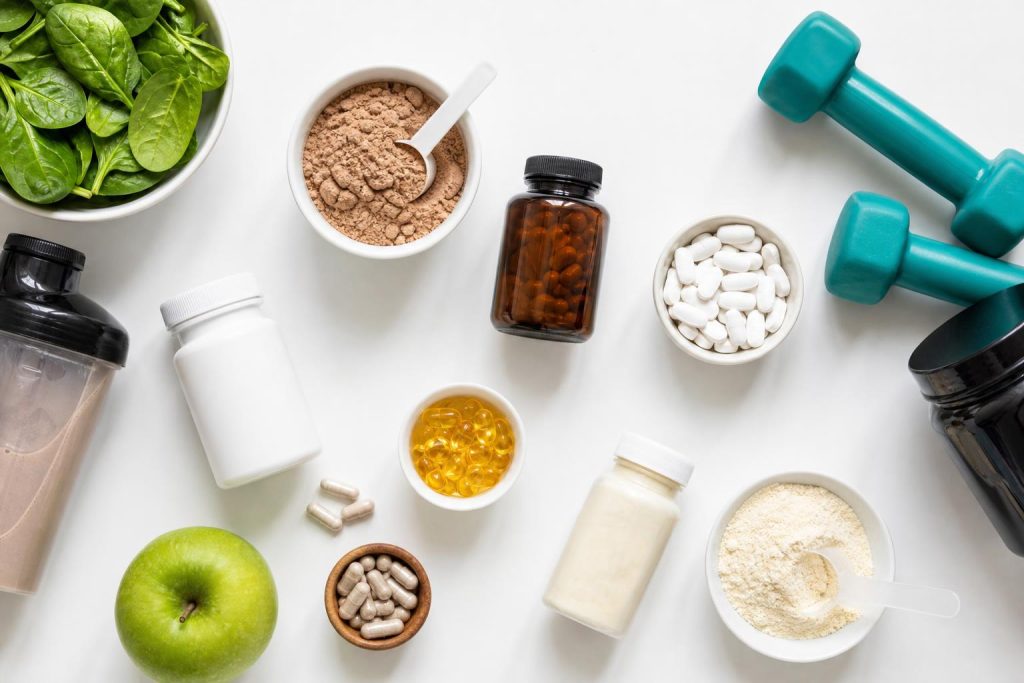
Protein is the most critical issue. The research on GLP-1 receptor agonists and body composition shows that weight lost through caloric restriction — even medically assisted — includes lean mass alongside fat. Preserving that lean mass requires two things working in concert: adequate dietary protein (most clinicians recommend 1.2 to 1.6 grams per kilogram of body weight, often higher for men actively lifting) and resistance training. When appetite suppression makes it difficult to hit protein targets through food alone, supplementing with a high-quality protein powder — whey isolate or a leucine-rich plant blend — becomes a practical and evidence-supported bridge. This applies equally to men who aren’t on GLP-1s but are cutting calories aggressively for fat loss. The muscle-preservation challenge is the same.
Beyond protein, the reduced food intake on Ozempic creates real risk of deficiency in several fat-soluble vitamins, B vitamins, magnesium, zinc, and iron. Nausea — one of the most common side effects, particularly in the titration phase — further limits what men can eat and digest comfortably. This isn’t a theoretical concern. It’s the predictable downstream consequence of significantly restricted eating, and addressing it proactively is far smarter than waiting for symptoms like fatigue, brain fog, cramps, or poor recovery to show up and then backtracking.
The Core Supplements Worth Taking Seriously
A high-quality multivitamin is the logical starting point, and for once, it earns that recommendation without much controversy. On a calorie-restricted diet — whether Ozempic-driven or otherwise — a comprehensive multi fills the gaps that food volume can no longer cover. Look for one that includes meaningful doses of B12, B6, folate, zinc, selenium, and vitamin D rather than nominal amounts that barely register against daily requirements. Men on semaglutide should be especially attentive to B12: GLP-1 medications don’t directly deplete it, but eating less meat, eggs, and dairy — common side effects of appetite suppression — absolutely does. B12 deficiency develops slowly and insidiously, and by the time fatigue or neurological symptoms appear, stores have been low for months.
Vitamin D and magnesium deserve particular attention as a pair. Vitamin D deficiency is already epidemic in men — estimates suggest 40 percent or more of American men are insufficient — and rapid weight loss has been shown to mobilize fat-stored toxins and alter the metabolism of fat-soluble vitamins including D. Most men benefit from 2,000 to 5,000 IU of D3 daily alongside K2 (MK-7 form), which directs calcium toward bone rather than arterial tissue. Magnesium is the cofactor for over 300 enzymatic reactions including insulin signaling, muscle contraction, and sleep regulation. It’s also lost through sweat and stress, and most men aren’t getting remotely enough from food even when eating normally. On a reduced-calorie diet, deficiency is nearly guaranteed. Magnesium glycinate or threonate are the preferred forms — better absorbed and less likely to cause the digestive discomfort associated with magnesium oxide.
Omega-3 fatty acids earned their place in this stack from a different angle. The Frontiers in Endocrinology meta-analysis highlighted semaglutide’s measurable impact on liver health markers — and omega-3s, specifically EPA and DHA from marine sources, have their own robust body of evidence supporting triglyceride reduction, hepatic fat reduction, and systemic anti-inflammatory activity. For men with elevated triglycerides, metabolic syndrome, or early-stage fatty liver changes, adding 2 to 4 grams of combined EPA and DHA daily is a sensible complement to what semaglutide is already doing metabolically. It also supports cardiovascular health and cognitive function — both relevant to men who are making significant body composition changes. Look for a molecularly distilled fish oil with third-party purity testing, or a high-quality algae-based DHA/EPA if you prefer a non-animal source.
Creatine monohydrate is arguably the most underutilized supplement in the GLP-1 conversation. While semaglutide doesn’t cause significant muscle loss on its own beyond what would occur with any caloric deficit, the combination of eating less and moving less during the early adaptation phase creates a real lean mass risk. Creatine is one of the most studied ergogenic compounds in existence — it supports intramuscular phosphocreatine stores, enhances high-intensity performance, aids in muscle recovery, and increasingly, research points to neuroprotective and cognitive benefits as well. A standard dose of 3 to 5 grams daily, taken consistently, is sufficient. No loading phase required. This is relevant whether you’re on semaglutide or simply in a caloric deficit trying to preserve your hard-earned muscle while losing fat — the biology is identical.
Collagen peptides are worth mentioning for men who are losing significant amounts of weight. Rapid fat loss — particularly in men who are significantly overweight — can affect skin elasticity and joint integrity. Collagen provides the amino acid precursors (glycine, proline, hydroxyproline) that support connective tissue remodeling. It’s not a replacement for complete protein, but as a supplement taken alongside vitamin C to enhance collagen synthesis, it addresses a specific concern that becomes more relevant the faster and more substantial the weight loss. It’s a low-risk, high-practicality addition for men experiencing joint discomfort or visible skin changes during their weight loss phase.
Fiber supplementation — specifically psyllium husk or partially hydrolyzed guar gum — rounds out a thoughtful stack for men on Ozempic. The medication slows gastric motility, which combined with reduced food intake often leads to constipation. A soluble fiber supplement taken with adequate water addresses this directly, while simultaneously supporting glycemic control, improving gut microbiome composition, and prolonging satiety. This one supplement solves a common quality-of-life complaint while delivering genuine metabolic benefits. For men not on GLP-1s, fiber supplementation still earns its place: most men consume half or less of the recommended daily fiber intake, and the downstream effects on metabolic health, gut health, and appetite regulation are well-documented.
What to Skip, and What to Watch
The supplement industry will aggressively market fat burners, thermogenics, and appetite suppressants to men on GLP-1 medications — and the logic is obviously backwards. You’re already suppressing appetite pharmacologically. Adding stimulant-based compounds on top of a medication that’s already stressing your cardiovascular system and GI tract is unnecessary at best and counterproductive at worst. Caffeine in moderate amounts through coffee or tea is fine and well-tolerated by most men. But high-dose caffeine supplements, synephrine, or proprietary blends with questionable stimulant cocktails have no place in this stack.
Berberine gets significant attention as a natural GLP-1 pathway activator and insulin sensitizer, and the mechanistic research is genuinely interesting. Some men who are not on semaglutide use it as part of a metabolic support stack with reasonable results. However, men on Ozempic should be cautious about stacking berberine due to additive blood glucose-lowering effects, particularly if they’re also using metformin or insulin. This is a conversation to have with your prescribing physician rather than a self-experiment. Similarly, alpha lipoic acid, which has legitimate antioxidant and insulin-sensitizing effects, can amplify hypoglycemic risk in some patients. These compounds aren’t useless — they’re just context-dependent, and semaglutide changes the context significantly.
Zinc and selenium are worth tracking individually rather than just relying on a multi to cover them. Thyroid function depends heavily on adequate selenium for T3 conversion, and zinc is essential for testosterone synthesis, immune function, and wound healing. Men losing significant weight are at real risk of zinc inadequacy given reduced dietary intake. A standalone zinc picolinate supplement of 15 to 25 mg daily, taken with food, is a reasonable insurance policy — especially for men who were already at the lower end of normal before starting their weight loss journey.
One supplement that deserves more attention in the weight loss conversation is vitamin K2 — specifically MK-7, the long-acting menaquinone form. As body weight drops and dietary calcium absorption shifts, K2 plays a critical role in routing calcium appropriately. Bone mineral density can decrease during rapid weight loss, particularly in older men. Pairing D3 with K2 isn’t just theoretical optimization — it’s prudent insurance against one of the less-discussed risks of aggressive caloric restriction at any age. A dose of 100 to 200 mcg of MK-7 daily alongside D3 is the typical evidence-guided approach.
The Takeaway
Ozempic is a legitimate, well-studied tool for metabolic health — the science on semaglutide’s effects on liver fat, glycemic control, and body weight is compelling. But no medication addresses the nutritional realities of eating significantly less food. The men who get the most out of semaglutide — or any serious fat loss protocol — are the ones who treat their body like a system requiring complete inputs: adequate protein, essential micronutrients, resistance training, quality sleep, and targeted supplementation where food volume falls short.
The core stack for any man navigating significant caloric restriction, whether through GLP-1 support or disciplined dieting, looks like this: a high-quality multivitamin, vitamin D3 with K2, magnesium glycinate, omega-3 fatty acids, creatine monohydrate, and a soluble fiber supplement. Protein powder fills the gap when whole-food protein targets become difficult to hit. Everything else is secondary and should be evaluated against your individual labs, goals, and whatever other medications you’re managing. When in doubt, work with a physician or registered dietitian who understands the metabolic context you’re operating in — the supplement industry doesn’t require that nuance, but your health does.
Scientific References
-
Yuan, Gao, Yang et al. (2023).
Comparing the effectiveness of long-term use of daily and weekly glucagon-like peptide-1 receptor agonists treatments in patients with nonalcoholic fatty liver disease and type 2 diabetes mellitus: a network meta-analysis..
Frontiers in endocrinology.
View on PubMed →