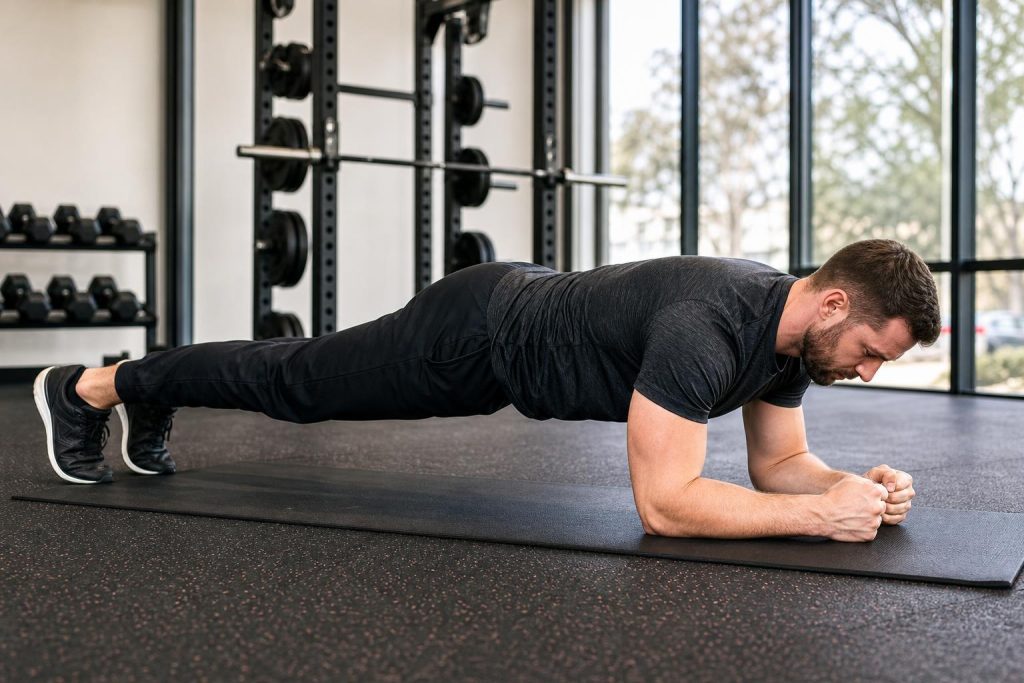
Most men treat the plank like a warm-up afterthought — something to knock out for 30 seconds before the real workout starts. That’s a mistake backed by a fundamental misunderstanding of what the core actually does. Research published in the Journal of Strength and Conditioning Research confirms that core stability — the ability to resist spinal movement under load — is a more accurate predictor of athletic performance and injury prevention than core strength measured in isolation. The plank, when done progressively and with intent, trains exactly that quality. But only if you treat it like the serious training tool it is.
Whether you’re cutting fat, building muscle, recovering from a period of low activity, or managing a metabolic condition like obesity or type 2 diabetes — core stability is foundational to everything. Men on GLP-1 medications like semaglutide or tirzepatide often experience rapid weight loss alongside muscle loss if they’re not actively training. But this same challenge applies to anyone who’s been sedentary, dieting aggressively, or returning from injury. The plank progression isn’t a GLP-1 strategy. It’s a fundamental human performance strategy that pays dividends no matter where you’re starting from.
Why Core Stability Is the Foundation You’ve Been Ignoring
The core isn’t just your abs. It’s a 360-degree system of muscles — including the transverse abdominis, multifidus, internal obliques, pelvic floor, and diaphragm — that work as an integrated unit to transfer force between your upper and lower body. A landmark study by McGill and colleagues demonstrated that individuals with poor lumbar stability generate significantly less power during compound movements and are at substantially higher risk of low back injury. Translation: if your core is weak, your squat, deadlift, and overhead press are all leaving performance on the table — and setting you up for pain down the road.
The static plank gets dismissed because it looks easy. But done correctly — full body tension, neutral spine, posterior pelvic tilt, glutes and quads contracted — a standard plank is a systemic isometric challenge. Electromyography studies show that proper plank execution activates the rectus abdominis, obliques, and erector spinae simultaneously at intensities comparable to many dynamic exercises. The problem isn’t the plank itself — it’s that most men plateau at it and never progress. Duration alone stops being a stimulus after a certain point. The body adapts, and if you’re not adding complexity, you’re not building anything new.
Progressive overload — the same principle that drives muscle growth in the weight room — applies directly to isometric core training. The goal is to systematically increase the demand placed on the stabilization system by manipulating leverage, instability, and movement complexity over time. This is where a structured plank progression becomes genuinely transformative.
Building the Progression: From Foundation to Advanced Stability
Start where your body actually is, not where your ego wants to be. If you can’t hold a perfect plank for 20 to 30 seconds without your hips sagging or your lower back arching, that’s your starting point. Quality beats duration every time. McGill’s research suggests that the optimal training stimulus for spinal endurance comes from multiple shorter sets — think three sets of 10 to 20 seconds — rather than one maximal hold. This approach reduces cumulative compressive load on the lumbar spine while still delivering a robust training signal.
Once you can perform three clean sets of 30 seconds with full tension throughout the body, it’s time to make the plank harder — not longer. The first meaningful progression is the plank with shoulder taps: while maintaining a rigid torso, lift one hand and touch the opposite shoulder, alternating sides. Studies on anti-rotation training consistently show that resisting rotational forces through the core produces significantly greater oblique activation than static holds alone. This single variation bridges the gap between basic stability and functional strength.
From there, the RKC plank — developed by Pavel Tsatsouline and validated in research from Contreras and Schoenfeld — dramatically increases muscular activation by creating full-body irradiation. The setup looks like a standard plank, but you actively try to drag your elbows toward your feet and your feet toward your elbows, squeeze your glutes maximally, and hold that tension. EMG data shows this technique produces nearly double the abdominal muscle activation compared to a standard plank. Ten seconds of RKC-style tension equals far more training stimulus than a minute of lazy holding.
Advanced progressions include the plank to pike, the plank with leg raise, the body saw, and eventually the ab wheel rollout — which research identifies as one of the highest-activating core exercises available, demanding extreme anti-extension strength through the full range of motion. Each step in this hierarchy builds on the last. Skip ahead too fast and you’ll compensate with your lower back. Earn each level and the carryover to every other lift in your program becomes immediately noticeable.
Men who are in a significant caloric deficit — whether through medication, diet, or both — should prioritize keeping training volume and intensity consistent. Research on resistance training during caloric restriction confirms that consistent mechanical loading is the primary signal that tells the body to preserve lean tissue rather than catabolize it. Core training counts as that signal. It doesn’t matter how you’re managing your nutrition — the biology of muscle preservation responds to the same stimulus.
The Takeaway
A plank is only a waste of time if you never evolve it. The progression from basic static hold to RKC tension to loaded anti-extension work represents a genuine strength-building arc — one that directly improves every compound lift, protects the lower back, and builds the kind of deep structural integrity that shows up in how you move, feel, and perform. Build your core like you build everything else: with patience, progressive overload, and respect for the fundamentals. That approach works whether you’re 180 pounds and shredded or 280 pounds and just getting started. The plank doesn’t care about your starting point — only your willingness to progress it.