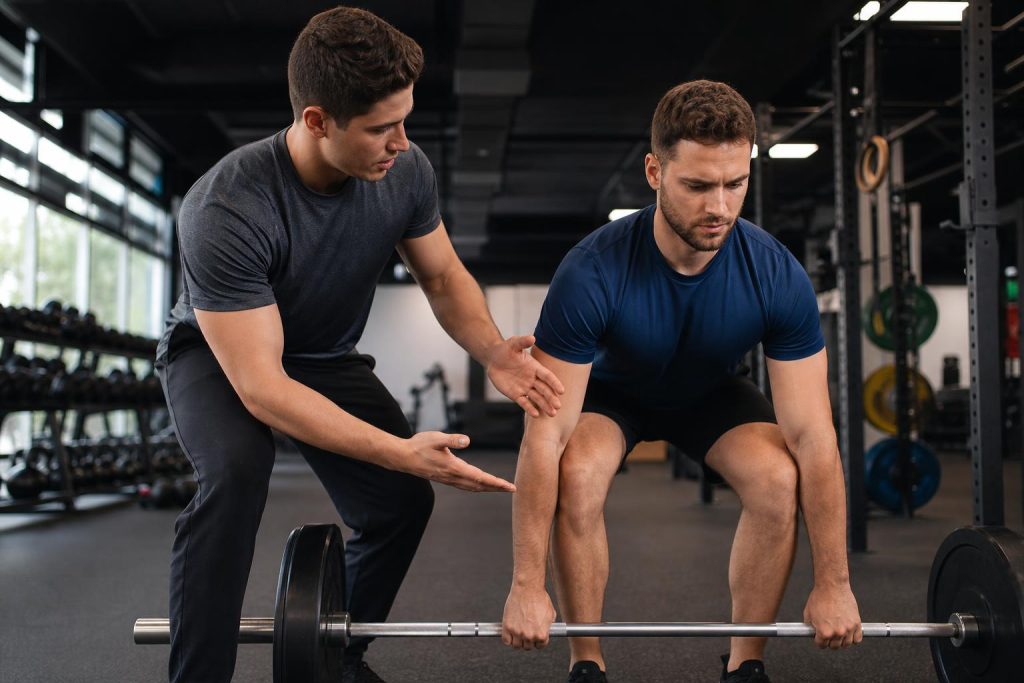
Here’s a number that should change how you think about your workouts: a single set of squats activates over 200 muscles simultaneously, while a leg extension targets roughly one. That difference isn’t just academic — it determines how efficiently you build muscle, burn fat, and preserve your metabolic health, especially when your caloric intake is restricted. Research published in the Journal of Strength and Conditioning Research confirms that multi-joint compound movements produce significantly greater hormonal responses — including testosterone and growth hormone — compared to isolation exercises, making them the most time-efficient tool in any man’s training arsenal.
Whether you’re logging serious hours in the gym, eating clean and lifting heavy, or using a GLP-1 medication like semaglutide or tirzepatide to accelerate fat loss, the compound-versus-isolation question matters enormously. GLP-1 users face a specific challenge: these medications suppress appetite aggressively, which means many men are training on a meaningful caloric deficit. In that context, every rep needs to work harder. But the logic applies universally — when calories are tight, or when time is limited, or when you simply want the best return on effort, your exercise selection becomes a strategic decision, not just a preference.
Why Compound Movements Are the Foundation
Compound exercises — squats, deadlifts, bench press, rows, overhead press, pull-ups — work multiple joints and muscle groups in a single movement pattern. This isn’t just convenient; it’s physiologically superior for most men’s goals. A study in the European Journal of Applied Physiology demonstrated that compound lifts elicit a greater acute anabolic hormonal response than isolation work, which directly supports muscle protein synthesis — the biological process of building and maintaining lean tissue. For men trying to lose fat without sacrificing muscle, this matters at a cellular level.
The metabolic case for compounds is equally strong. Because they recruit more total muscle mass, they burn more calories both during and after training through excess post-exercise oxygen consumption (EPOC). Research in the Journal of Strength and Conditioning Research found that multi-joint exercises produce significantly higher energy expenditure than single-joint movements at equivalent effort levels. For anyone managing body composition — GLP-1 user or not — that thermogenic advantage adds up over weeks and months of consistent training.
There’s also the practical reality of time. Most men don’t have two-hour windows to train every day. A well-constructed compound-focused session — think squat, press, pull, hinge — hits every major muscle group in 45 to 60 minutes. That’s not a compromise; it’s a smart allocation of limited resources.
Where Isolation Work Still Earns Its Place
Dismissing isolation exercises entirely would be a mistake, and that’s true whether you’re a competitive bodybuilder or a guy trying to look better with his shirt off. Isolation movements — curls, tricep extensions, lateral raises, leg curls, cable flyes — allow you to target specific muscles that compound lifts underload, correct imbalances, and accumulate additional volume for lagging body parts without systemically fatiguing the entire nervous system.
A meta-analysis in the Journal of Strength and Conditioning Research found that training volume — total sets multiplied by reps and load — is one of the strongest predictors of muscle hypertrophy. Isolation work is a low-fatigue way to add volume for specific muscles after compound movements have done the heavy lifting. Bicep curls after rows, lateral raises after overhead pressing, leg curls after deadlifts — these additions are additive, not redundant.
For men on GLP-1 medications specifically, there’s another consideration: reduced overall training capacity. Many GLP-1 users report lower energy levels, especially early in treatment. In that scenario, prioritizing compound lifts ensures that even a shortened session produces a meaningful training stimulus. Isolation work gets added back as energy and appetite stabilize. The sequencing matters: compounds first, isolation as a complement, never the other way around.
The practical prescription looks like this. Build your training around three to four compound movements per session, targeting two to three sets each with progressive overload as the constant goal. Add two to three isolation exercises afterward for lagging or high-priority muscle groups. Keep total weekly volume between 10 and 20 sets per muscle group, adjusting downward when in a significant caloric deficit. Evidence from Sports Medicine supports this range as optimal for hypertrophy across training experience levels.
The Takeaway
The compound-versus-isolation debate has a clear answer for most men: it’s not either/or, but it is hierarchical. Compound movements are non-negotiable. They drive the hormonal response, protect lean mass during fat loss, and produce the metabolic output that keeps your body composition moving in the right direction. Isolation work is a valuable supporting actor, not the lead. Build your program around big multi-joint patterns, use isolation to fill the gaps, and apply progressive overload consistently. That approach works whether you’re deep in a GLP-1 protocol, running a clean bulk, or simply trying to show up stronger than you were last month.