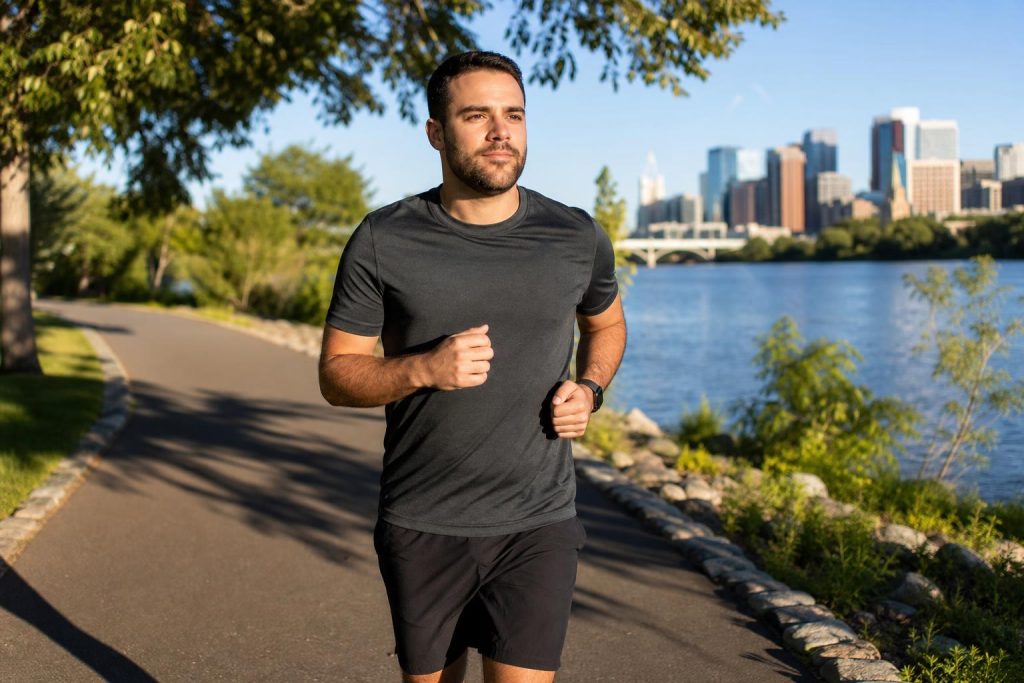
Here’s the uncomfortable truth that most GLP-1 prescribers don’t lead with: stop the drug, and the weight largely comes back. A 2025 meta-analysis published in Cureus quantified exactly how significant this rebound is — semaglutide users regained an average of 5.15 kg after discontinuation, the highest rebound of any anti-obesity agent studied, followed by exenatide at 3.06 kg and liraglutide at 1.50 kg. A separate 2025 meta-analysis in BMC Medicine found that significant weight regain began as early as 8 weeks after stopping anti-obesity medications and persisted through at least 20 weeks. These aren’t edge cases — they’re the expected trajectory when pharmacotherapy ends without a foundation underneath it.
This doesn’t make GLP-1 medications a failure. It means they were never designed to work alone. The men who keep the weight off after stopping — or who are strategically planning their off-ramp — are the ones who treated the medication as a launching pad rather than a finish line. Here’s what the evidence says that looks like in practice.
Why Exercise Changes Everything After You Stop
The most compelling data on post-GLP-1 weight maintenance comes from a 2024 randomized controlled trial published in EClinicalMedicine. Researchers followed participants for a full year after they stopped treatment — comparing those who had used liraglutide alone, supervised exercise alone, or a combination of both. The findings were stark. Participants who combined supervised exercise with liraglutide regained 6.0 kg less over the post-treatment year than those who used liraglutide alone. More strikingly, the exercise-only group maintained their body weight and body composition a full year after stopping — while the liraglutide-only group regained substantially. The combination group was also more than four times more likely to maintain at least 10% of their initial body weight loss compared to the liraglutide-alone group.
What this means practically: if you are currently on a GLP-1 medication and not training with resistance or structured cardiovascular exercise, you are building a house on sand. The drug is suppressing appetite and driving a caloric deficit, but it is not remodeling your metabolism, preserving lean muscle mass, or teaching your body to regulate energy more efficiently on its own. Exercise — particularly resistance training — does all three. It increases resting metabolic rate, improves insulin sensitivity, and builds the muscle tissue that acts as a metabolic buffer when appetite suppression is eventually removed. Men who want to keep the weight off after stopping should be in the gym, consistently, long before their last injection.
Building the Lifestyle Architecture That Outlasts the Prescription
Sustainable weight loss after GLP-1s is fundamentally a behavior and physiology problem, not a willpower problem. The medications work by mimicking a gut hormone that signals satiety to the brain — when they’re gone, hunger hormones largely rebound. That means the dietary habits and food environment you build while on the medication need to be strong enough to function without the pharmacological assist.
Protein intake is the single most important nutritional lever here. High-protein diets preserve lean mass during weight loss and have the strongest evidence for long-term satiety among macronutrients. Aiming for 0.7 to 1.0 grams of protein per pound of body weight daily — through whole food sources like eggs, lean meats, Greek yogurt, and legumes — gives your body the raw material to hold onto muscle even as the appetite suppression fades. This matters enormously because the weight regain data cited above reflects primarily fat mass returning, not muscle — which means men who preserve muscle during their GLP-1 phase have a meaningfully better metabolic baseline to work from afterward.
Sleep and stress management are not optional support structures — they are load-bearing walls. Cortisol dysregulation from poor sleep directly increases appetite, promotes visceral fat storage, and blunts the anabolic response to training. If a man exits his GLP-1 course sleeping five hours a night and managing chronic work stress with alcohol, the physiological deck is stacked against him regardless of how well he trained or ate. Prioritizing seven to nine hours of sleep and developing a genuine stress outlet — whether that’s zone-2 cardio, meditation, or something else entirely — is part of the clinical picture for long-term weight maintenance.
The medications work. The data is not in question. But research consistently shows that weight regain after discontinuation is the default outcome without deliberate lifestyle infrastructure. The men who beat that statistic are the ones who used the medication’s window of reduced appetite to build habits, strength, and metabolic resilience that can stand on their own.
The Takeaway
GLP-1 medications are a powerful tool — one of the most effective pharmacological interventions for obesity ever developed. But the research is unambiguous that stopping them without an exercise habit and a solid nutritional foundation leads to significant weight regain, often within weeks. The goal isn’t to be on these medications forever — it’s to use the window they provide to become someone whose lifestyle supports a healthy weight independently. Start the resistance training before you consider stopping. Lock in your protein targets. Protect your sleep. The drug opened the door; what you build while walking through it determines whether it stays open.
Scientific References
-
Jensen, Blond, Sandsdal et al. (2024).
Healthy weight loss maintenance with exercise, GLP-1 receptor agonist, or both combined followed by one year without treatment: a post-treatment analysis of a randomised placebo-controlled trial..
EClinicalMedicine.
View on PubMed → -
Sioutas, Mualem, Reavey-Cantwell et al. (2025).
GLP-1 Receptor Agonists in Idiopathic Intracranial Hypertension..
JAMA neurology.
View on PubMed → -
Kolli, Aoutla, Jyothi et al. (2025).
Rebound or Retention: A Meta-Analysis of Weight Regain After the Discontinuation of Glucagon-Like Peptide-1 (GLP-1) Receptor Agonists and Other Anti-obesity Drugs..
Cureus.
View on PubMed → -
Wu, Yang, Guo et al. (2025).
Trajectory of the body weight after drug discontinuation in the treatment of anti-obesity medications..
BMC medicine.
View on PubMed → -
Ji, Dong, Li et al. (2021).
Efficacy and safety of once-weekly semaglutide versus once-daily sitagliptin as add-on to metformin in patients with type 2 diabetes in SUSTAIN China: A 30-week, double-blind, phase 3a, randomized trial..
Diabetes, obesity & metabolism.
View on PubMed →