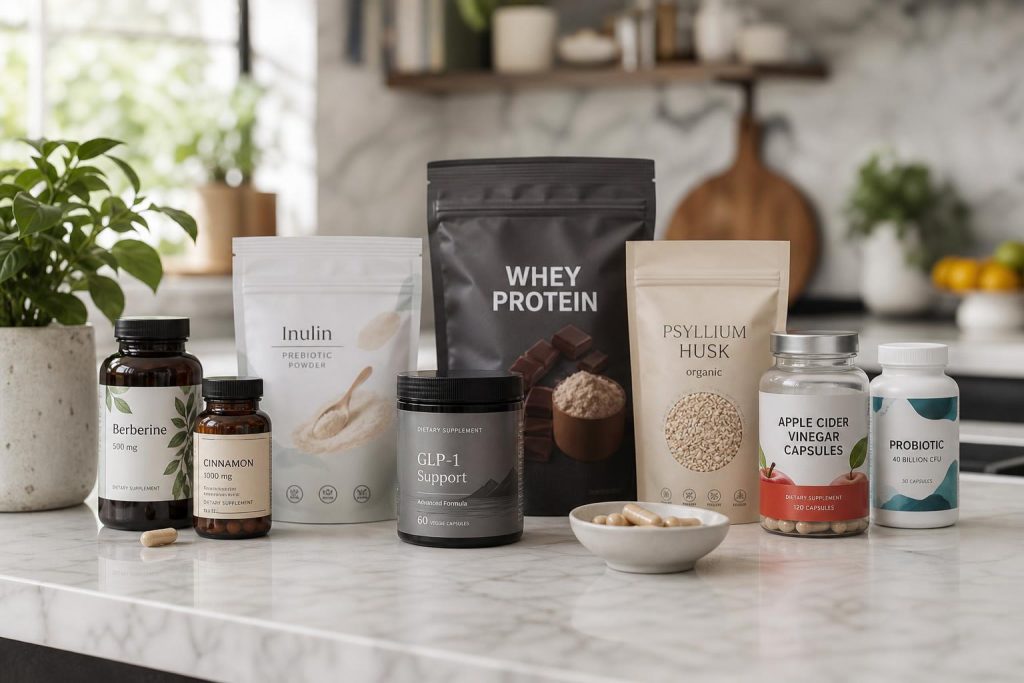
The GLP-1 space has exploded. What started as a conversation about prescription medications like semaglutide and tirzepatide has now spilled into supplement aisles, wellness brands, and Instagram ads promising “natural GLP-1 boosters” that can replicate the effects of these powerful drugs — without a prescription, without injections, and apparently without any of the complicated biology that makes this hormone so difficult to influence from the outside. The claims sound incredible. The science tells a more nuanced story.
GLP-1, or glucagon-like peptide-1, is a hormone your gut produces naturally in response to eating. It signals satiety to your brain, slows gastric emptying, stimulates insulin secretion, and suppresses glucagon — all the mechanisms that make GLP-1 receptor agonist medications so effective for weight loss and metabolic control. The real question isn’t whether natural compounds can influence GLP-1 at all. Some genuinely can. The question is whether any supplement can move the needle in a meaningful, clinically relevant way — and for whom that might actually matter.
What Natural Compounds Can Actually Do to GLP-1
Let’s start with the honest answer: no supplement will replicate the sustained, dramatic GLP-1 receptor activation that pharmaceutical agonists achieve. Semaglutide, for example, is engineered to resist enzymatic degradation, staying active far longer than your body’s native GLP-1, which has a half-life of roughly two minutes. That’s not a gap supplements can close. But that doesn’t mean natural compounds are useless — it means we need to think about them differently.
Berberine has attracted the most legitimate research attention in this category. A study published in Metabolism found that berberine supplementation significantly increased GLP-1 secretion in patients with type 2 diabetes alongside improvements in fasting blood glucose and insulin sensitivity. The mechanism appears to involve activation of L-cells in the gut — the same cells responsible for endogenous GLP-1 release. Importantly, berberine also inhibits DPP-4, the enzyme that degrades GLP-1, which may extend the hormone’s limited active window. It’s not semaglutide. But as a metabolic support compound, the evidence is more robust than most people realize.
Dietary fiber — particularly fermentable, soluble fiber — has a well-documented effect on GLP-1 through short-chain fatty acid (SCFA) production. When gut bacteria ferment fiber into butyrate, propionate, and acetate, those SCFAs directly stimulate L-cells to release GLP-1. Research in Cell Metabolism demonstrated that SCFA signaling through gut receptors plays a central role in GLP-1 secretion and overall energy homeostasis. This is why high-fiber diets consistently outperform low-fiber approaches for satiety and appetite regulation — it’s not just bulk, it’s hormonal signaling.
Protein deserves mention here because it’s one of the most potent natural GLP-1 stimulators available. Whey protein in particular has been shown to acutely increase GLP-1 concentrations when consumed before or with a meal. A randomized trial in Diabetologia found that a whey protein preload significantly elevated postprandial GLP-1 levels while reducing blood glucose excursions in type 2 diabetic patients. For any man focused on body composition — whether he’s on a GLP-1 medication or not — prioritizing protein isn’t just about muscle. It’s actively working your metabolic machinery.
Curcumin, the active compound in turmeric, has shown some promising early data. Animal and in vitro studies suggest curcumin may enhance GLP-1 secretion and improve GLP-1 receptor sensitivity, though the human trial data remains limited and the bioavailability of standard curcumin supplements is notoriously poor without piperine or lipid-based delivery systems. It’s promising, not proven — at least not to the degree that makes it a standalone strategy.
The Supplements Being Marketed as GLP-1 Boosters — and How to Read the Claims
Walk into any supplement store or open any wellness app right now and you’ll find products marketing themselves as “natural GLP-1 support,” “GLP-1 activators,” or sometimes more boldly as “the natural Ozempic.” These formulations typically contain a blend of berberine, fiber, amino acids, bitter melon extract, and sometimes glucomannan — a viscous fiber from the konjac plant that has genuine satiety data behind it. A meta-analysis in the British Journal of Nutrition found glucomannan supplementation produced modest but significant reductions in body weight, fasting blood glucose, and LDL cholesterol compared to placebo.
The issue isn’t that these ingredients are fraudulent. It’s that the marketing dramatically overstates what they do. A product containing 500mg of berberine and some glucomannan isn’t mimicking what a weekly injection of semaglutide does at the receptor level. The biological mechanisms are categorically different. Prescription GLP-1 agonists bypass your gut entirely, binding directly to GLP-1 receptors throughout your body with near-permanent persistence. Natural compounds nudge your gut to produce a bit more of a hormone that disappears within minutes. The effect size difference is enormous.
That said, the modest metabolic benefits of berberine are real enough that a 2015 meta-analysis in Evidence-Based Complementary and Alternative Medicine concluded berberine was comparable to metformin for glycemic control in some diabetic populations. That’s a legitimate clinical comparison — not magic, but meaningful for men managing blood sugar, insulin resistance, or pre-diabetes who aren’t on or can’t access pharmaceutical intervention.
There’s also a growing body of interest in inulin and other prebiotic fibers as GLP-1 modulators through the gut microbiome axis. Research published in Gut showed that inulin-type fructans increased GLP-1 and PYY (another satiety hormone) secretion while reducing energy intake and fat mass in overweight adults. The gut microbiome’s role in metabolic health is one of the fastest-evolving areas of clinical research, and prebiotic supplementation is one of the few supplement categories where the mechanistic data is genuinely compelling.
How to Actually Use This Information
Whether you’re using a GLP-1 medication and want to support its effects, or you’re taking a fully natural approach to fat loss and metabolic health, the framework here is the same: build your strategy around the habits and foods that move GLP-1 naturally, and use targeted supplements to fill specific gaps — not as a replacement for fundamentals.
Start with protein. Aim for 0.7 to 1 gram per pound of bodyweight daily, distributed across meals. Beyond muscle protein synthesis, this directly stimulates GLP-1 and other satiety hormones in a way that makes appetite management significantly easier over time. Prioritize fiber-rich whole foods — vegetables, legumes, oats, and resistant starches — to feed the gut bacteria producing the SCFAs that drive sustained GLP-1 release throughout the day. These aren’t just diet clichés. They’re directly mechanistic interventions in your hormonal environment.
If you want to add supplementation on top of that foundation, berberine has the strongest evidence base among natural compounds — typically studied at 500mg taken two to three times daily with meals. It’s worth noting that berberine can interact with certain medications, including metformin and some statins, so a conversation with your physician makes sense before adding it if you’re already on prescription drugs. Glucomannan taken before meals with adequate water has solid satiety data. A high-quality prebiotic fiber supplement can meaningfully support the gut microbiome axis driving GLP-1 production, particularly if your diet is lower in plant diversity.
For men on GLP-1 medications, the supplement discussion takes a slightly different shape. The medication is handling receptor-level activation far more powerfully than any supplement can. What matters in that context is nutritional adequacy — ensuring adequate protein to preserve muscle during caloric restriction, electrolytes to manage the GI side effects common in early treatment, and possibly digestive enzymes if gastric emptying slowdown is causing discomfort. Supplements here are supportive and complementary, not additive to the mechanism of the drug.
Exercise remains the most underrated GLP-1 modulator outside of diet. Research in Metabolism has demonstrated that acute exercise increases circulating GLP-1 levels, and that regular physical training may enhance GLP-1 receptor sensitivity over time. Resistance training specifically supports the metabolic context in which GLP-1 functions most beneficially — improving insulin sensitivity, increasing muscle glucose uptake, and creating the hormonal environment where satiety signaling is more efficient. No supplement replicates this either.
The Takeaway
There are natural compounds that genuinely influence GLP-1 — berberine, fermentable fiber, protein, and prebiotic substrates all have mechanistic and clinical evidence behind them. But none of them come close to replicating what prescription GLP-1 receptor agonists do at the pharmacological level, and any supplement marketed with that implication is overpromising on the science. The more useful framing isn’t “does this pill work like Ozempic?” — it’s “what can I do to optimize the GLP-1 I already produce, support my metabolic health, and build a body that functions the way I want it to?” That answer involves food quality, protein intake, fiber diversity, resistance training, and targeted supplementation used honestly — not as shortcuts, but as tools in a system that’s doing the real work anyway.