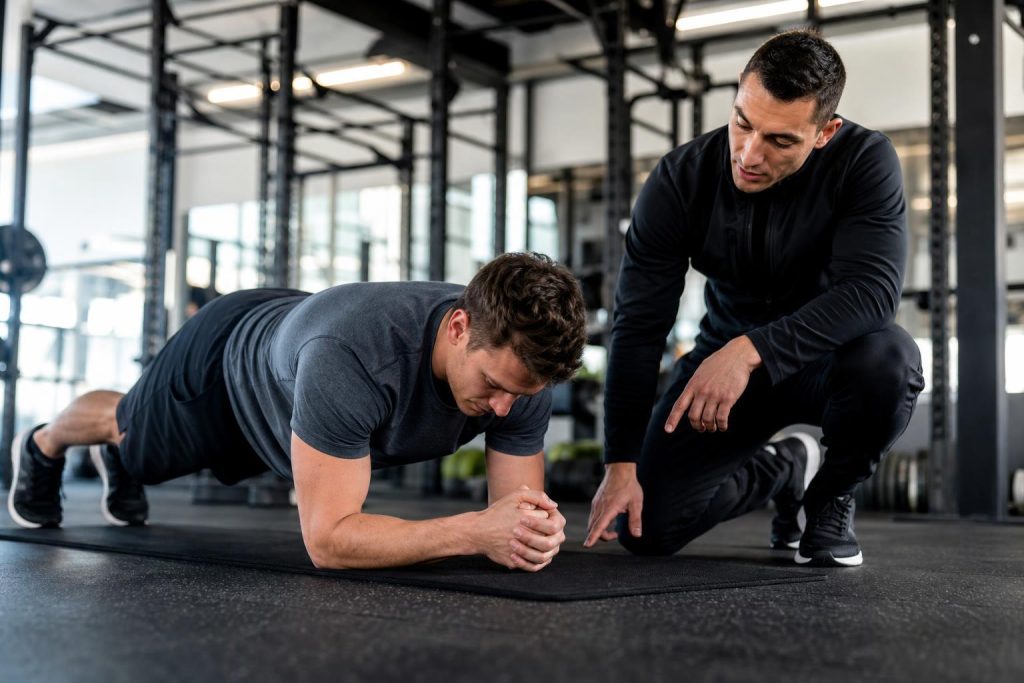
Most men underestimate the plank. They hold one for thirty seconds, feel a mild burn, and move on — convinced they’ve done something meaningful for their core. But research published in the Journal of Strength and Conditioning Research found that systematically progressed isometric core training produces significantly greater improvements in trunk stability and force transfer than random ab work — which means how you progress the plank matters as much as doing it at all. If you’re losing fat, building muscle, or simply trying to move and feel better as you age, your core is the engine underneath everything else. It’s time to treat it that way.
The core isn’t your six-pack. That’s a common and costly misconception. Your core is a 360-degree system of muscles — the rectus abdominis, transverse abdominis, internal and external obliques, multifidus, and the diaphragm — that work together to stabilize your spine under load and transfer force between your upper and lower body. Studies on lumbar spine mechanics have consistently shown that deficits in deep core activation — particularly the transverse abdominis — are associated with lower back pain, injury risk, and reduced athletic performance. The plank, done progressively and with intention, trains exactly these deep stabilizers in a way that crunches and sit-ups simply cannot.
This matters for every man pursuing a body recomposition goal. Whether you’re lifting heavy, in a caloric deficit, using a GLP-1 medication to support fat loss, or doing all three — a strong, stable core protects you during compound lifts, improves your posture as the weight comes off, and keeps you training consistently without the setbacks that come from weak trunk mechanics.
The Science Behind Progressive Overload for Isometric Training
Progressive overload is the foundational principle of all strength training — the idea that you must continually increase the demand placed on a muscle to continue forcing adaptation. Most lifters apply this principle to bench press and squats without question, then completely ignore it when it comes to core work. The result is a core that plateaus fast and stays there.
A 2020 review in Sports Medicine confirmed that isometric exercises like planks do follow the same adaptation principles as dynamic resistance training — meaning the body will stop responding once an exercise becomes too easy. The fix isn’t just holding the plank longer. Duration is one variable, but it’s the least interesting one. Leverage, instability, and load are far more powerful drivers of adaptation — and they’re what most plank progressions completely ignore.
Think of plank progression in four stages: position, duration, instability, and resistance. A standard forearm plank on the floor is your baseline. Once you can hold that with a rigid torso, neutral spine, and controlled breathing for 60 consecutive seconds, you’ve earned the right to move forward — not by holding for 90 seconds, but by changing the mechanical challenge. Elevating your feet shifts your body weight forward and increases the demand on your anterior core. Placing your forearms on a stability ball introduces a rotational component that forces the obliques and deep stabilizers to work harder to prevent collapse. Research using EMG analysis has shown that unstable surface planks produce significantly greater muscle activation in the rectus abdominis and external obliques compared to floor-based planks — a meaningful difference for anyone chasing functional core strength.
From there, dynamic plank variations become the bridge between isometric stability and real-world strength. The plank with shoulder tap — alternating lifting one hand to touch the opposite shoulder — adds anti-rotational demand without requiring equipment. The RKC (Russian Kettlebell Challenge) plank, where you actively squeeze every muscle in your body and create tension through the arms as if trying to pull them together, dramatically increases core activation and turns a passive hold into an active strength drill. For men working in a fat loss phase — regardless of how they’re achieving that deficit — these harder variations build the kind of dense, functional core that visually emerges as body fat drops.
Building Your Plank Progression Protocol
A well-structured plank progression doesn’t need to be complicated, but it does need to be intentional. Start each session by assessing where you are that day. Core fatigue accumulates, and after heavy deadlifts or squats your stabilizers may already be partially pre-fatigued — that’s actually a useful training stimulus if your form holds, but a liability if it breaks down.
For men at the beginner to intermediate stage, a practical four-week foundation looks like this: weeks one and two focus on mastering the standard forearm plank with perfect mechanics — neutral spine, glutes engaged, hips level, no breath-holding. Two to three sets of 30 to 45 seconds, three times per week, is enough stimulus to build the motor pattern without excessive fatigue. Weeks three and four introduce the feet-elevated variation and the plank with alternating shoulder taps, keeping the same set and frequency structure but now training the anti-rotational and loaded components of core stability.
Months two and three are where things accelerate. The stability ball forearm plank becomes your base, supplemented by the RKC plank for pure tension work. By month three, weighted plank variations — a 25 to 45 lb plate placed on the mid-back by a training partner — or plank-to-pike movements on a slide board or suspension trainer should feel genuinely challenging. Evidence from core stability research suggests that once an individual can demonstrate adequate isometric endurance, transitioning to more complex movement-based core training produces superior long-term outcomes for spinal health and athletic performance alike.
One point worth emphasizing, particularly for men in a significant caloric deficit or on GLP-1 therapy: muscle preservation becomes a higher priority when you’re losing weight rapidly. Clinical data on GLP-1 receptor agonists has noted that a meaningful portion of weight lost without structured resistance training can come from lean mass. Progressive core work — and resistance training broadly — is one of the most evidence-backed strategies to counteract this. The plank progression here isn’t just about aesthetics. It’s a tool for maintaining functional strength and movement quality through a transformation.
Breathing mechanics deserve a special mention because they’re almost universally neglected. The diaphragm is part of your core. Research has linked impaired diaphragmatic function to reduced intra-abdominal pressure and compromised spinal stability — which means if you’re holding your breath through every plank rep, you’re actually undermining some of the training benefit. Practice exhaling slowly through pursed lips while maintaining trunk rigidity. It’s harder than it sounds, and it’s one of the markers that separates a man with real core strength from one who’s just grinding out holds.
The Takeaway
The plank is one of the most underrated training tools available to men who want a stronger, more resilient body — but only when it’s treated with the same progressive logic applied to every other lift. Duration alone won’t get you there. Systematic progression through leverage, instability, and resistance will. Whether you’re six months into a fat loss journey, deep in a strength block, or just getting back under the bar after time away, a properly progressed core training practice is foundational — not optional. Start where you are, add challenge as you earn it, and your core will repay the investment in every other area of your training.