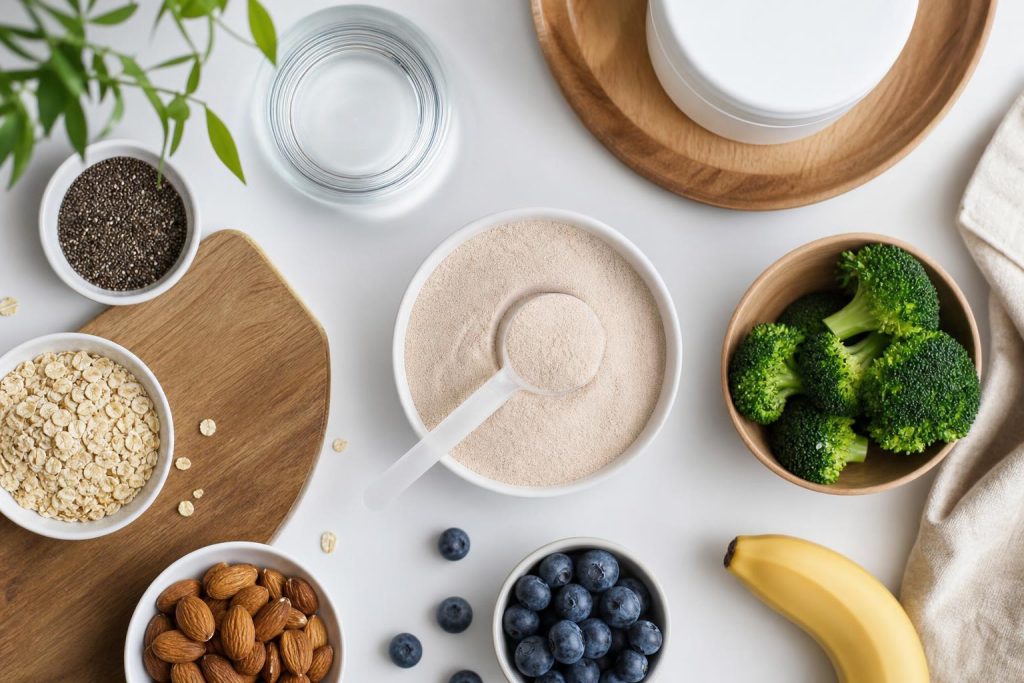
Here’s something that doesn’t get nearly enough attention in the GLP-1 conversation: fiber. Specifically, what happens to your gut, your hunger signaling, and your metabolic health when you’re eating significantly less food — and how the right fiber supplement can make or break your results on Ozempic or semaglutide. A landmark study published in Obesity Reviews found that dietary fiber plays a direct role in GLP-1 secretion itself — meaning fiber and GLP-1 medications are working on overlapping physiological pathways. Whether you’re on a GLP-1 drug or not, optimizing fiber intake is one of the highest-leverage nutritional moves a man can make for fat loss, gut health, and metabolic function.
The average American man consumes somewhere around 18 grams of fiber per day — well short of the 38 grams recommended by the Institute of Medicine. On Ozempic or similar medications, food intake drops substantially, and fiber intake often craters with it. This creates a compounding problem: constipation (one of the most commonly reported side effects of semaglutide), sluggish digestion, disrupted gut microbiome, and blunted satiety signals that were supposed to support the medication’s effects in the first place. A targeted fiber supplement fills that gap — and for any man trying to lose fat and preserve muscle on reduced calories, it does a lot more than keep things moving.
What Fiber Actually Does for Fat Loss and Metabolic Health
Fiber isn’t just roughage. It’s a metabolically active compound that interacts with your gut microbiome, hormone production, and blood sugar regulation in ways that directly support fat loss. Soluble fiber — the kind found in oats, psyllium husk, and legumes — forms a viscous gel in the digestive tract that slows glucose absorption and blunts post-meal insulin spikes. Research in the American Journal of Clinical Nutrition demonstrated that viscous fiber supplementation significantly reduced fasting glucose and LDL cholesterol in overweight adults — independent of any medication. For men managing metabolic health issues like insulin resistance or elevated triglycerides, this is clinically meaningful.
On the fermentation side, prebiotic fibers like inulin and partially hydrolyzed guar gum (PHGG) feed beneficial gut bacteria that produce short-chain fatty acids — particularly butyrate. Butyrate fuels colonocytes, reduces intestinal inflammation, and has been shown in animal and human studies to improve insulin sensitivity and reduce fat storage. For men on caloric deficits — with or without pharmaceutical assistance — keeping the gut microbiome intact matters enormously for long-term metabolic outcomes.
There’s also the satiety angle. Soluble fiber increases the release of peptide YY and cholecystokinin — gut hormones that signal fullness to the brain. A study in Nutrition Journal found that psyllium supplementation taken before meals significantly reduced hunger and caloric intake in overweight men. If you’re on Ozempic, this stacks on top of semaglutide’s own appetite-suppressing mechanisms. If you’re not on a GLP-1, you’re essentially getting a portion of that benefit from a natural, inexpensive supplement.
The Best Fiber Supplements to Consider — and How to Use Them
Psyllium husk is the most well-researched option and the one most clinicians reach for first. It’s a soluble, gel-forming fiber with an impressive body of evidence behind it. The FDA has even approved a qualified health claim linking psyllium to reduced cardiovascular disease risk. For men on Ozempic dealing with constipation or sluggish motility, psyllium taken with 8–16 ounces of water once or twice daily is typically the first intervention to try. A dose of 5–10 grams per day is a reasonable starting point, though studies have used up to 15 grams daily to achieve glycemic and lipid benefits. One important note: psyllium can slow the absorption of medications, so taking it at least two hours away from your semaglutide injection site or any oral medications is wise practice.
For men who want more of a prebiotic focus — supporting microbiome diversity alongside regularity — partially hydrolyzed guar gum (PHGG) is a standout. It’s water-soluble, tasteless, and mixes cleanly into coffee, protein shakes, or water without gelling. Clinical data shows PHGG improves both constipation and diarrhea by normalizing gut motility, which makes it particularly useful for men on GLP-1s whose GI symptoms are unpredictable. A dose of 5 grams once daily is generally well tolerated from day one without the bloating that can accompany higher-fermentation fibers like inulin.
Speaking of inulin — it’s worth mentioning for its robust prebiotic effects, but it comes with a caveat. Inulin and FOS (fructooligosaccharides) ferment rapidly in the colon, and for men already dealing with GI sensitivity on Ozempic, starting with more than 3–5 grams can cause significant gas and bloating. If you’re otherwise GI-stable and want to prioritize gut microbiome diversity, inulin-type fructans are among the most studied prebiotics for increasing Bifidobacterium populations — bacteria strongly associated with leanness and metabolic health. Start low, go slow.
Acacia fiber (acacia senegal) deserves mention as a gentler alternative that’s well-tolerated even at higher doses. It’s a soluble fiber that ferments slowly, producing butyrate without the immediate gas production of faster-fermenting prebiotics. For men who’ve had poor experiences with psyllium texture or inulin-related bloating, acacia is a practical middle ground that still delivers meaningful gut health benefits.
The Takeaway
Fiber supplementation isn’t a workaround for GLP-1 side effects — it’s a foundational metabolic health strategy that belongs in any serious man’s toolkit, regardless of whether he’s taking semaglutide or just cleaning up his diet. The practical approach: start with psyllium husk or PHGG at a low dose, take it with plenty of water away from medications, and build up gradually over two to three weeks. Aim to hit at least 25–30 grams of total daily fiber through a combination of whole foods and supplementation. The gut, the hormones, and the scale will all respond in kind.