Here’s a number that should get your attention: research published in the Journal of Strength and Conditioning Research found that individuals in a caloric deficit can lose up to 25% of their weight from lean muscle mass — not fat — when resistance training is absent from their program. That’s not a rounding error. That’s a quarter of your weight loss coming at the direct expense of the tissue that keeps your metabolism running, your joints protected, and your body functional for decades. If you’re going to go through the effort of losing weight — however you’re doing it — protecting that muscle is non-negotiable. And few exercises do it better than the Romanian deadlift.
The Romanian deadlift, or RDL, is not a trendy exercise. It’s been a staple of serious strength programs for decades because it does something that most exercises can’t: it loads the posterior chain — your hamstrings, glutes, and lower back — through a lengthened position under tension. That eccentric stretch, where the muscle is both contracting and elongating simultaneously, is one of the most powerful stimuli for muscle hypertrophy and preservation known to exercise science. Studies consistently show that eccentric-dominant training produces greater muscle protein synthesis and less muscle breakdown compared to concentric-only loading — making the RDL a mechanistically superior choice for anyone trying to hold onto muscle while in a deficit.
This matters for every man who is serious about his physique and metabolic health — whether you’re deep into a cut, managing your weight with the help of a GLP-1 medication like semaglutide or tirzepatide, or simply trying to build a leaner, more capable body through disciplined eating and training. The physiology is the same. The stakes are identical. And the solution starts with getting this lift right.
How to Actually Perform the Romanian Deadlift Correctly
The RDL is deceptively simple in theory and maddeningly easy to butcher in practice. Most men either turn it into a squat or collapse their spine under load — both of which defeat the entire purpose of the movement and put unnecessary stress on structures that shouldn’t be taking the brunt of the work.
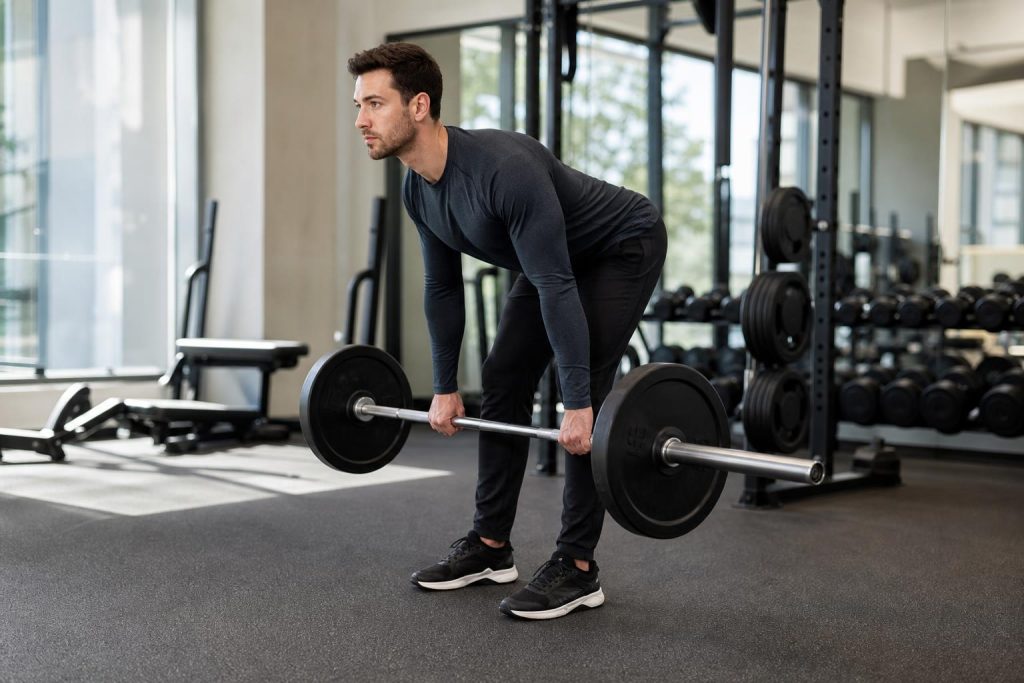
Start standing with a barbell in your hands, using an overhand grip just outside hip width. Your feet should be roughly hip-width apart, knees soft — not locked, but not bent. The spine must be neutral from your tailbone to the base of your skull before the bar ever leaves the starting position. This is not optional. Spinal loading research is unambiguous: a rounded lumbar under axial load dramatically increases disc compression forces and injury risk. Think about pulling your shoulder blades together and down slightly — this cue alone will eliminate the rounded-back pattern most beginners fall into.
Now hinge. Push your hips back — not down — as if someone has a rope attached to your pelvis and is pulling it toward the wall behind you. The bar should drag along your thighs as you descend. This is intentional. The moment the bar swings away from your body, your lower back is absorbing load it was never designed to handle. Let your hips drive the movement, keep your chest proud, and lower the bar until you feel a deep, significant stretch in your hamstrings — typically around mid-shin level for most men, though individual hamstring flexibility will vary. Don’t chase depth at the expense of spinal position. Then drive your hips forward to return to standing, squeezing your glutes hard at the top.
For men new to the movement, start with dumbbells. They allow for a more natural arc of motion and reduce the technical demands enough that you can actually feel the hamstrings working rather than white-knuckling your way through a movement you haven’t mastered yet. Once your hip hinge pattern is grooved and you can feel the posterior chain loading with every rep, graduate to the barbell. A practical starting protocol: three to four sets of eight to twelve repetitions, two to three times per week, with enough load that the final two reps of each set are genuinely challenging. Meta-analyses on resistance training volume suggest ten or more sets per muscle group per week is the threshold for meaningful hypertrophy — and the RDL can carry a significant portion of your weekly hamstring and glute volume efficiently.
Why This Movement Matters More During a Caloric Deficit
When you’re eating in a deficit — whether that deficit is driven by meticulous tracking, appetite suppression from a GLP-1 receptor agonist, or just genuine dietary discipline — your body is in a catabolic environment. It needs a reason to hold onto muscle. That reason is mechanical tension. Research on the mechanisms of muscle hypertrophy identifies mechanical tension as the primary driver of anabolic signaling, outweighing metabolic stress and muscle damage as standalone stimuli. The RDL, performed with progressive overload and full range of motion, delivers sustained mechanical tension through the entire length of the hamstring and into the glute complex — a stimulus powerful enough to tell your body that this tissue is being used and should not be cannibalized for energy.
This is particularly relevant for men using GLP-1 medications. The reduced appetite these drugs produce is clinically effective for weight loss, but emerging clinical data indicates that without structured resistance training, a meaningful proportion of weight lost on GLP-1 therapy comes from lean mass. The RDL, combined with adequate protein intake — most evidence supports at least 1.6 grams per kilogram of bodyweight daily for muscle preservation during a deficit — gives your body the anabolic signal it needs to prioritize fat as the substrate for that deficit, not muscle tissue.
Progressive overload is the variable that makes this work over time. Every few weeks, add weight, add a rep, or reduce rest periods. The muscle must be consistently challenged or the stimulus diminishes. Keep a training log. The men who track their lifts consistently outperform those who train by feel — not because tracking is magic, but because it creates accountability and makes progressive overload systematic rather than accidental.
The Takeaway
The Romanian deadlift is not a complicated exercise, but it is a consequential one. For any man serious about changing his body composition — regardless of the dietary strategy or tools he’s using — the posterior chain is where metabolic resilience is built. Master the hip hinge, load it progressively, pair it with sufficient protein, and the RDL becomes one of the most efficient muscle-preservation tools in your program. Weight loss without muscle preservation is just a smaller, weaker version of yourself. Do the lift. Keep the muscle.