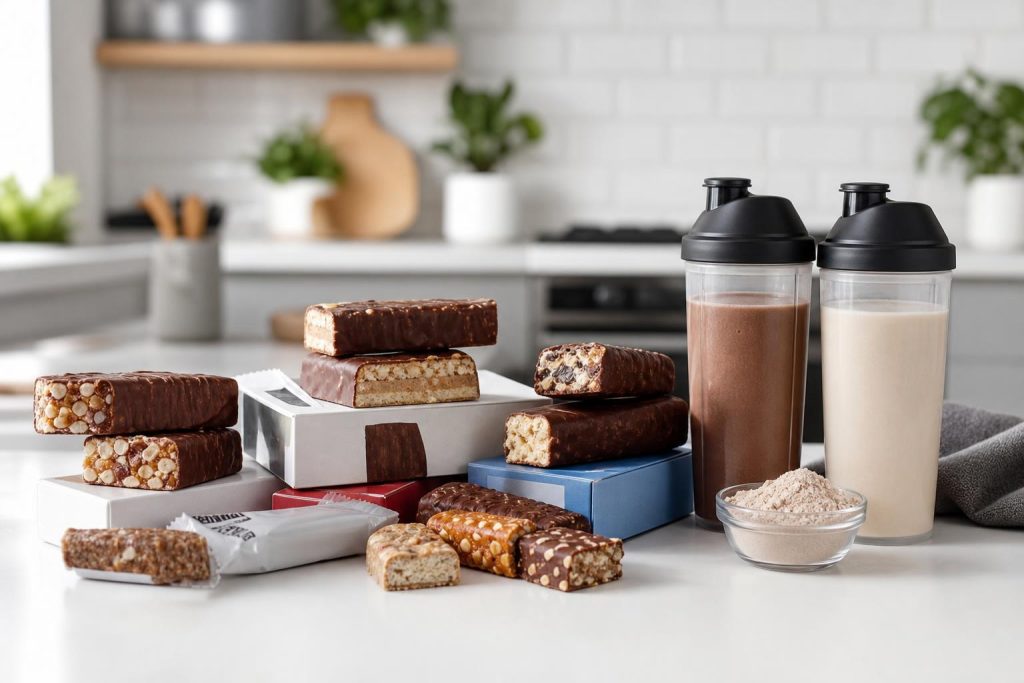
Most men grabbing a protein bar off a gas station shelf are making a costly mistake — not because protein bars are bad, but because the wrong one can quietly sabotage everything they’re working toward. A 2016 study published in The American Journal of Clinical Nutrition confirmed what nutrition researchers had long suspected: higher protein intake — specifically above 1.2 grams per kilogram of body weight — significantly improves lean mass retention during caloric restriction. The challenge isn’t knowing that protein matters. It’s consistently hitting your target when your appetite is suppressed, your schedule is packed, or your stomach simply won’t cooperate.
That’s where a well-chosen protein bar earns its place in your nutrition toolkit. Whether you’re running a caloric deficit the traditional way, training hard and eating clean, or using a GLP-1 medication like semaglutide or tirzepatide that’s dramatically reduced your appetite and food volume tolerance, the logic is the same: you need concentrated protein in a small, palatable package. The bars that deliver on that promise are fewer than the crowded supplement aisle would have you believe.
What Makes a Protein Bar Worth Eating — The Numbers That Actually Matter
The protein bar market is dominated by products that look impressive on the front of the wrapper and disappoint on the back. A bar advertising 20 grams of protein while packing 30 grams of sugar and 350 calories isn’t a protein bar — it’s a candy bar with a marketing budget. For men focused on fat loss or muscle preservation, the calculation needs to favor protein density: how much usable protein are you getting relative to total calories and food volume?
The sweet spot for a high-performance protein bar is roughly 20 to 25 grams of complete protein, under 250 calories, with minimal added sugars — ideally under 5 grams. Fiber content matters too. Research published in Nutrients found that dietary fiber intake is independently associated with greater satiety and improved body composition outcomes, making 5 to 10 grams of fiber per bar a meaningful bonus rather than a gimmick. What you want to avoid are bars relying heavily on sugar alcohols like maltitol, which cause significant gastrointestinal distress in many people — a particularly important consideration for anyone already managing gut sensitivity.
Protein source quality also separates the serious options from the filler. Whey protein isolate and milk protein isolate are the gold standard for bioavailability and leucine content — the branched-chain amino acid most directly linked to muscle protein synthesis. A landmark study in the Journal of the American College of Nutrition demonstrated that whey protein stimulates muscle protein synthesis more effectively than casein or soy at equivalent doses, making source quality a meaningful differentiator — not just label snobbery.
The Bars That Hold Up Under Scrutiny
Quest Bars remain one of the most nutritionally defensible options on the market. A standard Quest bar delivers 20 to 21 grams of protein — primarily from whey and milk protein isolates — with roughly 4 to 5 grams of net carbs and around 190 to 210 calories depending on flavor. The fiber comes from soluble corn fiber and chicory root, which are generally well-tolerated and contribute meaningfully to satiety without the bloating associated with maltitol-heavy competitors. For men on GLP-1 medications navigating significantly reduced appetite, a Quest bar can cover nearly half a meal’s worth of protein in a few bites — which is exactly the point.
RXBAR takes a different approach, using egg whites, almonds, and dates as the primary ingredients with no added sugar alcohols or artificial sweeteners. A standard RXBAR contains 12 grams of protein, which is lower than the Quest ceiling, but the clean ingredient profile and whole-food protein sources make it an excellent option for men who prioritize dietary quality over maximum protein concentration. The date-based carbohydrates also make RXBARs a better fit around training sessions where fast-digesting carbohydrates serve a purpose.
Barebells protein bars have earned significant attention for their macronutrient profile — around 20 grams of protein and only 1 to 2 grams of sugar — while managing to taste genuinely good without leaning on excessive sweeteners. The texture is more candy-bar-adjacent than most high-protein options, which matters for adherence. If a bar is unpleasant to eat, you won’t reach for it when you need it. Barebells uses a milk and whey protein blend, keeping the amino acid profile strong for both acute muscle protein synthesis and slower overnight recovery support.
For men specifically managing reduced food volume — whether from GLP-1 use, post-bariatric eating patterns, or simply disciplined caloric restriction — the Built Bar deserves mention. At roughly 130 to 150 calories and 15 to 17 grams of protein, Built Bars are among the lowest-calorie options that still deliver a meaningful protein hit. They’re not going to replace a full protein meal, but as a between-meal bridge when your appetite is minimal and a full shake feels like too much, they thread a narrow needle effectively.
One bar that has gained credibility in performance nutrition circles is the Momentous PR Lotion Protein Bar — though Momentous more broadly is known for third-party tested supplements. For men who care about purity and testing certification, particularly competitive athletes subject to drug testing or anyone who simply wants verified label accuracy, choosing bars from brands with NSF Certified for Sport or Informed Sport certification adds a layer of trust that the broader bar market often lacks. Research on supplement contamination has repeatedly shown that label claims in the supplement industry frequently don’t match actual contents — a known risk that certified products meaningfully reduce.
How to Use Protein Bars Without Relying on Them
The most important reframe around protein bars is strategic versus habitual use. Real food — eggs, meat, Greek yogurt, cottage cheese — provides micronutrients, satiety signals, and digestive complexity that processed bars simply can’t replicate. Evidence from dietary pattern research consistently links higher whole-food protein intake with superior metabolic outcomes compared to equivalent protein from processed sources. Bars work best as a precision tool: travel days, post-training when a meal isn’t immediately available, or as a strategic protein bridge during periods of low appetite.
For men on GLP-1 medications specifically, the math becomes even more pointed. When semaglutide or tirzepatide reduces your functional hunger to the point where a full chicken breast feels impossible, getting 20 grams of protein from a single compact bar is not a compromise — it’s a clinical strategy. Studies tracking GLP-1 users have documented significant lean mass loss alongside fat loss when protein intake isn’t actively protected, making deliberate, concentrated protein intake a priority rather than a preference. But this same urgency applies to any man eating in a meaningful caloric deficit — medication or not.
The Takeaway
The best protein bar is the one that fits your macros, agrees with your gut, and you’ll actually eat consistently. For most men serious about body composition, that means prioritizing whey or milk protein isolates, keeping sugar low, fiber reasonable, and total calories controlled. Quest, Barebells, RXBAR, and Built Bar each hit that profile from slightly different angles — and the right choice depends on your total daily target, how your digestion responds, and whether taste keeps you coming back. Use bars to fill gaps, not to build your nutrition around. Anchor your protein intake in real food, use bars as precision tools, and the results will follow regardless of what path brought you to this point.