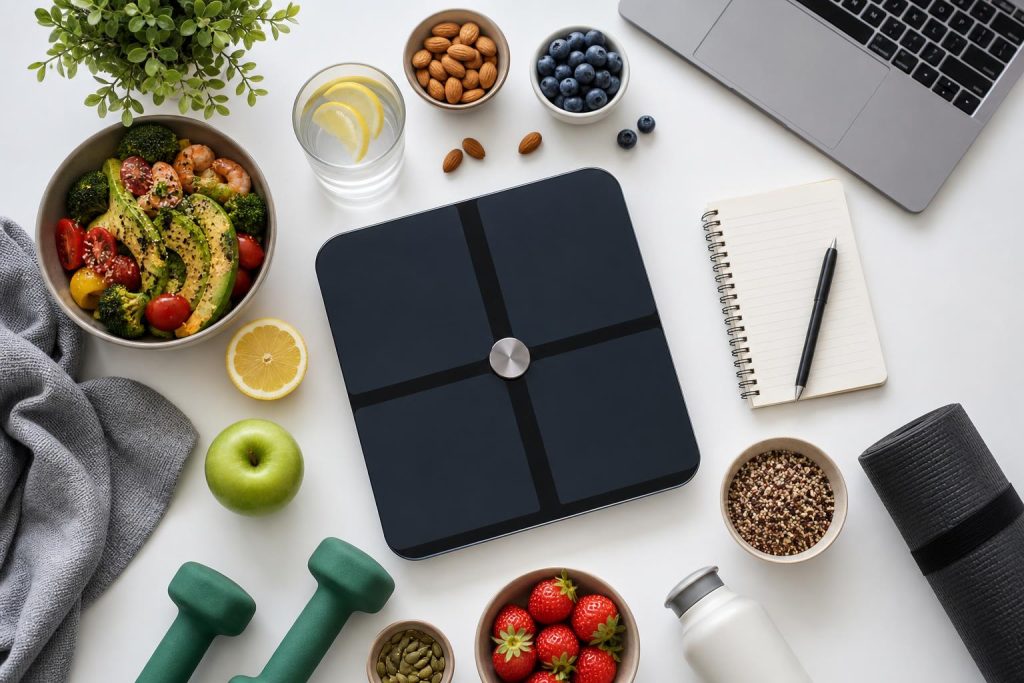
Most men who struggle to hit their nutrition targets aren’t eating the wrong foods — they’re guessing the wrong amounts. Research published in the Journal of the Academy of Nutrition and Dietetics found that self-reported portion estimates can deviate from actual intake by as much as 50%, with men consistently underestimating calorie-dense foods like protein, oils, and grains. That single blind spot can silently undo weeks of disciplined eating. A food scale doesn’t lie. And for anyone serious about fat loss, muscle preservation, or metabolic health — whether you’re tracking macros on a clean bulk, following a structured cut, or managing your appetite on a GLP-1 medication — precision matters far more than most men realize.
The physiology is simple but demanding. To build or preserve lean muscle, you need adequate protein — typically 1.6 to 2.2 grams per kilogram of body weight daily, according to a 2017 meta-analysis in the British Journal of Sports Medicine. To lose fat without sacrificing that muscle, you need a caloric deficit that’s controlled, not chaotic. Neither goal is achievable through eyeballing. A kitchen scale turns nutrition from an art form into an actual discipline.
What Makes a Food Scale Worth Using Every Day
The best food scale for macro tracking isn’t necessarily the most expensive one — it’s the one you’ll actually use consistently. That comes down to four practical factors: accuracy, tare function responsiveness, readability, and surface size. A scale that reads in increments of 1 gram is the standard baseline for macro tracking. Go smaller (0.1g resolution) if you’re tracking sodium, creatine, or powders, but for daily food weighing, 1g precision is sufficient and keeps the display cleaner. The tare function — which resets the weight to zero after each ingredient is added — is non-negotiable. Being able to build a meal in a single bowl without doing mental math is what separates a useful scale from an annoying one.
Platform size matters more than most buyers anticipate. A cramped 4-inch surface is fine for portioning protein powder but becomes maddening when you’re weighing a chicken breast or a full bowl of oatmeal. Look for platforms at least 6 inches wide. Display visibility is equally important — backlit screens and large digit readouts prevent the frustrating habit of hunching over the counter trying to read a number before it times out. Auto-shutoff is standard on nearly all modern scales, but check that the timeout window is at least 90 seconds, giving you enough time to move between ingredients without restarting.
For most men, the OXO Good Grips 11-pound Food Scale with a pull-out display is the benchmark for daily usability. The display slides out from under the platform so a large plate or bowl doesn’t obscure the readout — a design detail that solves one of the most common frustrations with kitchen scales. The Escali Primo is the entry-level standard: accurate, durable, and under $30. For those who want Bluetooth integration with apps like Cronometer or MyFitnessPal, the Etekcity Luminary Food Nutrition Scale syncs data automatically and even breaks down macros per weighed portion — worth the premium for anyone who tracks daily. If you weigh supplements or precise powders, the American Weigh Scales Blade series offers 0.1g resolution without jumping to lab-scale pricing.
How to Actually Use a Food Scale to Hit Your Macros
Owning a scale is step one. Building a system that makes weighing food automatic is what produces results. The most effective approach is to weigh foods in their raw state whenever possible, since cooked weights vary significantly based on water loss — a 200g raw chicken breast can weigh as little as 140g cooked, and the macro databases in most apps use raw measurements as the default. Studies on dietary adherence consistently show that consistency of method matters more than perfection — choosing either raw or cooked and sticking with it eliminates a major source of tracking error.
For men using GLP-1 medications like semaglutide or tirzepatide, a food scale becomes even more clinically important. These medications suppress appetite significantly, and while that’s the therapeutic mechanism, it also creates a real risk of undereating protein — which accelerates muscle loss during weight reduction. A 2023 analysis in Diabetes, Obesity and Metabolism noted that lean mass losses during GLP-1-assisted weight loss can be substantial without intentional protein targeting and resistance training. When you’re eating significantly less volume, every gram of food counts, and a scale ensures that the smaller meals you are eating are protein-dense and macro-optimized rather than accidentally calorie-light and protein-poor.
A simple daily protocol that works for most men: weigh protein sources first, since hitting your protein target is the highest-priority macro, then allocate carbohydrate and fat around your remaining calorie budget. Prep your primary protein portions for two or three meals at the start of the day, weigh them once, log them immediately, and build the rest of your eating around those anchors. This reduces decision fatigue and keeps tracking from feeling like a full-time job. Pair your scale with a food diary app that has a robust database — Cronometer is widely regarded as the most accurate for micronutrient data, while MyFitnessPal’s larger community database makes it faster for common foods.
The Takeaway
A food scale is one of the cheapest, highest-leverage tools in a man’s fitness arsenal — less than the cost of a single supplement, with a direct and immediate return on investment. Whether you’re cutting body fat, building muscle, managing your health on medication, or simply trying to eat better with more intentionality, precision eating starts with precise measurement. The research is unambiguous: portion distortion is real, widespread, and quietly sabotaging results for men who are otherwise doing everything right. A scale doesn’t require discipline — it replaces the need for willpower with a system. And systems beat intentions every time.