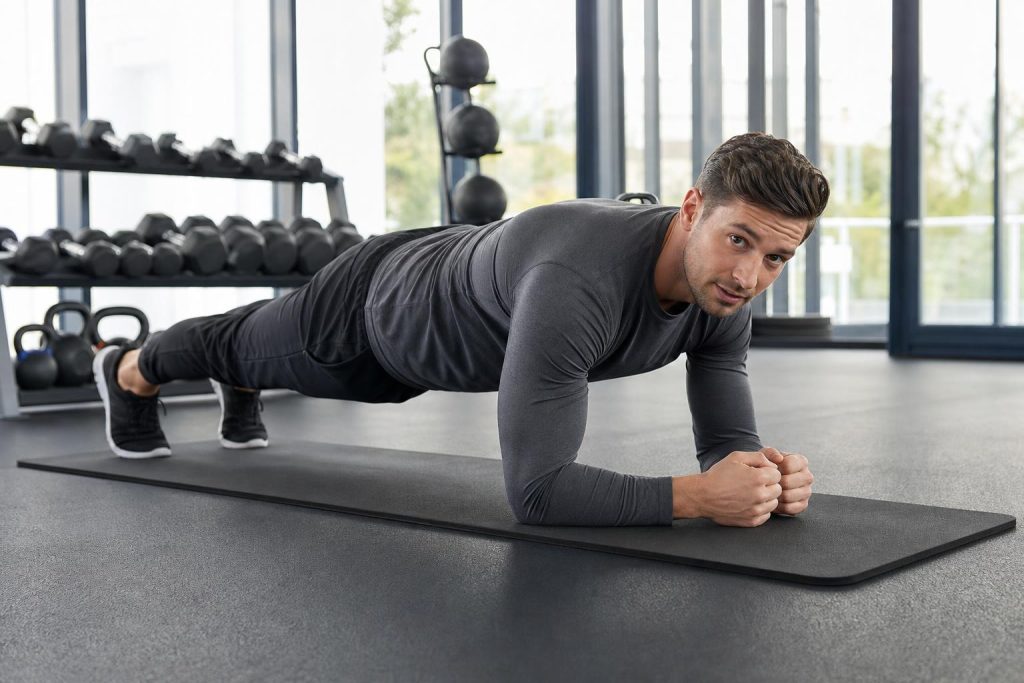
Most men treat the plank like a warm-up afterthought — something you hold for thirty seconds before moving on to the “real” work. That’s a mistake. Research published in the Journal of Strength and Conditioning Research demonstrates that isometric core exercises like the plank produce significant activation of the rectus abdominis, transverse abdominis, and lumbar multifidus simultaneously — a combination that dynamic crunches simply cannot replicate. When properly progressed, the plank is one of the most efficient tools in existence for building the kind of deep, functional core strength that transfers to every lift, every sport, and every aspect of metabolic health.
This matters beyond aesthetics. A strong core isn’t just about looking good with your shirt off — though that’s a perfectly valid goal. Studies in PLOS ONE have linked poor trunk muscle endurance to increased all-cause mortality risk, independent of cardiovascular fitness. Core strength is foundational infrastructure. Whether you’re cutting body fat, building lean mass, recovering from injury, or simply trying to function better at forty-five than you did at thirty, a structured plank progression belongs in your program.
For men using GLP-1 receptor agonists like semaglutide or tirzepatide, this is especially worth noting. Rapid weight loss from any source — medication, aggressive dieting, or bariatric surgery — carries a meaningful risk of muscle loss alongside fat loss. Clinical data from the SURMOUNT-1 trial showed that participants on tirzepatide lost significant lean mass in addition to fat mass, reinforcing why resistance training — including core-specific work — is non-negotiable during any weight loss phase. The plank, because it requires no equipment, produces low joint stress, and can be performed anywhere, is often the ideal entry point.
Understanding What the Plank Actually Does — And Why Progression Matters
The plank is an anti-extension exercise. Its purpose is to train your core to resist forces that would otherwise buckle your spine — not to crunch, flex, or rotate. When you hold a proper forearm plank, your transverse abdominis, internal obliques, and lumbar multifidus are working in concert to create what researchers call “intra-abdominal pressure” — a stabilizing mechanism that protects the spine under load. McGill’s landmark work on spine biomechanics established that training this bracing mechanism — rather than simply flexing the spine — is the superior approach for building durable, injury-resistant core function.
The problem with how most men approach planks is that they treat duration as the only variable. Hold it longer, they think, and you’ll get stronger. But once you can maintain a rock-solid plank for 60 to 90 seconds, adding more time yields diminishing returns on strength development and starts training muscular endurance almost exclusively. EMG research confirms that muscle activation doesn’t significantly increase past the point of good-form failure — meaning a sloppy two-minute plank is physiologically inferior to a perfect forty-five second hold. Progression, therefore, means increasing difficulty — not just time.
A well-structured plank progression moves through several distinct phases. The first is mastering the foundational position itself: forearms parallel and shoulder-width apart, elbows directly beneath the shoulders, hips level with the shoulders (not sagging, not piked), glutes and quads actively squeezed, and the entire body rigid as a steel beam. Breathing must be deliberate — short nasal inhales, bracing through the exhale — not breath-holding, which spikes blood pressure unnecessarily. Once you can hold this position for three sets of 45 to 60 seconds with zero form breakdown, you’re ready to move forward.
The next layer of progression introduces instability and load redistribution. Transitioning to a straight-arm (high) plank shifts more demand onto the shoulders and chest while maintaining the same anti-extension core requirement. From there, variations like the RKC (Russian Kettlebell Challenge) plank — where you actively squeeze every muscle simultaneously and create tension through the hips and posterior chain — dramatically increase core activation without adding a single second of hold time. Research comparing RKC plank technique to standard plank positions found up to 32% greater rectus abdominis and external oblique activation, making it a high-efficiency upgrade that most men have never tried.
From the RKC plank, effective progressions include the plank with shoulder tap — which introduces a rotational anti-rotation challenge as you lift one hand — and the plank with hip extension, where alternating leg lifts force the core to resist lateral collapse. These unilateral variations are where core training starts to mirror real-world demands. Carrying groceries, picking something off the floor, decelerating during a sprint — all of these require your core to stabilize asymmetrical loading. Training symmetrically in a two-point plank doesn’t fully prepare you for that.
Building Your Plank Progression Protocol
The most effective approach to plank progression follows a simple principle borrowed from strength training: progressive overload applied systematically, with recovery respected. For men newer to structured core work — whether because they’ve been sedentary, recovering from injury, or simply starting a fat loss phase — three sessions per week is a practical starting point, with at least one rest day between sessions.
In the first two to three weeks, the goal is positional mastery. Three sets of 20 to 30 second holds with full attention to technique will do more good than any amount of time spent sagging your hips and praying your way through two minutes. Once your form is airtight, extend holds to 45 seconds over the following two weeks, then to 60 seconds. At that point, rather than pushing to 90 seconds or two minutes, introduce the RKC modification and reset to shorter holds — because the exercise has become meaningfully harder.
Weeks five through eight introduce the unilateral variations: shoulder taps, hip extensions, and eventually the side plank, which specifically targets the quadratus lumborum and lateral obliques — muscles that are chronically underdeveloped in most men who only train in the sagittal plane. Research has identified the quadratus lumborum as a primary stabilizer against lateral spinal compression, and weakness here is a common contributor to lower back pain — one of the most prevalent issues affecting working-age men.
From weeks eight onward, loaded progressions become appropriate. A weight plate placed on the upper back during a forearm plank, or a plank performed with feet elevated on a bench, meaningfully increases the mechanical demand without requiring any additional equipment beyond what most gyms or home setups already have. For advanced trainees, the plank-to-pike on a Swiss ball or TRX handles introduces dynamic instability that challenges even well-trained core musculature. Studies using surface EMG during unstable surface planks confirm significantly higher activation of the transverse abdominis compared to stable surface variations, validating this progression for men who have plateaued on ground-based work.
One practical note for men managing body composition — whether through caloric restriction, GLP-1 therapy, or structured dieting: core training during a fat loss phase should prioritize preservation of strength rather than volume accumulation. This means keeping intensity high and managing fatigue carefully. If you’re in a caloric deficit, your recovery capacity is reduced. Three quality core sessions per week, kept under 15 minutes each, will produce better outcomes than six scattered sessions that leave you depleted and unable to train your primary lifts effectively.
Nutrition plays a direct role in how well this training sticks. Studies consistently show that dietary protein above 1.6 grams per kilogram of bodyweight is necessary to maximally support muscle protein synthesis during a training program — a threshold many men in a fat loss phase fail to hit. If you’re cutting calories and not hitting your protein target, the core training you’re doing is fighting an uphill physiological battle. The exercise stimulus is only as effective as the recovery environment you create around it.
What This Means For You
The plank is not a beginner exercise you graduate from. It’s a platform you build on — and when you build on it intelligently, it becomes one of the most powerful tools in your physical development toolkit. The research is consistent: isometric core training improves lumbar stability, reduces injury risk, enhances force transfer during compound lifts, and contributes to the kind of functional fitness that makes you better at everything you do, not just what happens in the gym.
Start where you are. If sixty seconds of solid plank form is a stretch today, that’s your baseline, and there’s nothing wrong with it. Follow the progression deliberately — add difficulty before adding duration, prioritize position over time, and treat the unilateral and loaded variations as tools you’re working toward rather than tricks to skip. Support the training with adequate protein and sleep, and you’ll be surprised how quickly the core strength you build here starts showing up in your deadlift, your posture, your back health, and your ability to sustain every other training goal you’re chasing.
That’s not a small thing. That’s the infrastructure your entire fitness life is built on.