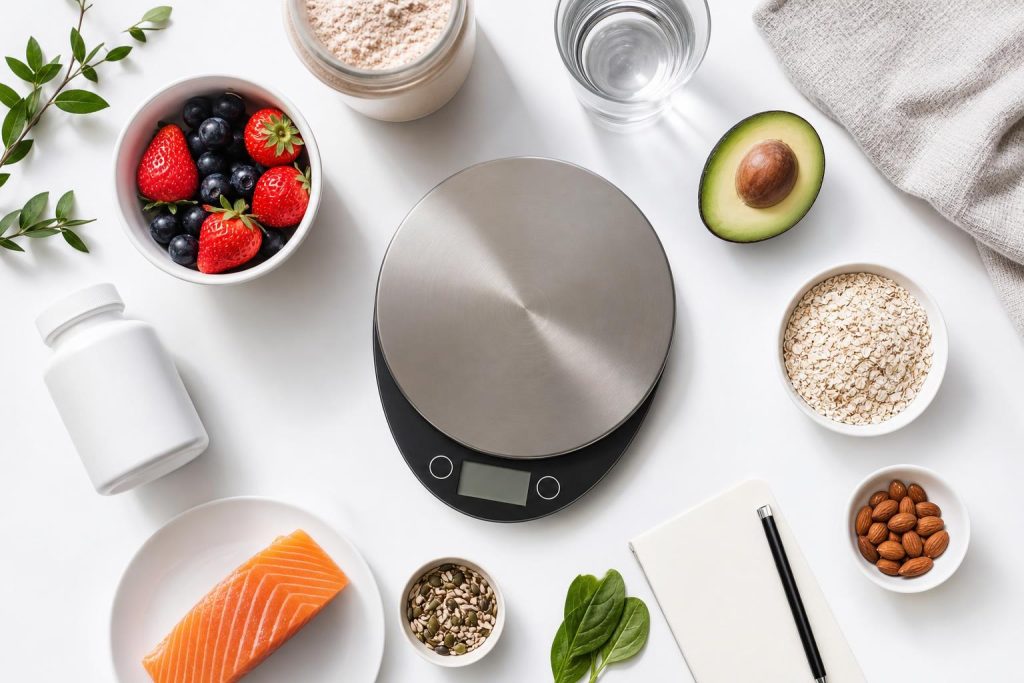
Here’s a number worth sitting with: in a controlled study published in the Journal of the Academy of Nutrition and Dietetics, self-reported food intake was off by as much as 40% compared to actual intake — and that was among nutrition-conscious adults. Eyeballing portions, using measuring cups, or trusting your instincts puts you at the mercy of systematic underestimation that quietly derails fat loss, stalls muscle building, and makes it nearly impossible to dial in your metabolic health. A food scale eliminates that variable entirely.
Whether you’re cutting body fat, trying to hit 180 grams of protein a day to preserve muscle while in a calorie deficit, managing your intake on a GLP-1 medication like semaglutide, or just eating cleaner than you used to — a kitchen food scale is one of the highest-leverage tools you can own. It costs less than a single month’s worth of supplements, takes thirty seconds to use, and gives you ground truth about what you’re actually consuming. This guide breaks down what to look for, which models are worth your money, and how to build a tracking habit that actually sticks.
Why Accurate Measurement Changes Everything
Protein is the non-negotiable macronutrient for any man focused on his physique or metabolic health. Research published in the American Journal of Clinical Nutrition consistently supports daily protein intakes of 1.6 to 2.2 grams per kilogram of body weight for maximizing muscle protein synthesis — and hitting those targets requires knowing exactly how much chicken, Greek yogurt, or steak is on your plate. A handful of almonds that looks like an ounce might be closer to two, and that single daily miscalculation adds up to roughly 180 extra calories and 14 grams of fat per week. Multiply that across multiple foods and you’ve invented a calorie surplus you didn’t intend.
This matters especially for men navigating appetite suppression from GLP-1 receptor agonists. When you’re eating significantly less volume, every gram of food carries more metabolic weight. Clinical data on semaglutide users shows meaningful lean mass loss alongside fat loss when protein intake isn’t deliberately prioritized — making precision tracking not optional, but essential. The food scale becomes a tool for protecting the muscle you’ve built, not just counting calories.
Beyond protein, accurate carbohydrate tracking matters for men managing blood sugar, following a lower-carb protocol, or trying to optimize post-workout nutrition timing. Fat tracking matters for anyone working with specific caloric targets. The point isn’t obsession — it’s building an accurate internal map of what foods actually weigh and contain, so that over time, your instincts become trustworthy rather than wildly off.
What to Look for in a Food Scale — and the Models Worth Buying
Not all food scales are built the same. The most important features for serious tracking are accuracy to at least one gram (ideally 0.1 grams for small portions like spices and oils), a tare function that lets you zero out the scale with a container on it, a capacity of at least five kilograms to handle full meal prep loads, and a clear readable display. A backlit screen matters more than it sounds when you’re weighing food at 6am or in a dimly lit kitchen.
The Etekcity Food Kitchen Scale consistently ranks as one of the best entry points — accurate to 1 gram, holds up to 11 pounds, tares instantly, and runs around $12 to $15. For men who want finer precision, the Ozeri Pronto Digital offers 1-gram graduations with a slim profile that stores easily. If you’re doing serious macro tracking and want nutritional data displayed directly on the scale, the Greater Goods Nourish Digital Food Scale integrates with an app to display macros in real time — genuinely useful for men building a consistent tracking habit without needing to manually log everything into a separate app afterward.
For meal preppers working with larger volumes, the OXO Good Grips 11-Pound Stainless Steel Food Scale has a pull-out display that prevents large bowls from blocking your view — a small feature that removes a genuinely annoying daily friction point. Durability and a stainless steel platform make it worth the higher price point if you’re using it multiple times a day.
What you don’t need: Bluetooth connectivity for its own sake, complex unit conversion menus, or any scale marketed primarily as a baking tool. You want fast, accurate, and simple. The scale that’s easiest to grab and use is the one that actually improves your tracking consistency.
Building a Tracking Habit That Holds
Research on dietary self-monitoring shows a strong dose-response relationship between tracking frequency and weight management outcomes — men who tracked more consistently lost more weight and maintained it longer. The obstacle isn’t motivation; it’s friction. The fix is environmental design. Keep the scale on your counter, not in a cabinet. Position it next to your most-used cutting board. If it requires effort to access, it won’t get used.
Pair your scale with a macro tracking app — Cronometer and MacroFactor are both research-informed options that offer solid food databases and accurate logging. Scan barcodes when possible, but weigh packaged foods regardless of the serving size listed on the label, since FDA-allowed label tolerances permit up to 20% variance in actual nutrient content from what’s printed. That margin is why professional athletes and precision-focused individuals weigh everything rather than trusting package claims.
You don’t need to track every meal forever. Most experienced trackers use a scale intensively for eight to twelve weeks, develop a calibrated sense of portion sizes, then use the scale periodically to recalibrate when weight or performance stalls. Think of it as building a skill, not a permanent chore.
The Takeaway
A $15 food scale is one of the most cost-effective investments in your body composition you can make. It removes guesswork, gives you control over the primary variable in fat loss and muscle building, and pays compounding dividends over months of consistent use. Whether you’re deep in a structured cut, building a lean bulk, managing a medical nutrition protocol, or simply trying to eat more intentionally — accurate measurement is the foundation that makes every other effort more effective. Get the scale. Use it daily. Watch how quickly your understanding of your own nutrition sharpens.