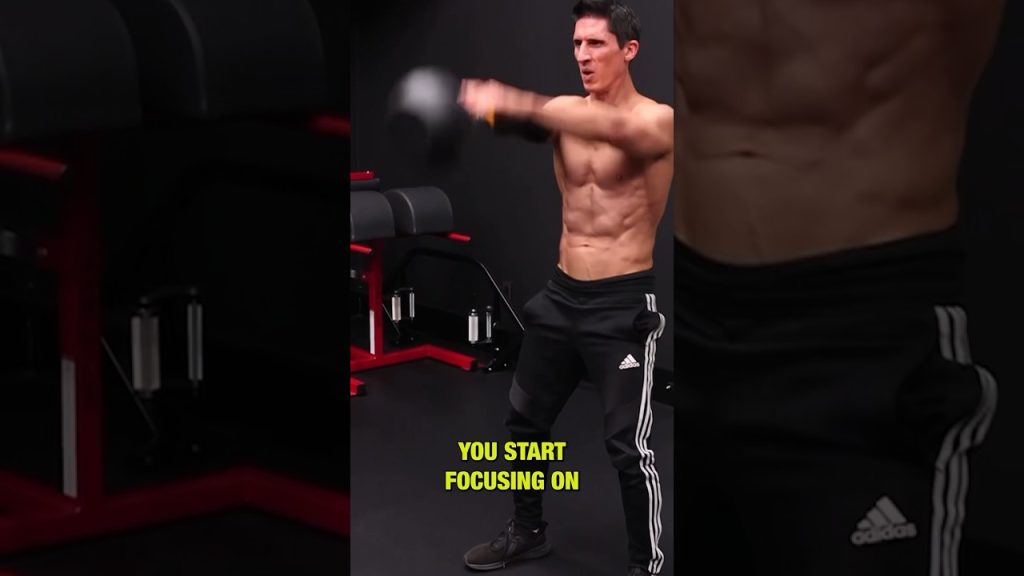
Video by AthleanX on YouTube
If you had to pick one exercise to preserve muscle mass while losing fat, the goblet squat would make a strong case for the top spot. It loads the quadriceps, glutes, and core simultaneously, demands full-range hip flexion, and is approachable enough for any training level — yet challenging enough to drive real adaptation. And when you’re in a caloric deficit trying to protect the muscle you’ve built, that combination matters more than most people realize.
Research consistently shows that resistance training during caloric restriction is the most effective strategy for attenuating lean mass loss — and compound lower-body movements are central to that effect. The goblet squat, in particular, activates the rectus femoris and vastus lateralis at rates comparable to the barbell back squat while placing far less compressive load on the lumbar spine, making it a reliable tool whether you’re a seasoned lifter or just getting started.
How to Actually Do It Right
The setup sounds simple: hold a dumbbell or kettlebell at chest height, feet shoulder-width apart, and squat down. But the details are where most men leave results on the table. Start by holding the weight close to your sternum with both hands cupped under the top of a kettlebell or gripping the top plate of a dumbbell vertically. Your elbows should point downward, not flare out — this keeps tension through the upper back and prevents forward collapse at the bottom.
Before you descend, take a deep breath into your belly and brace your core as if you’re about to take a punch. This intra-abdominal pressure protects the spine and gives your lower body something stable to push against. Begin the descent by pushing your knees out in line with your toes while simultaneously sitting your hips back and down. The goal is to reach parallel or below — deeper squats produce significantly greater glute and quad activation compared to partial-range movements, which translates directly to better muscle retention signals during a cut.
At the bottom, your chest should remain upright, your heels should stay flat on the floor, and your knees should track over the second and third toes. If your heels rise or your torso pitches forward aggressively, your ankles lack the dorsiflexion range the movement demands. A simple fix: elevate your heels slightly on a 5 or 10-pound plate until you develop the mobility to squat flat-footed. Drive back up by pressing the floor away, squeezing your glutes at the top, and exhaling through the sticking point.
Why It Works So Well for Fat Loss Without Muscle Loss
The goblet squat’s value during weight loss phases goes beyond mechanics. Because the load sits in front of your center of gravity, your anterior core — particularly the transverse abdominis and rectus abdominis — has to work continuously throughout the movement. This makes every rep a functional core training session on top of a lower-body strength stimulus. That’s a high return on investment when your recovery capacity may be reduced by a caloric deficit.
Studies examining muscle protein synthesis indicate that mechanical tension — the kind generated by slow, controlled compound movements through a full range of motion — is the primary driver of muscle preservation signals. The goblet squat delivers this efficiently. For men in a deficit, three to four sets of eight to twelve reps with two to three seconds on the eccentric phase and a brief pause at the bottom maximizes time under tension without excessive fatigue or joint stress.
Progressively adding load over weeks is non-negotiable. Start with a weight that challenges you by rep eight or nine, and increase by five pounds every one to two weeks as long as form holds. Many men plateau here by staying comfortable — but progressive overload is what tells your body to keep the muscle tissue it has. Without that signal, even perfect nutrition can’t fully prevent lean mass erosion during prolonged deficits.
For programming, pair goblet squats with a hip-dominant movement like Romanian deadlifts in the same session. This balanced approach — anterior chain and posterior chain working together — builds a more complete stimulus for lower-body muscle retention and keeps your training time efficient.
The Takeaway
The goblet squat isn’t a beginner exercise you graduate out of — it’s a precision tool for anyone who wants to lose fat without losing the physique they’ve worked for. Master the form, load it progressively, and use it as an anchor in your training program. The men who keep their muscle through a weight loss phase are rarely the ones doing more cardio. They’re the ones squatting with intention.