There’s a persistent myth in fitness culture that if you’re not under a barbell, you’re wasting your time. The research disagrees. A 2019 meta-analysis published in PLOS ONE found that resistance band training produces comparable strength gains to conventional resistance training using free weights and machines — without the gym, without the commute, and without a rack of iron in your living room. For men focused on fat loss, muscle preservation, and metabolic health, that’s not a minor finding. That’s a green light.
Resistance bands have quietly become one of the most versatile and underrated training tools available, particularly for men who need a structured home workout that actually delivers. Whether you’re managing a packed schedule, recovering from injury, cutting weight, or simply prefer the convenience of training at home, bands can serve as the foundation of a legitimate strength and conditioning program. For men using GLP-1 medications like semaglutide or tirzepatide, where muscle preservation during caloric restriction is a genuine concern, resistance training of any kind becomes especially important — but the benefits here extend to every man chasing a leaner, stronger physique.
Why Resistance Bands Deserve Serious Attention
The mechanical case for bands is stronger than most people realize. Unlike free weights, which provide a constant load through a movement, bands deliver variable resistance — meaning the tension increases as the band stretches, which corresponds with the portion of the lift where your muscles are typically strongest. This progressive overload curve actually matches muscle force-velocity relationships more closely in certain movements. Research published in the Journal of Human Kinetics demonstrated that elastic resistance training significantly improves muscle strength and functional performance, with effects comparable to traditional gym-based protocols when programmed consistently.
Beyond the mechanics, there’s the metabolic argument. Preserving lean muscle mass during periods of weight loss is one of the most important — and most overlooked — goals in any fat loss program. A study in Obesity Reviews confirmed that resistance training during caloric restriction significantly attenuates lean mass loss compared to diet alone or diet combined with cardio. Put simply: if you’re eating in a deficit to lose fat, you need to be lifting something. Resistance bands count.
The practical advantages compound the physiological ones. A full set of loop bands and tube bands with handles costs under fifty dollars, takes up less space than a shoebox, and requires no setup. That removes the single biggest barrier most men face with home training: infrastructure. No power rack required. No square footage sacrificed. Just consistent tension, progressive loading, and intentional movement.
Building Your Home Band Workout: The Core Movements That Actually Matter
A well-designed resistance band program should mirror the movement patterns of any sound strength program: push, pull, hinge, squat, and carry or brace. Cover those patterns three to four times per week with adequate volume and progressive tension, and you have a program that drives real adaptation.
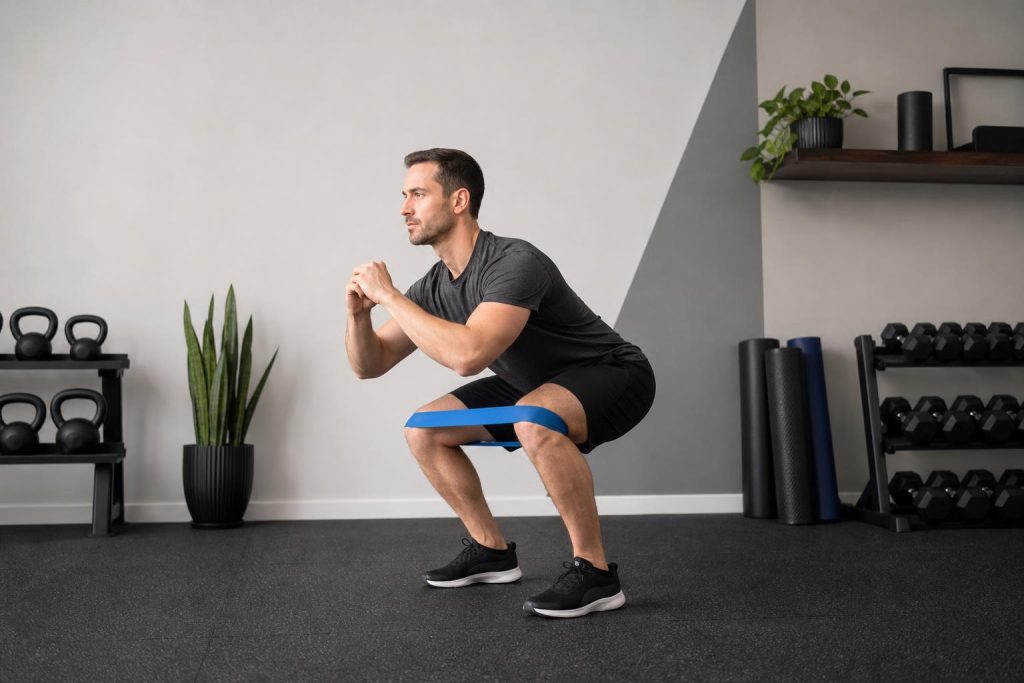
For the lower body, the banded Romanian deadlift is one of the most effective hip-hinge movements available outside of a weight room. Stand on a medium-to-heavy band, hold the handles at hip height, and hinge with a neutral spine, loading the hamstrings and glutes under tension. Pair this with banded squats — standing on the band, handles at shoulder height — and you have the foundation of a legitimate leg session. For glute activation and hip abductor strength, lateral band walks and clamshells remain staples in both rehabilitation and performance contexts, with EMG research confirming high glute medius activation during elastic band hip exercises compared to bodyweight-only alternatives.
For the upper body, banded rows are the anchor of any pulling routine. Anchor a band to a door frame or a sturdy post, grab the handles, and drive your elbows back toward your hips while squeezing the scapulae together. This directly targets the mid-back, rear deltoids, and biceps — the muscles most men neglect in favor of pressing movements. Banded chest presses, performed by anchoring the band behind you and pressing forward in a standing or floor position, load the pectorals and anterior deltoid through a functional range. Overhead presses with a band under foot build shoulder strength and stability without the spinal compression that can accompany heavy barbell work.
Core and anti-rotation work rounds out a complete program. The Pallof press — anchoring a band at chest height and pressing straight out while resisting rotation — is one of the most evidence-supported core stability exercises in the literature. Research on anti-rotation training supports its role in building functional core strength that transfers to everyday movement and athletic performance alike. Train it bilaterally, and you’re addressing the rotational imbalances most men develop from years of asymmetrical loading.
In terms of programming structure, three sets of twelve to fifteen reps per exercise, with a one-to-two second controlled eccentric phase, is a reliable starting point. As exercises become easier, progress by using a heavier band, shortening your stance on the band to increase tension, or slowing your tempo further. These are your levers for progressive overload — the non-negotiable driver of adaptation in any training system.
The Takeaway
Resistance bands won’t replace every tool in a serious lifter’s arsenal — but for home training, they are far more capable than their reputation suggests. The science is clear that elastic resistance drives strength and muscle preservation outcomes that rival conventional equipment when programmed with intention. For men in a caloric deficit, managing medications, traveling frequently, or simply building a sustainable home training habit, a quality set of bands and a structured plan removes every excuse that stands between where you are and where you want to be. The equipment was never the limiting factor. The commitment is.