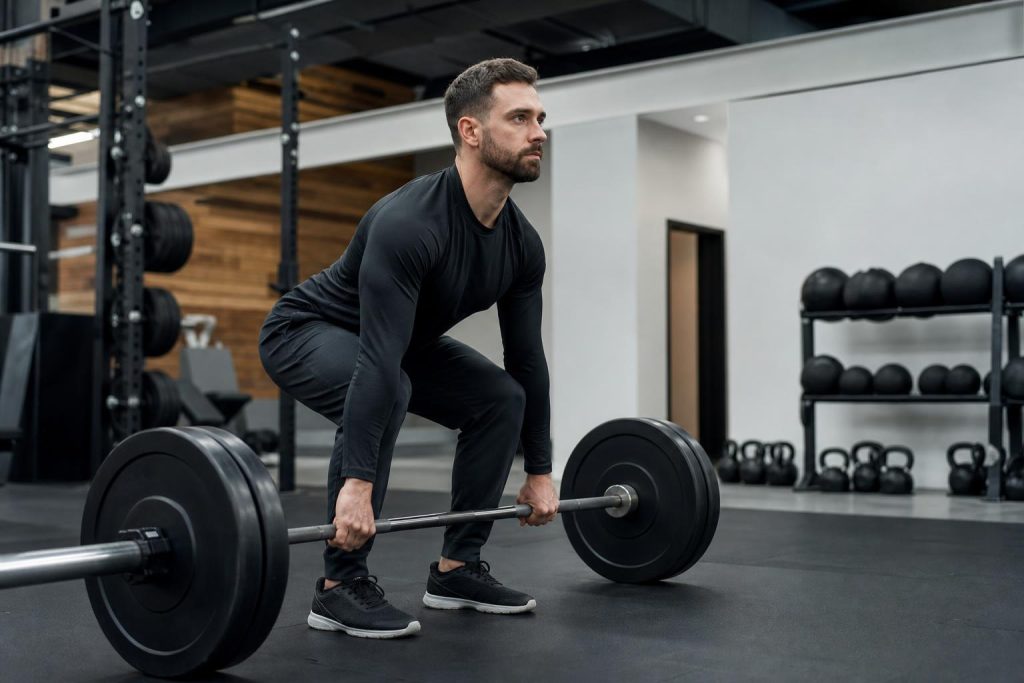
Most men walk into the gym with a vague plan — some pressing, some curling, maybe a few sets of squats — and wonder why their body composition barely shifts. The answer often isn’t effort. It’s movement selection. And one pattern consistently separates the men who transform their physiques from those who just maintain them: the hip hinge. Research published in the Journal of Strength and Conditioning Research confirms that compound posterior chain movements drive significantly greater hormonal and metabolic responses than isolation exercises — and the hip hinge sits at the core of that equation.
The hip hinge is a fundamental human movement pattern involving the flexion and extension of the hips while maintaining a neutral spine. It’s the mechanical basis for deadlifts, Romanian deadlifts (RDLs), kettlebell swings, good mornings, and trap bar pulls. Done correctly, it loads the hamstrings, glutes, and erector spinae under tension — three muscle groups that collectively represent some of the largest contractile tissue in the body. More muscle mass recruited per repetition means more energy expended, more testosterone and growth hormone released, and more metabolic machinery built over time. That’s not gym folklore. A study in the European Journal of Applied Physiology demonstrated that heavy compound lower-body movements produce acute hormonal responses — including elevated testosterone and IGF-1 — that support both muscle retention and fat oxidation.
For men specifically, this matters enormously. Fat loss without muscle preservation is a losing trade. You end up lighter but metabolically weaker — a smaller engine running on less fuel. Whether you’re cutting calories hard, running a caloric deficit through dietary discipline, or using a GLP-1 medication like semaglutide to manage appetite, the principle is identical: you must signal your body to hold onto lean tissue. The hip hinge is one of the most efficient ways to send that signal.
Why the Posterior Chain Is Your Fat Loss Engine
The posterior chain — glutes, hamstrings, adductors, spinal erectors — is often undertrained because it’s the part of the body you can’t see in the mirror. Men naturally gravitate toward chest, shoulders, and arms. But the posterior chain represents roughly 40% of total lean mass in the lower body, and evidence suggests that greater lower-body muscle mass is independently associated with improved insulin sensitivity and reduced visceral adiposity — two of the most important metabolic markers for long-term health.
The Romanian deadlift is perhaps the most practical entry point into hip hinge training. Starting with a barbell or dumbbells at hip height, you push the hips backward while keeping the spine long and neutral, lowering the load down the front of the legs until you feel a deep stretch through the hamstrings, then drive the hips forward to return to standing. The key isn’t just pulling the weight — it’s the eccentric phase, the controlled lowering, where most of the muscle damage and subsequent growth stimulus occurs. Research on eccentric-emphasized training shows it produces greater hypertrophy compared to concentric-only protocols, making the slow, deliberate RDL an exceptionally efficient tool for building muscle in a fat-loss phase.
The conventional deadlift builds on this pattern with a load from the floor, adding quadriceps engagement at the bottom while still placing the majority of demand on the posterior chain. Trap bar deadlifts offer a more upright torso position that reduces lumbar stress — making them an excellent option for men with limited hip mobility or lower back history. The kettlebell swing takes the hinge into the power domain: a ballistic hip extension that trains explosive force production, elevates heart rate rapidly, and has been shown in studies measuring VO2 and caloric expenditure to rival interval training for metabolic conditioning.
How to Program the Hip Hinge for Real Results
The mistake most men make is treating hinge movements as secondary — something tacked onto the end of leg day. Instead, anchor at least one training session per week around a primary hinge pattern, loaded progressively. For hypertrophy and muscle retention during a fat-loss phase, aim for three to four sets of six to ten repetitions on your primary hinge movement — deadlift or RDL — at a load that challenges you without compromising spinal position. A second hinge variation, such as single-leg RDLs or kettlebell swings, can serve as accessory work within the same session or in a separate session later in the week.
Progressive overload remains the governing principle. A landmark meta-analysis in the British Journal of Sports Medicine confirmed that resistance training with progressive overload preserves lean mass during caloric restriction more effectively than any other intervention tested — outperforming protein supplementation alone and cardio-only approaches. Adding five to ten pounds to your deadlift every two to three weeks, or adding a rep before adding weight, is how you build the kind of muscle density that changes how your body handles energy at rest.
Protein intake acts as the necessary co-factor. Aim for at least 0.7 to 1.0 grams per pound of bodyweight daily to support the muscle protein synthesis triggered by hinge training. This holds true regardless of whether you’re eating in a 500-calorie deficit, following a time-restricted eating protocol, or managing appetite with medication. The training stimulus and the nutritional substrate work together — neither alone is sufficient.
Don’t neglect mobility as a prerequisite. Tight hamstrings and limited hip flexion cause the lumbar spine to compensate, converting a safe, productive movement into an injury waiting to happen. Spending five minutes before each session on 90-90 hip stretches, hamstring mobilizations, and cat-cow spinal warm-ups will dramatically improve your hinge mechanics and protect your lower back over the long term.
The Takeaway
The hip hinge isn’t a trend or a hack. It’s a foundational movement pattern that humans are built to perform — and one that delivers an outsized return on investment for men pursuing fat loss without sacrificing the muscle they’ve worked to build. If you’re not anchoring your program around deadlifts, RDLs, or swings, you’re leaving your best metabolic tool unused. Load the hinge, protect the spine, eat enough protein, and let the physiology work in your favor.