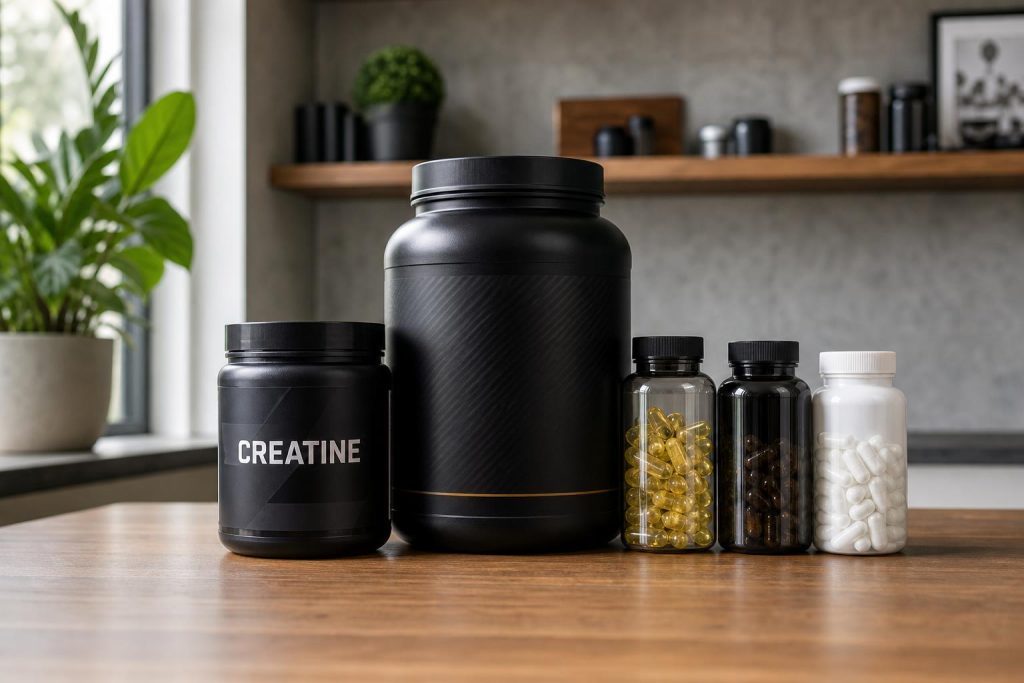
The supplement industry promises quick fixes for fat loss—but most fall short of the hype. If you’re serious about losing fat, you need to know which supplements actually work according to science, and which ones waste your money.
The reality: nutrition, training, and sleep are the foundation. Supplements fill gaps—they don’t replace fundamentals. But when chosen correctly, certain supplements can accelerate fat loss, preserve muscle, boost metabolism, and improve your results.
This guide covers the supplements with the strongest evidence for fat loss in men, practical dosing protocols, and honest talk about what actually moves the needle.
The Supplement Foundation: What Actually Works for Fat Loss
Before diving into specific supplements, let’s establish what “works” means. A supplement for fat loss should:
- Increase fat oxidation (fat burning) or reduce appetite
- Preserve lean muscle during a caloric deficit
- Support metabolic health and energy levels
- Have human clinical evidence—not just animal studies or test tubes
Most supplements fail because they’re tested in isolation, at unrealistic doses, or in populations that don’t match you (obese women, sedentary individuals, etc.). Your job is to separate signal from noise.
The most impactful supplements for fat loss work through one of three mechanisms:
- Appetite suppression – making it easier to maintain a caloric deficit
- Thermogenesis/metabolic rate – increasing calorie expenditure
- Muscle preservation – protecting lean mass during fat loss
Everything else is noise.
1. Caffeine: The Most Studied and Reliable Fat Loss Tool
Let’s start with what works: caffeine is one of the few supplements with robust evidence for fat loss across dozens of clinical trials.
How it works: Caffeine increases thermogenesis (heat production), enhances fat oxidation, and improves workout performance—all of which contribute to fat loss when combined with training.
The evidence: A meta-analysis of caffeine and fat loss shows consistent 3-5% increases in fat oxidation when combined with exercise. It also reduces perceived effort during training, meaning you work harder without feeling it—a huge advantage during a cut.
Practical protocol:
- Dose: 3-6 mg/kg of body weight (roughly 200-400 mg for most men)
- Timing: 30-60 minutes before training or cardio
- Form: coffee, tea, or caffeine pills (all equally effective)
- Tolerance: Cycle off for 1-2 weeks every 8-12 weeks to maintain sensitivity
Caffeine is cheap, safe at appropriate doses, and doesn’t require a prescription. If you’re only adding one supplement, this should be it.
2. Protein Powder: Muscle Preservation and Satiety During Fat Loss
Protein supplementation isn’t sexy, but it’s essential during fat loss. When you’re in a caloric deficit, your body catabolizes muscle for energy. Adequate protein intake is your primary defense.
How it works: Protein has the highest thermic effect of any macronutrient (you burn 20-30% of protein calories just digesting it). It’s also highly satiating, meaning it keeps you full longer—critical when cutting calories.
The evidence: Research consistently shows that higher protein intake during caloric deficits preserves more lean mass and promotes fat loss specifically (rather than losing a mixture of fat and muscle). Studies suggest 0.7-1.0g per pound of body weight daily during fat loss.
Practical protocol:
- Target: 1.6-2.2g per kg of body weight daily (roughly 0.7-1.0g per lb)
- Type: Whey isolate or concentrate, casein, or plant-based blends—all work equally if total protein is adequate
- Timing: Spread throughout the day; post-workout is slightly advantageous but not critical
- Quality: Look for third-party tested brands (NSF Certified, Informed Choice) to avoid contaminants
Protein powder is cost-effective and makes hitting protein targets easier when whole food alone isn’t practical. It’s not optional if you’re serious about preserving muscle during fat loss.
3. Creatine Monohydrate: Muscle Retention and Strength During a Cut
Creatine is one of the most researched supplements in sports science—and it deserves a spot in any fat loss protocol, particularly if you’re training hard.
How it works: Creatine increases ATP availability in muscle cells, enhancing strength and power output. During a caloric deficit when energy is low, this allows you to maintain training intensity—which directly preserves muscle mass.
The evidence: Multiple studies show that creatine supplementation during resistance training and caloric restriction preserves lean mass better than placebo. It also appears to have mild cognitive benefits and may support metabolic health.
Practical protocol:
- Dose: 5g daily (no loading phase necessary, though some prefer 20g/day for 5-7 days then 5g daily)
- Timing: Anytime daily; consistency matters more than timing
- Form: Creatine monohydrate (most studied, cheapest, equally effective as expensive versions)
- Hydration: Drink slightly more water when supplementing (creatine pulls water into muscles)
- Timeline: Takes 3-4 weeks to see full effects; requires consistent use
Creatine is safe, inexpensive, and backed by decades of research. It won’t directly burn fat, but it preserves muscle and maintains strength when everything else is working against you during a cut.
4. Green Tea Extract (EGCG): Modest but Measurable Fat Loss Support
Green tea extract contains catechins, particularly EGCG, which show modest thermogenic effects in research. It’s not a game-changer alone, but it stacks well with other tools.
How it works: EGCG appears to inhibit catechol-O-methyltransferase (COMT), an enzyme that breaks down norepinephrine. Higher norepinephrine drives fat oxidation and thermogenesis.
The evidence: Meta-analyses show green tea extract produces a small but consistent increase in fat oxidation and fat loss—roughly 1-3 pounds over 12 weeks when combined with exercise. Effects are modest but reliable.
Practical protocol:
- Dose: 300-500 mg of EGCG daily (standardized extract)
- Timing: With meals, split into 2-3 doses
- Form: Standardized extract (more reliable than whole leaf tea)
- Duration: 8-12 weeks minimum to assess effects
Green tea extract is a supporting player, not a primary tool. Use it alongside caffeine, solid training, and proper nutrition for cumulative benefit.
5. Omega-3 Fatty Acids (Fish Oil): Metabolic Health and Inflammation
Fish oil isn’t a direct fat-burner, but it supports the metabolic environment that allows fat loss to happen efficiently.
How it works: Omega-3 fatty acids reduce inflammation, support insulin sensitivity, and may enhance fat oxidation at the cellular level. They’re particularly important if your diet is high in omega-6 (vegetable oils, processed foods).
The evidence: While fish oil alone won’t create fat loss, studies show it improves metabolic markers and may enhance fat loss when combined with exercise and caloric deficit. It also supports cardiovascular and neurological health—benefits beyond fat loss.
Practical protocol:
- Dose: 2-3g combined EPA+DHA daily
- Quality: Ensure third-party testing for mercury and oxidation (rancid oil is harmful)
- Alternative: Fatty fish (salmon, mackerel) 2-3x weekly provides equal benefits without supplementation
- Timing: With meals to enhance absorption
Fish oil is a metabolic health investment more than a fat-loss accelerant. Think of it as supporting the system rather than forcing change.
Supplements to Skip (And Why)
Before we wrap up, let’s address what doesn’t work:
- CLA (Conjugated Linoleic Acid) – Minimal fat loss in humans; most studies show negligible results
- Carnitine – Effective only if deficient; supplementation doesn’t help adequately-nourished men
- Garcinia Cambogia/Hydroxycitric Acid – Modest appetite suppression in some studies, but effect is small and inconsistent
- Proprietary “fat-burner” blends – Uncontrolled formulas with untested ingredient combinations and marketing hype
The general rule: if a supplement isn’t well-studied in isolation, it’s likely not going to work. Skip the complexity.
The Complete Fat Loss Supplement Stack (Evidence-Based)
If you’re implementing supplements, here’s what actually matters:
Tier 1 (Essential):
- Protein powder (to hit daily protein targets)
- Caffeine (pre-workout)
- Creatine monohydrate (5g daily)
Tier 2 (Supportive):
- Fish oil (omega-3s for metabolic health)
- Green tea extract (modest thermogenic support)
That’s it. Everything else is either unnecessary or unproven.
Monthly cost estimate: $40-60 for high-quality versions of all five. Compare that to the price of one month of gym membership, and the investment becomes trivial.
What Supplements Don’t Replace
This is critical: supplements enhance a solid foundation. They do not replace:
- Caloric deficit – You cannot out-supplement overeating
- Resistance training – Lifting preserves muscle during fat loss; supplements alone won’t
- Sleep – Recovery hormones (testosterone, growth hormone) are regulated during sleep; poor sleep destroys fat loss
- Whole foods – Real nutrition should be 90%+ of your intake; supplements fill gaps
If your foundation is weak, adding supplements is like putting premium fuel in an engine with no oil. Get the basics right first.
Bottom Line
The best supplements for fat loss in men are:
- Caffeine – Most reliable, proven, inexpensive. Use it.
- Protein powder – Essential for hitting protein targets and preserving muscle during a cut.
- Creatine monohydrate – Maintains strength and muscle when calories are low.
- Fish oil – Supports metabolic health and inflammation management.
- Green tea extract – Modest thermogenic support; pairs well with caffeine.
Everything else is marketing. Supplements work—but only when diet, training, and sleep are locked in first. Start there, add these five tools, and reassess in 8-12 weeks. The results will speak for themselves.
Next Steps
Ready to optimize your fat loss? Check out our complete guide to structuring a caloric deficit or explore the best training protocols for fat loss. Questions about specific supplements? Review our supplement FAQ or reach out with your situation.
Scientific References
-
Rawlings et al. (2006).
Cellulite and its treatment..
International journal of cosmetic science.
View on PubMed →