When you’re trying to lose fat, your body doesn’t discriminate—it will burn muscle and fat indiscriminately unless you take specific steps to prevent it. The difference between losing 20 pounds of pure fat versus losing 12 pounds of fat and 8 pounds of muscle comes down to one primary factor: dietary protein intake.
Research from the American Journal of Clinical Nutrition shows that men consuming higher protein during a calorie deficit combined with resistance training preserved significantly more lean body mass and lost more fat than those eating standard protein amounts. This isn’t theoretical—it’s measurable, reproducible, and one of the most evidence-backed nutrition strategies for fat loss.
Here’s what you need to know about using protein strategically for fat loss, backed by peer-reviewed research and actionable for your specific situation—whether you’re training hard in the gym, using GLP-1 medications, or pursuing fat loss through diet and lifestyle alone.
Why Protein Is Non-Negotiable During Fat Loss
When you’re in a calorie deficit—the only proven way to lose fat—your body is in a catabolic state. Without sufficient protein, your body will break down muscle tissue for energy alongside fat. This is metabolically expensive and ruins your body composition.
The landmark study by Longland, Oikawa, and Mitchell (2016) demonstrated that men consuming 2.4g of protein per kilogram of body weight during a calorie deficit lost significantly more fat while gaining lean mass, compared to men eating 1.2g/kg. The difference wasn’t marginal—it was substantial enough to completely change body composition outcomes.
Why does protein matter this much?
- Preserves muscle tissue: Protein provides amino acids needed to maintain muscle fibers during calorie restriction
- Increases satiety: Protein is the most satiating macronutrient, reducing hunger and making calorie deficits sustainable
- Higher thermic effect: Your body burns ~25% of protein calories digesting it (vs. ~10% for carbs, ~5% for fat), meaning higher protein creates a slight metabolic advantage
- Supports strength training recovery: Critical for maintaining performance and muscle mass during deficit phases
How Much Protein Do You Actually Need for Fat Loss?
The standard recommendation of 0.8g per kilogram of body weight (the RDA) is designed for sedentary adults maintaining weight—not for men losing fat while training.
Evidence-based protein targets for fat loss:
- Minimum: 1.6-1.8g per kilogram of body weight (~0.73-0.82g per pound)
- Optimal for fat loss + muscle preservation: 2.0-2.4g per kilogram (~0.9-1.1g per pound)
- For aggressive deficits (>500 cal/day): Aim toward the higher end (2.2-2.4g/kg)
Practical example: A 200-pound man should aim for 180-220g of protein daily during fat loss, with 200-220g being ideal if training hard or in a significant deficit.
This seems high, but it’s achievable and necessary. Studies show this level is safe and produces superior fat loss outcomes compared to standard protein intake.
Protein Sources That Actually Work
Not all protein is equal. You need complete proteins containing all nine essential amino acids, and you need them distributed throughout the day for maximum muscle protein synthesis.
Best protein sources for fat loss:
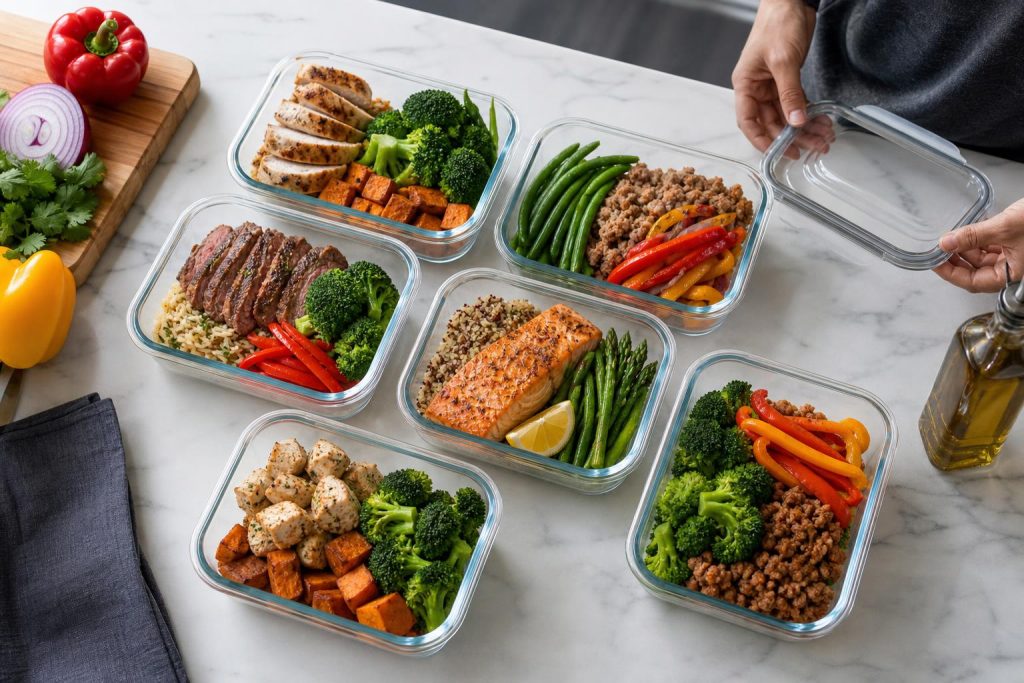
- Lean meats: Chicken breast, turkey, lean beef (93% lean or higher)
- Fish: Salmon, cod, tilapia—added benefit of omega-3s
- Eggs: Whole eggs and egg whites, one of the most satiating foods
- Dairy: Greek yogurt (20-30g protein per serving), cottage cheese, low-fat milk
- Protein powder: Whey protein isolate for convenience and minimal carbs/fat
- Plant-based: Legumes, tofu, tempeh (combine with complete amino acid profiles)
Practical strategy: Aim for 30-40g of protein per meal across 3-4 meals, rather than front-loading all protein at dinner. This optimizes muscle protein synthesis throughout the day and maintains satiety.
The Carbohydrate Question: How Low Should You Go?
One of the most controversial aspects of fat loss is carbohydrate intake. Many men ask: should I go low-carb or keto to maximize fat loss?
The evidence is nuanced. A 2022 Cochrane review comparing low-carbohydrate to balanced-carbohydrate diets found that both approaches produce similar fat loss over 2+ years when calories are controlled. In other words: total calories matter more than carb restriction.
However, research in The Lancet found that very low carbohydrate diets (below 40% of calories) may carry long-term metabolic risks, particularly when carbs are replaced with saturated fat rather than protein or unsaturated fat.
The practical takeaway: You don’t need to go ultra-low-carb for fat loss. Instead:
- Prioritize protein first (as outlined above)
- Create your calorie deficit primarily through portion control, not carb elimination
- Maintain 40-50% of calories from carbs, focusing on whole sources: oats, rice, potatoes, vegetables
- Fill the remainder with healthy fats: olive oil, nuts, avocado
- If you prefer low-carb or keto, that works too—but it’s not required and may complicate adherence for some men
Protein, Exercise, and Fat Loss: The Critical Combination
High protein alone doesn’t build or preserve muscle during a deficit—you need resistance training. The research specifically showed that the benefits of high protein only emerged when combined with intense resistance exercise.
Why this matters: Your muscles only have reason to remain if you’re using them under load. Without training stimulus, excess protein is simply metabolized for energy.
Optimal fat loss protocol:
- Resistance training: 3-5 days per week, compound movements (squats, deadlifts, bench press, rows)
- Protein intake: 2.0-2.4g per kilogram of body weight
- Calorie deficit: 300-500 calories below maintenance (aggressive deficits without training = muscle loss)
- Cardio: Optional, but 2-3 sessions of moderate cardio can enhance deficit without compromising recovery
Long-term studies show that men who combine calorie restriction with exercise maintain better cardiometabolic health markers than diet alone, meaning this isn’t just about aesthetics—it’s about durability.
Practical Implementation: A Real-World Example
Let’s say you’re a 200-pound man aiming to lose fat while preserving muscle:
Daily targets:
- Protein: 200-220g (1.0-1.1g per pound)
- Calories: 2,200-2,500 (assuming ~3,000 maintenance, creating 500-calorie deficit)
- Carbs: 225-275g (roughly 40% of calories)
- Fat: 60-75g (roughly 25-30% of calories)
Sample day:
- Breakfast: 3 whole eggs + 1 cup oatmeal (35g protein, 50g carbs)
- Snack: Greek yogurt with berries (25g protein, 30g carbs)
- Lunch: 7oz chicken breast + 2 cups white rice (55g protein, 80g carbs)
- Snack: Protein shake with banana (30g protein, 30g carbs)
- Dinner: 8oz salmon + sweet potato + broccoli (50g protein, 40g carbs)
Total: ~195g protein, ~230g carbs, ~2,400 calories
This creates a sustainable deficit while keeping you full and maintaining training performance.
Bottom Line
Fat loss for men comes down to three proven pillars: a calorie deficit, high protein intake (2.0-2.4g per kilogram of body weight), and consistent resistance training. Research consistently shows this combination preserves muscle while maximizing fat loss, producing the body composition changes you’re actually after.
You don’t need extreme diets, carb elimination, or supplements. You need protein, consistency, and patience. Whether you’re using GLP-1 medications (which suppress appetite and make high protein easier to hit), traditional calorie restriction, or any other approach, prioritizing protein and training will dramatically improve your results.
Start with 2.0g per kilogram of body weight, train hard 3-5 days per week, and create a moderate calorie deficit. Track for 2-4 weeks to ensure you’re hitting targets, then adjust based on results. Most men see meaningful fat loss and muscle preservation within 8-12 weeks.
Ready to optimize your approach? Explore our guides on effective resistance training protocols for fat loss and sustainable calorie deficit strategies to build out your full fat loss plan.
Scientific References
-
Longland, Oikawa, Mitchell et al. (2016).
Higher compared with lower dietary protein during an energy deficit combined with intense exercise promotes greater lean mass gain and fat mass loss: a randomized trial..
The American journal of clinical nutrition.
View on PubMed → -
Seidelmann, Claggett, Cheng et al. (2018).
Dietary carbohydrate intake and mortality: a prospective cohort study and meta-analysis..
The Lancet. Public health.
View on PubMed → -
Naude, Brand, Schoonees et al. (2022).
Low-carbohydrate versus balanced-carbohydrate diets for reducing weight and cardiovascular risk..
The Cochrane database of systematic reviews.
View on PubMed → -
Kraus, Bhapkar, Huffman et al. (2019).
2 years of calorie restriction and cardiometabolic risk (CALERIE): exploratory outcomes of a multicentre, phase 2, randomised controlled trial..
The lancet. Diabetes & endocrinology.
View on PubMed → -
Bazzano, Hu, Reynolds et al. (2014).
Effects of low-carbohydrate and low-fat diets: a randomized trial..
Annals of internal medicine.
View on PubMed →