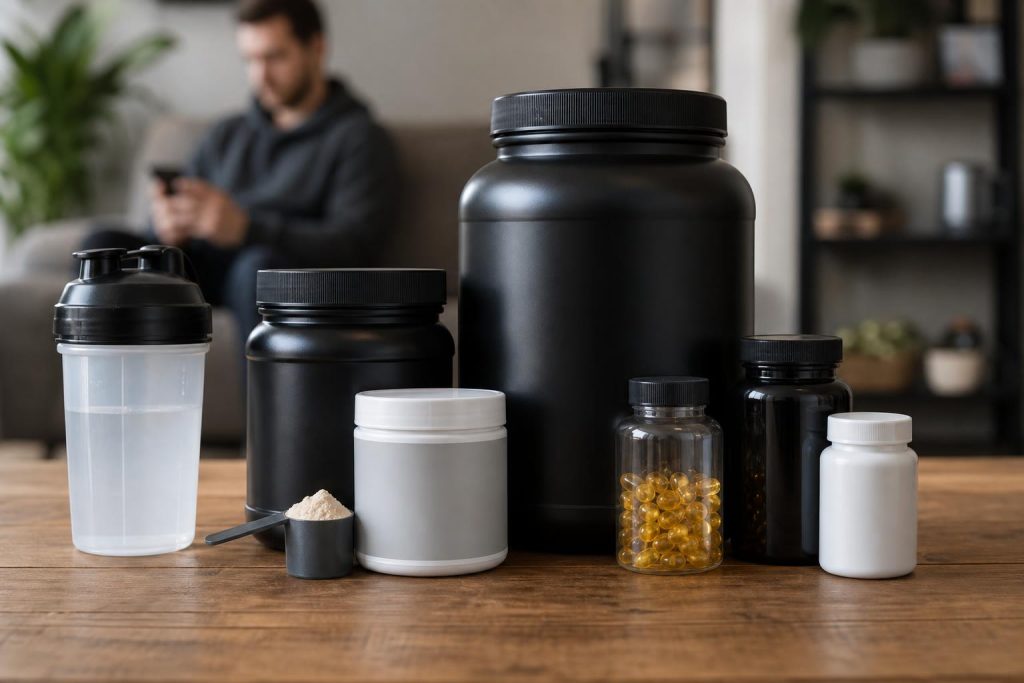
Supplement companies make bold claims about fat loss every day. Most don’t hold up to scrutiny. But some do—and the research is clear about which ones actually move the needle when combined with solid nutrition and training.
This guide cuts through the marketing noise and focuses on supplements with genuine clinical evidence supporting their role in body composition improvement for men. Whether you’re pursuing fat loss through traditional diet and exercise, using GLP-1 medications, or taking a hybrid approach, understanding what supplements can legitimately help is essential to making smart spending decisions.
Why Most Fat Loss Supplements Fail—And What Actually Works
The supplement industry thrives on hope, not results. Most fat loss products fail because they try to compensate for poor fundamentals: inadequate protein intake, caloric excess, lack of resistance training, and poor sleep.
The hierarchy of what matters for fat loss:
- Caloric deficit or appropriate energy balance
- Adequate protein intake (0.7-1g per lb of body weight)
- Resistance training to preserve muscle
- Sleep and stress management
- Supplements (as a secondary tool)
Supplements can enhance fat loss, but they cannot replace these fundamentals. Think of them as a 5-10% optimization on top of solid execution elsewhere.
Caffeine: The Proven Metabolic Amplifier
Caffeine is the most researched fat-loss supplement, and the evidence is robust. It increases fat oxidation, boosts metabolic rate, and improves exercise performance—all of which support fat loss when combined with a caloric deficit.
Mechanism: Caffeine blocks adenosine receptors and increases norepinephrine, which mobilizes fat and increases thermogenesis (heat production). Studies show a 3-5% increase in metabolic rate and enhanced fat loss, particularly during fasted training.
Practical protocol:
- Dose: 200-400mg per day, split into 100-200mg doses (morning, pre-workout)
- Timing: 30-60 minutes before training for maximum fat mobilization
- Best source: Coffee, tea, or a quality caffeine supplement
- Note: Tolerance develops, so cycling off for 1-2 weeks every 8-12 weeks maintains efficacy
If you’re using GLP-1 medications and experiencing appetite suppression, caffeine can help with energy and training performance without forcing additional food consumption.
Protein Powder: The Muscle-Preserving Essential
Protein powder isn’t technically a “fat loss” supplement—it’s a nutritional tool that enables fat loss by supporting muscle preservation during caloric deficits.
Men pursuing fat loss often fall short of adequate protein intake (0.7-1g per lb of body weight). This leads to muscle loss alongside fat loss, a poor outcome that undermines long-term metabolism and appearance.
Why it works: Protein has the highest thermic effect of any macronutrient (20-30% of calories burned in digestion), increases satiety, and provides amino acids necessary for muscle retention during caloric restriction.
Practical protocol:
- Daily intake: 1g per lb of target body weight (or 0.8-1g per lb of current weight)
- Dose: 25-40g per serving
- Best options: Whey isolate for fast absorption post-workout, whey protein concentrate for cost-effectiveness, or casein for sustained release before bed
- Whole food first: Prioritize chicken, fish, beef, and eggs; use powder to fill gaps
Protein powder is particularly valuable if you’re managing multiple dietary approaches—GLP-1 users often find it easier to consume adequate protein through shakes given reduced appetite.
Creatine Monohydrate: The Overlooked Fat-Loss Tool
Creatine is famous as a muscle-building supplement, but research shows it indirectly supports fat loss by enhancing training performance and muscle preservation.
Mechanism: Creatine increases ATP availability in muscle cells, allowing for more reps, heavier weights, and longer training sessions. More intense training = greater muscle stimulus = better muscle retention during caloric deficit. Additionally, creatine pulls water into muscle cells, which may enhance protein synthesis.
Practical protocol:
- Dose: 5g per day (no loading phase needed; effects plateau after 3-4 weeks)
- Timing: Take with carbs and protein for better absorption; timing is secondary to consistency
- Duration: Continuous use; creatine is safe and side-effect free at standard doses
- Best source: creatine monohydrate (most researched, cheapest)
- Expect: 2-3 lbs of water weight gain initially (not fat); improved workout performance over 4-6 weeks
Green Tea Extract (EGCG): The Modest Thermogenic
Green tea extract contains EGCG (epigallocatechin gallate), a polyphenol that slightly increases fat oxidation and thermogenesis.
Reality check: The effect is modest—roughly 3-5% enhanced fat loss when combined with a caloric deficit and exercise. It’s not a game-changer, but it’s safe, inexpensive, and has broader health benefits (antioxidants, cardiovascular support).
Practical protocol:
- Dose: 300-400mg EGCG per day (standardized extract)
- Timing: With meals, or combined with caffeine for synergistic effect
- Source: Green tea supplement or simply drink 2-3 cups of green tea daily
- Cost-benefit: At $10-15/month, it’s reasonable if you’re already optimizing fundamentals
Bottom Line: Supplements Are the 5% Play
The best fat-loss supplements for men are:
- Caffeine – For metabolic boost and training performance
- Protein powder – For muscle preservation and satiety
- Creatine monohydrate – For training quality and muscle retention
- Green tea extract – Optional, for a modest additional thermogenic effect
These are legitimate, research-backed tools. But they work only within the context of:
- A caloric deficit (or appropriate energy balance if using GLP-1)
- Adequate protein intake
- Consistent resistance training
- Quality sleep and stress management
Spend your money on real food and a gym membership first. Use supplements to optimize what’s already working, not to compensate for weak fundamentals.
Ready to build a complete fat-loss protocol? Read our guide on protein targets for men cutting fat or the evidence-based resistance training split for body composition.
Scientific References
-
Rawlings et al. (2006).
Cellulite and its treatment..
International journal of cosmetic science.
View on PubMed →