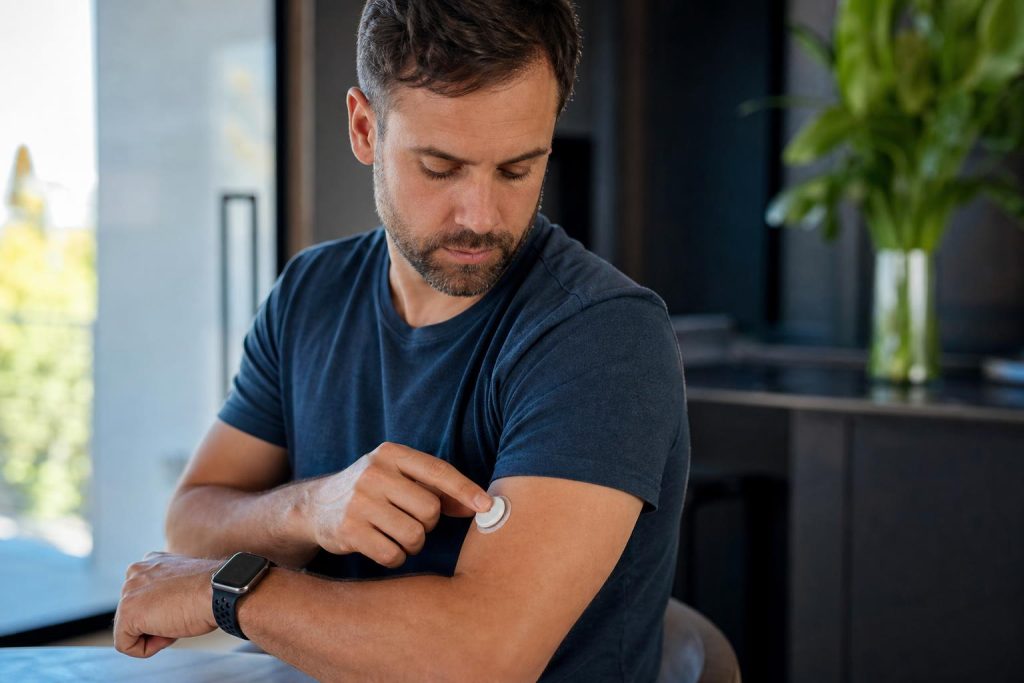
Continuous Glucose Monitoring for Metabolic Health Optimization: A GLP-1 User’s Guide
If you’re taking semaglutide, tirzepatide, or any GLP-1 medication, you already understand the power of optimized metabolic control. But here’s what many users miss: continuous glucose monitoring (CGM) can amplify your results by providing real-time feedback on how your body responds to food, training, and medication.
Recent research shows that CGM users achieve significantly higher time-in-range (TIR) metrics and develop more precise understanding of their metabolic patterns. For GLP-1 users specifically, this data becomes a strategic advantage—allowing you to preserve muscle during fat loss, optimize training performance, and prevent the metabolic adaptation that often stalls progress.
This guide walks you through exactly how to leverage CGM technology alongside your GLP-1 therapy to maximize fat loss while maintaining lean mass and metabolic health.
How Continuous Glucose Monitoring Works With GLP-1 Medications
GLP-1 agonists work by slowing gastric emptying and enhancing insulin secretion—fundamentally changing how your body processes glucose. But without visibility into your glucose patterns, you’re optimizing blind.
CGM devices measure interstitial glucose every 5-15 minutes, providing 288-1,440 data points per day compared to traditional finger-stick testing’s 4-6 points. This granular data reveals:
- Postprandial glucose spikes—how different foods trigger blood sugar responses while on GLP-1
- Dawn phenomenon patterns—whether your fasting glucose is optimally controlled
- Exercise-induced glucose dynamics—how training impacts your metabolic state
- GLP-1 medication efficacy—whether your dose is optimally suppressing appetite and glucose excursions
For GLP-1 users in a caloric deficit (necessary for fat loss), this feedback prevents guesswork. You’ll know exactly whether that “low appetite” moment is genuine metabolic suppression or a glucose dip that needs fuel.
CGM Data-Driven Nutrition Optimization on GLP-1 Therapy
One of the biggest challenges for GLP-1 users is eating enough protein and calories while managing appetite suppression. CGM data solves this.
Research comparing Mediterranean and plant-based diets in prediabetic adults shows that calorie restriction combined with strategic dietary choices significantly improves glycemic control and metabolic markers. For GLP-1 users, this means:
Protein Timing Strategy:
- Track CGM response 30-60 minutes post-protein intake. High-quality protein (chicken, fish, whey isolate, Greek yogurt) should produce minimal glucose spikes while providing satiety signals that complement GLP-1’s appetite suppression.
- Aim for 0.8-1.0g protein per pound of body weight daily, split across 4-5 meals. This dose preserves muscle mass during the aggressive fat loss phase that GLP-1 enables.
- Use CGM to identify “safe carb windows”—typically post-workout when glucose clearance is highest. A continuous glucose monitoring system will show you when your muscles are primed to absorb carbs without blood sugar dysregulation.
Practical Protocol:
- Log meals in a CGM app (Freestyle Libre, Dexcom, Eversense) alongside your food intake
- Identify your personal glycemic load threshold—the calorie and carb amount that keeps you under 140 mg/dL postprandial
- For most GLP-1 users, this range is 20-40g net carbs per meal, but your CGM will show your individual tolerance
- Pair carbs with protein and healthy fat to blunt glucose excursions further
Training Performance and Recovery: Using CGM to Prevent Energy Crashes
GLP-1 medications enhance insulin sensitivity and glucose utilization, but this creates a unique challenge: if you’re training hard while in a caloric deficit, glucose crashes become a real risk.
Pre-Workout CGM Protocol:
- Check your CGM 30 minutes before training. You want to see a stable or slightly rising glucose trend.
- If glucose is below 100 mg/dL, consume 15-20g fast carbs (4-6 oz orange juice, 1 medium banana, 4-5 glucose tablets) with your GLP-1 dose—the medication will slow absorption and prevent spiking.
- If glucose is 100-150 mg/dL and rising, train fasted—your endogenous glucose production and fat mobilization will fuel performance.
Intra-Workout Fueling (for sessions >90 minutes):
- Monitor CGM every 20-30 minutes. If you see declining glucose trend, consume 5-10g carbs with electrolytes.
- GLP-1 users typically need 30-50% less carbs than non-users during endurance work because of enhanced glucose efficiency.
Post-Workout Recovery Window:
- CGM will show elevated glucose uptake into muscles for 30-60 minutes post-training. This is your carb-loading window.
- Consume 20-40g carbs + 20-30g protein within 60 minutes of training completion
- Your CGM should show glucose stabilizing around 120-140 mg/dL—not spiking above 180 mg/dL (which signals overfeeding relative to your current needs)
CGM Metrics That Matter for GLP-1 Users: Beyond HbA1c
Diabetes technology research shows that CGM-based metrics like time-in-range (TIR) and glucose variability are now preferred over HbA1c alone for assessing metabolic control. For GLP-1 users, focus on these specific metrics:
Time in Range (TIR): 70-180 mg/dL
- Target: ≥70% of your readings in this window
- GLP-1 users often achieve 80-95% TIR because the medication inherently suppresses postprandial spikes
- Track weekly, not daily—daily variance is normal and doesn’t indicate poor control
Glucose Variability (Standard Deviation or Coefficient of Variation)
- Lower variability = more stable energy, better workout performance, reduced metabolic stress
- GLP-1 medications reduce variability by 15-25% in clinical studies
- Target: CV <30% (more stable than 35-40%)
Time Below Range (TBR): <70 mg/dL
- For non-diabetic GLP-1 users: Keep <5% of readings in this range
- Persistent TBR indicates either overestimation of medication dose or under-fueling during training—adjust intake accordingly
Fasting Glucose Trend
- Morning readings should fall in 85-110 mg/dL range on GLP-1
- Rising fasting glucose despite medication suggests inadequate evening meal composition—shift toward more protein, less refined carbs at dinner
Practical Implementation: Your 4-Week CGM Optimization Protocol
Week 1: Baseline Assessment
- Start CGM without changing diet or training
- Log all meals, training sessions, sleep quality, and stress levels
- Identify your current average glucose, TIR %, and glucose variability
- Note the foods that produce your largest spikes (likely refined carbs or high-fat processed foods)
Week 2-3: Macro Optimization
- Increase protein intake to 0.8-1.0g/lb bodyweight. Monitor how this affects satiety and glucose stability.
- Reduce refined carbs. Replace with whole grains, legumes, and vegetables—track which sources keep you in range.
- Test different meal timing windows. Many GLP-1 users find 3 meals (no snacking) works better than 5-6 meals.
- Continue training normally; observe glucose response to different exercise types.
Week 4: Training Integration
- Use pre-workout CGM data to guide fueling decisions
- Document performance metrics (strength, endurance, recovery) alongside glucose data
- Identify your ideal pre-workout glucose state (most users perform best at 110-150 mg/dL)
- Finalize your nutrition protocol based on 4 weeks of data
Consider pairing CGM with a smart scale that tracks body composition trends to correlate glucose patterns with fat loss and muscle preservation progress.
Common GLP-1 + CGM Questions Answered
Q: Will CGM show me if I’m taking too high a GLP-1 dose?
Yes. Excessive glucose variability, frequent TBR events, or persistently low fasting glucose (below 85 mg/dL) suggest your dose may be optimized beyond your current needs. Discuss with your prescriber—they may reduce dose slightly to improve training performance without sacrificing fat loss.
Q: Do I need CGM if I’m not diabetic?
For metabolic health optimization and body recomposition, yes. Non-diabetic GLP-1 users still benefit from understanding individual carb tolerance, identifying reactive foods, and preventing energy crashes during training. Think of CGM as performance biofeedback, not just diabetes management.
Q: How long should I use CGM?
Minimum 4 weeks to establish baseline patterns. Ideally, 8-12 weeks to catch seasonal variations and training cycle changes. Many users benefit from ongoing intermittent CGM use (1 week per quarter) to ensure their nutrition stays optimized as GLP-1 doses change.
Q: Will better glucose control hurt my fat loss results?
No. Stable glucose = stable energy = better training adherence = better body composition. Dysregulated glucose (spikes and crashes) increases cortisol, impairs fat oxidation, and triggers cravings. GLP-1 + CGM optimization accelerates fat loss while preserving muscle.
Bottom Line: CGM as a GLP-1 Force Multiplier
Continuous glucose monitoring transforms GLP-1 therapy from a blunt metabolic tool into a precision instrument. By providing real-time glucose data, CGM allows you to:
- Optimize nutrition without guesswork—eat enough protein and calories to preserve muscle
- Train harder without energy crashes—fuel strategically based on actual glucose trends
- Prevent medication tolerance—ensure your dose remains effective by monitoring actual metabolic response
- Accelerate fat loss—leverage the metabolic advantages of GLP-1 with data-driven precision
If you’re serious about body recomposition on GLP-1, CGM isn’t optional—it’s your competitive advantage.
Ready to maximize your GLP-1 results? Explore our complete guides on muscle preservation during GLP-1 therapy and optimizing GLP-1 dosing for fat loss without side effects. Your metabolic future starts with data.
Scientific References
-
Schubert-Olesen, Kröger, Siegmund et al. (2022).
Continuous Glucose Monitoring and Physical Activity..
International journal of environmental research and public health.
View on PubMed → -
Flockhart, Larsen et al. (2024).
Continuous Glucose Monitoring in Endurance Athletes: Interpretation and Relevance of Measurements for Improving Performance and Health..
Sports medicine (Auckland, N.Z.).
View on PubMed → -
Nwokolo, Hovorka et al. (2023).
The Artificial Pancreas and Type 1 Diabetes..
The Journal of clinical endocrinology and metabolism.
View on PubMed → -
Albairmani, Basheer, Macky et al. (2025).
Management of Diabetes in Pregnancy: A Review of Clinical Guidelines and Practices..
Cureus.
View on PubMed → -
Luo, Wang, Sun et al. (2022).
Isocaloric-restricted Mediterranean Diet and Chinese Diets High or Low in Plants in Adults With Prediabetes..
The Journal of clinical endocrinology and metabolism.
View on PubMed →